だいたい: "roughly", "mostly", and the one that means "in the first placeだいたい: 「およそ」「ほとんど」、そして「そもそも」の意味
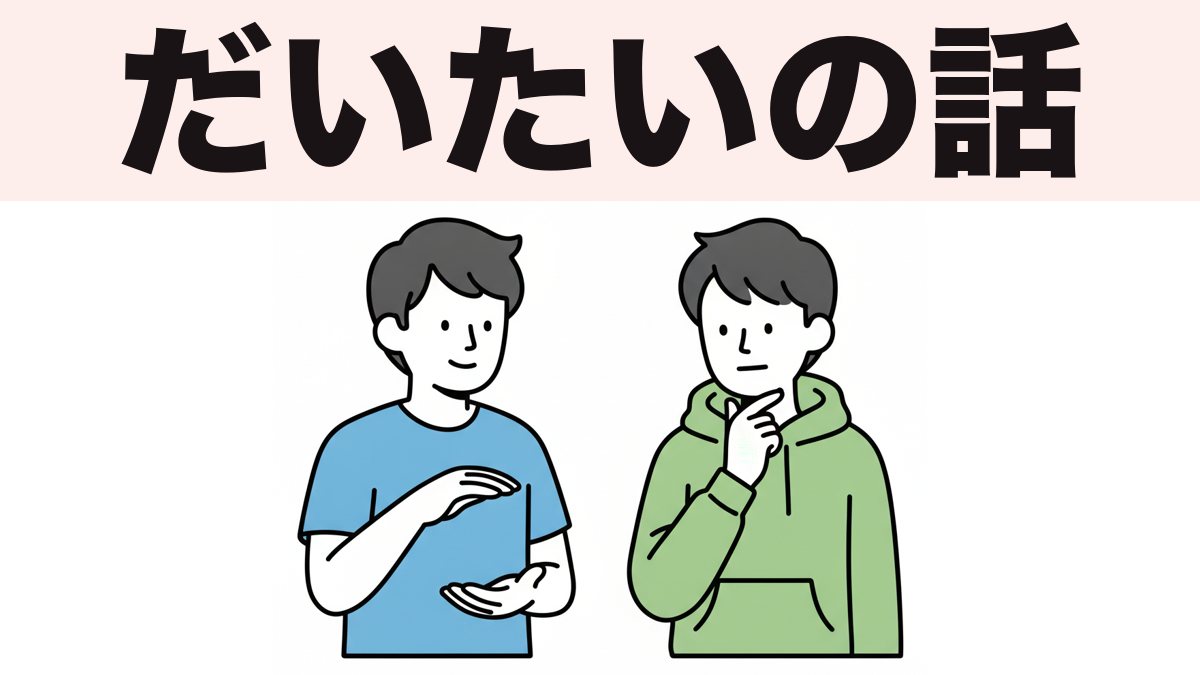
だいたい does three separate jobs: it makes a number approximate, it says something is true most of the time, and — dropped at the front of a sentence — it means "in the first place", which is how a Japanese argument announces itself.
「だいたい」には三つの仕事があります。数をあいまいにする、ほとんどそうだと言う、そして文のはじめに置いて「そもそも」という意味になる、の三つです。三つ目は、けんかのはじまりによく出ます。
The first two are in every textbook. The third is not in any of them, and it is the one you will hear in real conversation and in anime, usually right before someone loses their temper. All three are the same word, and the position in the sentence tells you which one is running.
The basics
だいたい with a number
Put it before the amount, and the amount becomes approximate.
だいたい三十分かかります。 — It takes roughly thirty minutes. (polite) だいたい千円ぐらいです。 — It's about a thousand yen. (neutral — だいたい and ぐらい together is normal)
Note the position: だいたい goes before the number, unlike くらい which goes after. Using both at once is not redundant to Japanese ears — it is the ordinary way to sound relaxed about a figure. The くらい half of that sentence is covered in くらい or ぐらい.
だいたい with an action
Here it stops being about numbers and becomes about coverage: most of it, in the main, by and large.
宿題はだいたい終わりました。 — I've mostly finished the homework. (polite) 話はだいたい分かりました。 — I understood the gist of it. (polite — extremely common)
だいたい分かりました is one of the most useful sentences a learner can own. It is honest — it says you got the shape, not every word — and it keeps a conversation moving instead of stopping it for a full repair.
だいたい as "usually"
With a habit, it slides into "generally, as a rule".
朝はだいたいパンを食べます。 — I generally have bread in the morning. (polite)
This is the use that overlaps with たいてい, and for most sentences either word works.
Beyond the basics
だいたい at the start of a sentence
Front-load it and the meaning changes completely: "in the first place", "to begin with". It reopens the whole question instead of qualifying an amount.
だいたい、お前が悪いんだろ。 — In the first place, this is your fault, isn't it. (casual, confrontational) だいたい、そんな話は聞いていない。 — For a start, nobody told me about this. (casual, annoyed)
It signals that the speaker is done with the current point and is going back to the beginning of the argument. In anime it is frequently the line that turns a disagreement into a fight, and the tone attached to it is almost never neutral. そもそも does the same job in more formal register.
だいたい vs たいてい vs ほとんど
Three words English flattens into "mostly", and they measure different things.
| Word | Measures | Example |
|---|---|---|
| だいたい | Amount or extent — how much of it | 宿題はだいたい終わった |
| たいてい | Frequency — how often | たいてい家にいます |
| ほとんど | A near-total proportion, often with a negative | ほとんど分からない |
たいてい家にいます。 — I'm usually at home. (polite — frequency) ほとんど分かりません。 — I hardly understand any of it. (polite — near zero)
The trap is ほとんど, which with a negative verb flips to "hardly any". ほとんど分からない is much weaker understanding than だいたい分かった, and confusing them is the difference between "I got the gist" and "I got almost nothing".
だいたい vs 約 vs およそ
約 and およそ are the written, formal versions of the numerical use.
約三十分かかります。 — It takes approximately thirty minutes. (formal — signage, announcements)
約 belongs on signs and in documents; およそ is similar and slightly more literary. Neither sounds natural in casual speech, where だいたい is the word people actually use.
大体 and 大概
Both are written with kanji you will meet: 大体 is だいたい, and 大概 (たいがい) is a near-synonym of たいてい meaning "generally, in most cases". 大概 also has a scolding idiom attached — いい加減にしろ's cousin 大概にしろ, "that's enough of that" — which is worth recognising even though you will rarely say it.
Common mistakes
- Putting だいたい after the number. It goes before: だいたい三十分, not 三十分だいたい. くらい is the one that goes after.
- Using だいたい for frequency when you mean たいてい. Both are possible with habits, but for "how often" specifically, たいてい is the precise word.
- Reading ほとんど分からない as "I mostly understand". With a negative, ほとんど means "hardly any" — the opposite of what it looks like.
- Using 約 in conversation. It is correct but stiff. In speech it sounds like reading from a notice.
- Missing sentence-initial だいたい. If だいたい opens the sentence with no number in sight, the speaker has just reopened the argument.
The three positions
| Position | Meaning | Example |
|---|---|---|
| Before a number | Roughly, about | だいたい三十分 |
| Before a verb or after a topic | Mostly, the gist of | だいたい分かりました |
| At the start of a sentence | In the first place, to begin with | だいたい、お前が悪い |
FAQ
Can I use だいたい and くらい in the same sentence? Yes, and it is completely normal: だいたい三十分くらい. It sounds relaxed rather than redundant.
Is だいたい casual? It is neutral. It works in polite speech — だいたい分かりました is something you can say to a teacher or a client without any problem.
How do I say "I mostly understood" without sounding like I understood everything? だいたい分かりました is exactly that. It claims the gist and nothing more, which is why it is safer than 分かりました alone when you are not sure.
What is the difference between だいたい and 大体? None — 大体 is just the kanji spelling of the same word. You will see both in writing.
Does だいたい ever sound rude? The sentence-initial one can. だいたい、お前が… is confrontational by design. The other two uses are neutral.
What is そもそも? The more formal equivalent of sentence-initial だいたい: "fundamentally, to begin with". Same move, different register.
Practice
Build each answer before opening it. Questions 4 and 5 are a pair — the same word doing two different jobs.
1. Say "it takes roughly thirty minutes."
Show answer
だいたい三十分かかります — だいたい goes before the number.
2. Something is wrong here: 三十分だいたいかかります。
Show answer
だいたい三十分かかります — the one that goes after the number is くらい, not だいたい.
3. Tell someone you got the gist of what they said.
Show answer
話はだいたい分かりました — honest, polite, and it keeps the conversation moving.
4. Translate: 宿題はだいたい終わりました。
Show answer
I've mostly finished the homework — extent. This is the pair to question 5.
5. Translate: だいたい、そんな話は聞いていない。
Show answer
For a start, nobody told me about this — sentence-initial だいたい reopens the argument. This is the pair to question 4.
6. Say "I'm usually at home" — about frequency.
Show answer
たいてい家にいます — for how often, たいてい is the precise word.
7. Translate: ほとんど分かりません。
Show answer
I hardly understand any of it — with a negative, ほとんど means "almost none", not "mostly".
8. Which is stronger understanding: だいたい分かった or ほとんど分からない?
Show answer
だいたい分かった — it means you got the gist. ほとんど分からない is close to nothing.
9. You are writing a sign about a thirty-minute wait. Which word?
Show answer
約 — 約三十分. 約 belongs on signage; in speech it sounds like reading aloud from a notice.
10. A character opens with だいたい、お前が…. What is about to happen?
Show answer
An argument — sentence-initial だいたい abandons the current point and goes back to the beginning, usually with heat behind it.
Vocabulary from this article
Tap the block to select all of it, then copy. In Anki: File → Import, note type Basic, separator Tab — the first column becomes the front, the second the back.
大体	だいたい — roughly; mostly; in the first place
大抵	たいてい — usually, generally
ほとんど	ほとんど — almost all; (with negative) hardly any
約	やく — approximately (written)
およそ	およそ — roughly (written, literary)
宿題	しゅくだい — homework
終わる	おわる — to finish
分かる	わかる — to understand
話	はなし — story, what was said
朝	あさ — morning
悪い	わるい — bad, at fault
聞く	きく — to hear, to ask
家	いえ — house, home
時間	じかん — time, hour
かかる	かかる — to take (time, money)
程度	ていど — degree, extent
I'm Yuuki, a Japanese teacher based in Tokyo. I've taught on italki as a Top 1% teacher and watched over 1,500 anime. だいたい分かりました is the sentence I most want beginners to own — it is the honest answer, and it keeps the lesson moving instead of stopping it dead.
Sources: the author's own lessons and standard reference grammars.
はじめの二つは教科書にあります。三つ目はどの教科書にもありません。でも、会話とアニメでいちばんよく聞きます。同じ言葉で、置く場所でどれか分かります。
基本
数といっしょに使う
数の前に置きます。数があいまいになります。
だいたい三十分かかります。 — It takes roughly thirty minutes. (polite) だいたい千円ぐらいです。 — It's about a thousand yen. (neutral — だいたい and ぐらい together is normal)
場所に気をつけてください。「だいたい」は数の前、「くらい」は数のあとです。両方いっしょに使うのはふつうです。→ 「くらい」と「ぐらい」
動作といっしょに使う
数ではなく「どのくらい終わったか」をあらわします。
宿題はだいたい終わりました。 — I've mostly finished the homework. (polite) 話はだいたい分かりました。 — I understood the gist of it. (polite — extremely common)
「だいたい分かりました」は、学ぶ人がいちばんもっておきたい文です。正直です。ぜんぶではなく、だいたいの形が分かったと言えます。会話が止まりません。
「いつも」に近い使い方
しゅうかんの話では「ふだんは」という意味になります。
朝はだいたいパンを食べます。 — I generally have bread in the morning. (polite)
この使い方は「たいてい」と重なります。ほとんどの文で、どちらでも使えます。
もう少しくわしく
文のはじめの「だいたい」
前に置くと、意味がまったくかわります。「そもそも」「はじめから」という意味です。
だいたい、お前が悪いんだろ。 — In the first place, this is your fault, isn't it. (casual, confrontational) だいたい、そんな話は聞いていない。 — For a start, nobody told me about this. (casual, annoyed)
今の話をやめて、はじめにもどる合図です。アニメでは、言い合いがけんかになる場面でよく出ます。しずかな言い方ではありません。かたい言い方では「そもそも」です。
「だいたい」「たいてい」「ほとんど」
英語ではどれも "mostly" になりますが、はかっているものがちがいます。
| 言葉 | 何をはかる | 例 |
|---|---|---|
| だいたい | どのくらいの量・ていど | 宿題はだいたい終わった |
| たいてい | どのくらいの回数 | たいてい家にいます |
| ほとんど | ほぼ全部(ひていと一緒だとほぼゼロ) | ほとんど分からない |
たいてい家にいます。 — I'm usually at home. (polite — frequency) ほとんど分かりません。 — I hardly understand any of it. (polite — near zero)
気をつけるのは「ほとんど」です。ひていの形といっしょだと「ほとんどゼロ」になります。「ほとんど分からない」と「だいたい分かった」は、まったくちがいます。
「だいたい」「約」「およそ」
「約」「およそ」は、書き言葉のかたい形です。
約三十分かかります。 — It takes approximately thirty minutes. (formal — signage, announcements)
「約」はかんばんやしょるいの言葉です。話すときは「だいたい」です。
「大体」と「大概」
「大体」は「だいたい」の漢字です。「大概(たいがい)」は「たいてい」に近い言葉です。「大概にしろ」」「いいかげんにしろ」という言い方もあります。
よくあるまちがい
- 数のあとに置く。「だいたい三十分」です。あとに置くのは「くらい」です。
- 回数に「だいたい」を使う。 回数なら「たいてい」がせいかくです。
- 「ほとんど分からない」を「だいたい分かる」だと思う。 反対の意味です。
- 会話で「約」を使う。 正しいですが、かたすぎます。
- 文のはじめの「だいたい」を見おとす。 数がないのに「だいたい」で始まったら、話がはじめにもどっています。
三つの場所
| 場所 | 意味 | 例 |
|---|---|---|
| 数の前 | およそ | だいたい三十分 |
| 動詞の前・話題のあと | ほとんど・大すじ | だいたい分かりました |
| 文のはじめ | そもそも | だいたい、お前が悪い |
よくある質問
「だいたい」と「くらい」を一つの文で使える? はい。「だいたい三十分くらい」はふつうです。
「だいたい」はカジュアル? まんなかです。「だいたい分かりました」は先生にもお客さまにも言えます。
「ぜんぶ分かった」と言わずに「だいたい分かった」と言うには? そのまま「だいたい分かりました」です。大すじだけ、という意味になります。
「だいたい」と「大体」のちがいは? 同じ言葉です。「大体」は漢字の書き方です。
「だいたい」は失礼になる? 文のはじめの形は、けんかの言い方になります。ほかの二つはふつうです。
「そもそも」とは? 文のはじめの「だいたい」の、かたい形です。
練習
答えを見る前に、自分で作ってください。4番と5番はペアです。
1. 「だいたい三十分かかります」と言う。
答えを見る
だいたい三十分かかります — 「だいたい」は数の前です。
2. まちがいをなおす: 三十分だいたいかかります。
答えを見る
だいたい三十分かかります — 数のあとに来るのは「くらい」です。
3. 「大すじは分かりました」と伝える。
答えを見る
話はだいたい分かりました — 正直で、会話も止まりません。
4. やくす: 宿題はだいたい終わりました。
答えを見る
宿題はほとんど終わりました — どのくらい終わったか、の意味です。5番とペアです。
5. やくす: だいたい、そんな話は聞いていない。
答えを見る
そもそも、そんな話は聞いていない — 文のはじめの「だいたい」は、はじめにもどる合図です。4番とペアです。
6. 回数の話で「ふだんは家にいます」と言う。
答えを見る
たいてい家にいます — 回数なら「たいてい」です。
7. やくす: ほとんど分かりません。
答えを見る
ほとんど分かりませんりませんほぼゼロ — ひていと一緒だと「ほとんどない」です。
8. どちらがよく分かっている? 「だいたい分かった」「ほとんど分からない」
答えを見る
だいたい分かった — 大すじが分かっています。
9. 三十分待つというかんばんを書く。どの言葉?
答えを見る
約 — 「約三十分」。かんばんは「約」です。
10. 「だいたい、お前が…」で始まりました。このあと何が起きる?
答えを見る
言い合い — 今の話をやめて、はじめにもどる合図です。
この記事に出た単語
上のブロックをタップしてぜんぶ選んで、コピーしてください。Ankiでは ファイル → インポート、ノートタイプは 基本、区切りは タブ です。左が表、右がうらになります。
大体	だいたい — roughly; mostly; in the first place
大抵	たいてい — usually, generally
ほとんど	ほとんど — almost all; (with negative) hardly any
約	やく — approximately (written)
およそ	およそ — roughly (written, literary)
宿題	しゅくだい — homework
終わる	おわる — to finish
分かる	わかる — to understand
話	はなし — story, what was said
朝	あさ — morning
悪い	わるい — bad, at fault
聞く	きく — to hear, to ask
家	いえ — house, home
時間	じかん — time, hour
かかる	かかる — to take (time, money)
程度	ていど — degree, extent
More drills like the ones above, plus a timed JLPT-style mock test: Practice · N4上のような練習問題と、時間つきのJLPT形式のもぎ試験: 練習ページ · N4
Want to try this in a real conversation?
本当の会話で、ためしてみませんか?
30-minute trial lesson, $13. Times shown in your own timezone.
30分の体験レッスン、$13。時間はあなたのタイムゾーンで表示されます。
Book a trial lesson · $13