San, kun, chan, sama: the honorifics guide anime fans actually needさん くん ちゃん さま アニメファンに必要な敬称ガイド
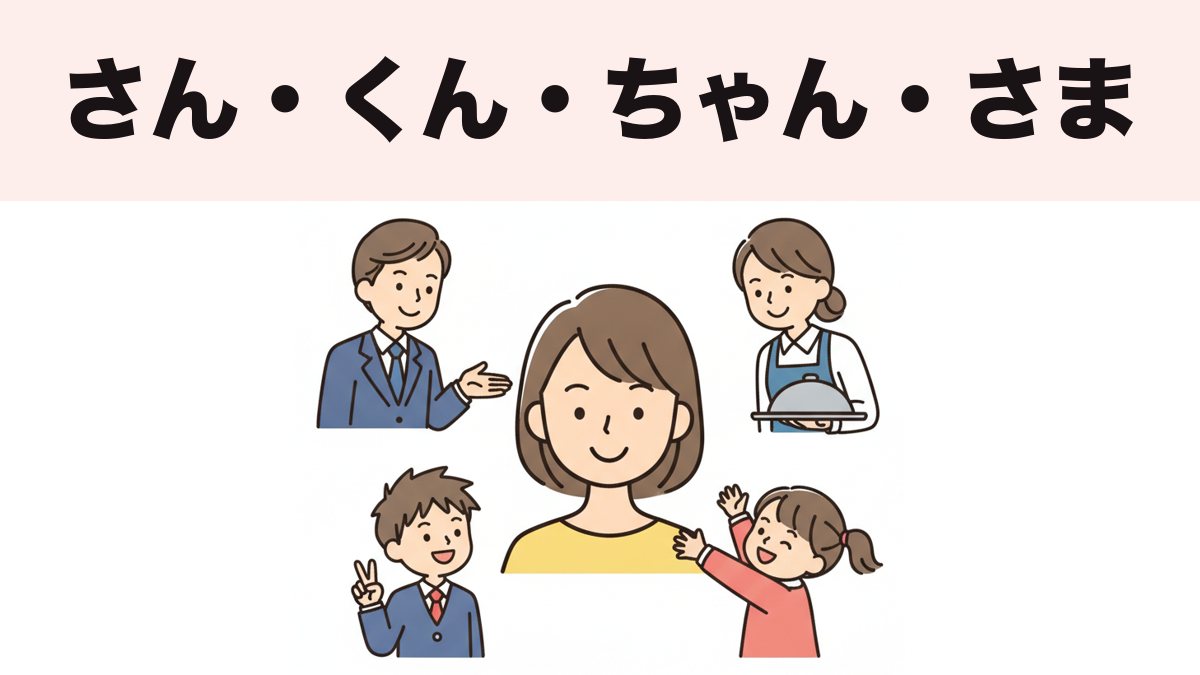
I teach Japanese honorifics as relationship markers as well as expressions of respect. さん, くん, ちゃん, and さま tell a listener how I am treating the person I name. They are not interchangeable steps on a simple politeness ladder.
さん・くん・ちゃん・さまは、ていねいさの段階ではありません。関係を表すしるしです。
The familiar summary is さん for politeness, ちゃん for cuteness, and さま for extra respect. That gives me a starting point, but it does not tell me whether a particular name sounds appropriate. I also need to consider familiarity, the setting, the person's role, and what they want to be called. A respectful intention does not automatically make an unfamiliar form of address comfortable.
In this guide, I start with family name + さん for an adult whose preferred form of address I do not know. Then I separate the choices that anime often presents together: choosing a name, choosing an honorific, and deciding whether to use polite sentence endings. The example conversations below are written for practice.
The basics
The working set
| Form | What it commonly signals | My starting point |
|---|---|---|
| 〜さん | Ordinary respectful distance | An adult acquaintance, colleague, or stranger whose name I know |
| 〜くん | Familiarity or a relationship to someone younger or junior, often male | Follow an established convention, rather than guess from gender |
| 〜ちゃん | Affection and familiarity | Children, close friends, family, and pets where the usage fits |
| 〜さま / 〜様 | Formal respect or an elevated position | Customers, formal correspondence, and references to deities |
| 〜先生 | Recognition of a professional or teaching role | Teachers, doctors, lawyers, and manga artists |
| 〜先輩 | Recognition of an earlier member of the same group | Someone senior within a shared school, club, or workplace |
I use this table as a map of common situations, not as a set of permissions based only on age or occupation. A younger adult does not automatically welcome くん, and someone I find charming does not automatically welcome ちゃん. An existing relationship gives those forms their meaning.
さん is the ordinary starting point
さん follows the name. It does not change with gender or marital status, and it can follow either a family name or a given name. I often translate it loosely as Mr. or Ms. when explaining the structure, but English does not have an exact equivalent that fits every use.
田中さん、おはようございます。 — Good morning, Tanaka. (polite greeting with a family name)
ゆうきさん、ありがとうございます。 — Thank you, Yuuki. (polite thanks with a given name)
Both examples use さん. The difference is which name comes before it. I do not treat a given name + さん as rude by itself, but I do not assume that everyone wants me to move to their given name. Family name + さん is a useful neutral default in many adult interactions.
The original shortcut, that さん can never offend anyone, is too broad. A person may prefer a professional title or a particular name. I begin with さん when appropriate and adjust when I learn their preference. The useful habit is attention to the person, rather than confidence that a suffix makes every choice safe.
I leave honorifics off my own name
When introducing myself, I give my name without さん, くん, ちゃん, or さま. Other people can add an honorific when they address me. The です in an introduction supplies a polite sentence ending; it does not need an honorific attached to the speaker's name.
ゆうきです。よろしくお願いします。 — I'm Yuuki. It's nice to meet you. (introducing myself without さん)
If I am repeating what someone called me, the honorific can appear inside the quotation. That is a different task from introducing myself. For an ordinary introduction, I keep the pattern simple: name + です. I explain the rest of that exchange in Japanese self-introductions.
Beyond the basics
くん does not simply mean “boy”
くん is often associated with boys and young men, but gender alone does not explain it. It can also express a relationship in which the speaker treats the named person as junior. The existing example of a department head addressing a 40-year-old woman as 田中くん illustrates that use. It is possible in some workplace conventions; it is not a recommendation for addressing every female colleague that way.
田中くん、この資料をお願いします。 — Tanaka, please take care of these materials. (a senior addressing a junior where くん is established)
I would not copy this sentence's form of address merely because I had learned the person's age or position. Workplace habits differ, and an individual may dislike くん. さん remains a useful starting point when I do not know the local convention.
This is also why I avoid reading romance into every くん in anime. A character might be using a familiar school convention, an established friendship pattern, or a way of marking seniority. I need the surrounding relationship before deciding what the suffix contributes to a scene.
ちゃん expresses familiarity, not a general welcome
ちゃん often appears with children, family members, close friends, and pets. Its affectionate quality depends on that relationship. It is not limited to girls, and it does not make an unfamiliar adult relationship closer just because I want to sound warm.
ゆうきちゃん、また明日。 — See you tomorrow, Yuuki. (an affectionate name already accepted in this relationship)
Without the context in parentheses, I cannot judge whether that address is welcome. Between people who already use it, it may be ordinary affection. From a stranger, it may sound patronizing, overly intimate, or flirtatious. I would check the person's preference before adopting a nickname I heard someone else use.
I also separate hearing a name from being invited to use it. A family member's ちゃん does not automatically become my form of address. The relationship belongs to those speakers, and I may need a different name for the same person.
さま is not an upgrade for every conversation
さま, often written 様, appears in customer address, formal correspondence such as envelopes, and references to deities. Anime also uses it to establish elevated status or dramatic distance. These settings explain why it can sound striking when moved into an ordinary conversation between acquaintances.
お客さま、こちらへどうぞ。 — This way, please. (staff addressing a customer)
田中様へ。 — To Tanaka. (a formal written addressee line)
The English translation of お客さま does not need to contain “customer” when the staff member is speaking directly to someone. Japanese can name the role where English simply gives the invitation. This is a useful reminder that translating an honorific word for word can make the English sound less natural.
I do not normally change a friend's mother's name from さん to さま to show extra gratitude. In an everyday conversation, that can create unexpected formality or sound theatrical. A formal letter has different conventions. I choose the form for the situation rather than turn respect into a ladder that always ends at さま.
Given name or family name?
Choosing the name and choosing the suffix are separate decisions. 田中さん uses a family name with さん. ゆうきさん uses a given name with the same suffix. ゆうき drops the suffix altogether. Those are different changes, so I do not make them all at once just because a conversation becomes friendly.
For foreign names, I usually follow the name the person introduces. If someone introduces herself as Michelle, ミシェルさん is a natural possibility. I do not need to invent a Japanese family-name arrangement for her. Her preference still matters, just as it does for someone with a Japanese name.
何と呼べばいいですか。 — What should I call you? (asking for a preferred form of address)
ゆうきと呼んでください。 — Please call me Yuuki. (offering a name without an honorific)
I find these sentences more useful than trying to infer every preference from a person's age. The request gives the other person room to choose. The reply provides a clear example of the intended name, although I still pay attention to the setting when using it later.
Dropping the suffix: 呼び捨て
Calling someone by their name without an honorific is called 呼び捨て, read よびすて. Between close friends or within families, it can express intimacy or simply be the established habit. With someone who expects respectful distance, it can sound abrupt or disrespectful. I avoid calling it a deliberate insult in every case, because the speaker's intention and the listener's interpretation can differ.
ゆうき、ちょっといい? — Yuuki, do you have a moment? (casual speech with a bare name)
ゆうきさん、ちょっといいですか。 — Yuuki, do you have a moment? (さん with a polite sentence ending)
The translations are similar, but the Japanese choices carry different relationship signals. Anime can use the change from an honorific to a bare name as an emotional event. English subtitles may leave that difference unexpressed, so I listen to the name itself as well as the sentence around it.
I would not use “wait until they drop yours” as my only rule. A senior may omit an honorific without inviting the same treatment in return. A clear invitation or an established mutual habit is more useful evidence. If I am uncertain, I keep さん and ask what the person prefers.
先生 and 先輩 can stand alone
先生 and 先輩 belong in the same discussion, but they are titles that can also function independently. さん normally needs something before it. 先生 can address someone by itself, or follow a name as in 田中先生. I do not stack さん after it to make 田中先生さん.
先生、質問があります。 — Teacher, I have a question. (using the title alone)
田中先生、ありがとうございます。 — Thank you, Professor Tanaka. (a title after a name, in a university teaching context)
先生 is broader than the English job label “teacher.” The original article includes teachers, dentists, lawyers, and manga artists, including Eiichiro Oda. I keep those examples while distinguishing a conventional title from an occupation: not everyone who explains something briefly becomes 先生 in every interaction. My guide to 先生 explores that distinction further.
先輩 refers to a senior within a shared group, such as a school or company. Earlier membership is central; it does not simply mean someone who is older or more skilled at an unrelated activity. I can use a name + 先輩 or address an established senior as 先輩 alone.
先輩、ちょっといいですか。 — Do you have a moment? (addressing a senior in a shared group)
Honorifics and sentence endings do different jobs
A name tells me how the speaker positions the person being named. A sentence ending helps establish the speech style of the whole utterance. The two choices often work together, but neither replaces the other. A familiar name can appear in a polite request, and さん can appear in a casual sentence between people whose usual habit includes it.
I therefore listen for both parts before copying an anime line. I check who is speaking, who is being addressed, and whether the scene shows affection, distance, or a power difference. My explanation of when to switch between polite and casual Japanese covers the sentence side of that decision.
Common mistakes
- Adding さん to my own introduction. I use ゆうきです, because an ordinary self-introduction does not attach respect to my own name.
- Using ちゃん with a new acquaintance to sound friendly. I begin with the preferred name and an appropriate respectful form; affection needs a relationship that supports it.
- Treating くん as a translation of “boy.” I consider seniority and local habits as well as the common association with male names.
- Replacing every さん with さま to sound more polite. I reserve さま for contexts that call for that formal or elevated address.
- Copying someone else's bare name automatically. I check whether the relationship is mutual and whether the person has invited that familiarity.
- Combining 先生 and さん. I use 田中先生 or 先生, since the title already supplies the form of address.
Practice
I use these situations to practise choosing a name for a specific relationship. Each answer gives the reason as well as the form. Where context could change the choice, I state the assumption in the question.
1. I am meeting an adult named 田中 and know no preferred title or nickname. What is a neutral starting form of address?
Show answer
田中さん — Family name + さん is an ordinary respectful starting point when I have no information calling for another form.
2. Correct this ordinary self-introduction: ゆうきさんです。
Show answer
ゆうきです。 — I leave the honorific off my own name; です already gives the introduction a polite sentence ending.
3. A senior colleague calls a female junior 田中くん. Does くん prove that the speaker thinks the colleague is male?
Show answer
No. — くん can mark a junior relationship in some workplace conventions, so gender alone does not explain the address.
4. I have just met someone and want to sound friendly. Should I start using ちゃん without checking?
Show answer
I would keep さん or the person's stated preference. — ちゃん assumes familiarity that a first meeting does not establish and may sound overly intimate or patronizing.
5. Complete this customer-service invitation with the honorific taught here: お客__、こちらへどうぞ。
Show answer
お客さま、こちらへどうぞ。 — さま fits the formal customer address in this service setting.
6. Correct the stacked address: 田中先生さん、ありがとうございます。
Show answer
田中先生、ありがとうございます。 — 先生 already functions as the title after the name, so I do not add さん after it.
7. Ask someone what they would like to be called.
Show answer
何と呼べばいいですか。 — This asks for a preferred form of address instead of assuming a level of familiarity.
8. A senior has dropped the honorific from my name. Does that alone tell me to drop theirs?
Show answer
No. — Forms of address can be asymmetric in a senior-junior relationship; an invitation or established mutual usage gives clearer guidance.
9. Which can stand alone when I address my teacher: さん or 先生?
Show answer
先生 — 先生 is a title that can function independently, whereas さん normally attaches to a name or another suitable expression.
10. What is the term for addressing someone as ゆうき instead of ゆうきさん, and does it always express an insult?
Show answer
呼び捨て; it does not always express an insult. — A bare name can be an established intimate form among friends or family, but it may sound disrespectful where that familiarity is absent.
FAQ
Is さん only for family names? No. I can attach it to a given name too, as in ゆうきさん or ミシェルさん. I follow the name the person prefers.
Can くん be used for a woman? Yes, in some established settings where it marks a junior relationship. I do not assume that this is welcome in every workplace or for every individual.
Is ちゃん only for girls? No. It can be used affectionately for people of different genders and for pets. I look for an accepted relationship or nickname, rather than choose it from gender alone.
Should I use さま for someone I respect deeply? Respect alone does not decide the form. I consider whether the setting involves formal correspondence, customer address, or another established use of さま.
Can I call my teacher 先生 without a name? Yes. I can address a teacher as 先生 alone or use a name + 先生. I do not add さん after the title.
Is dropping an honorific always rude? No. I may use a bare name in an established close relationship. I keep the honorific when I lack that context or an invitation to use a more familiar name.
Vocabulary from this article
Tap the block to select all of it, then copy. In Anki: File → Import, note type Basic, separator Tab.
さん	さん — ordinary respectful name suffix
くん	くん — familiar or junior-address suffix, often used for males
ちゃん	ちゃん — affectionate name suffix
様	さま — formal respectful name suffix
先生	せんせい — teacher; professional title
先輩	せんぱい — senior in a shared group
呼び捨て	よびすて — addressing someone without an honorific
お客さま	おきゃくさま — customer; respectful customer address
資料	しりょう — materials; documents
質問	しつもん — question
明日	あした — tomorrow
I'm Yuuki, a Japanese teacher based in Tokyo. I use names and short exchanges to explain how honorifics change the relationship a sentence suggests. In a lesson, I can contrast forms of address so the difference becomes something to hear and practise.
In a trial lesson I will call you the wrong thing on purpose so you can hear the difference.
Sources
The author's existing lesson explanations in this article, including the examples of forms of address and their relationship contexts. The practice dialogues are original teaching examples, not quotations from students.
学習者はよく「さんはていねい、ちゃんはかわいい、さまはとてもていねい」というはしごの形で教わります。でも、このはしごは、よく間違いのもとになります。これらの敬称が本当に表しているのは、「どれだけ近いか」「どちらの立場から見た関係か」ということだからです。
よく使う敬称
〜さん — 基本の形。相手がだれでも、どんな年齢でも、同僚でも知らない人でも使えます。 。〜くん — 自分より年下、または立場が下の人に。男性に使われることが多いです。上司が部下に使うこともあります。 。〜ちゃん — 近くて、親しみがある相手に。子ども、親しい友だち、家族、ペット。 。〜さま — お客さん、神様、手紙のあて名に。 。〜先生 — 先生、医者、弁護士、マンガ家などに。
さんだけ覚えておけば、ほとんどいつも正解です。さんで気を悪くする人はいません。
アニメがかんちがいさせるところ
くんは「男の子」という意味ではありません。 部長が40歳の女性を「田中くん」と呼ぶのは、正しい使い方です。これは「自分より下」という意味であって、「男性」という意味ではありません。アニメではあまり見かけません。会社の中間管理職の場面が、アニメにはあまり出てこないからです。
さまは「もっとていねいなさん」ではありません。 尊敬している人を、さまに「格上げ」するわけではありません。さまは、お客さん(お客さま)、神様、そしてフィクションや正式な手紙の中だけにある、貴族のようなきょりのために使います。友だちのお母さんを「〜さま」と呼ぶのは、ていねいなのではなく、変です。
先生は、職業ではなく、敬称です。 何かを教えたり、その道の専門家である人にはだれでもつけられます。あなたの日本語の先生も、歯医者さんも、有名なマンガ家も、みんな先生です。
敬称をつけない呼び方
ここは、理解する価値があるところです。本当の気持ちが表れる部分だからです。
敬称を何もつけずに名前を呼ぶことを 呼び捨て といいます。親しい友だちや家族の間では、これは親しさを表します。「もう、かたい言い方はいらない」という意味です。でも、親しくない相手に対してだと、わざとの冷たい一言になります。
だから、アニメの中でキャラクターが敬称を落とす瞬間は、大事な瞬間なのです。字幕では表現できないので、英語で見ている人はほとんど気づきません。一度気づくと、あちこちで目につくようになります。
自分のためのルール: 相手が先に敬称を落とすまで、自分から落とさないこと。これが本当のサインで、そのサインが来るまで待っていれば安全です。
名字?名前?
英語との2つ目の大きなちがいです。日本語では、大人に対しては 名字+さん が基本です。いきなり下の名前で呼ぶのは、英語の「ファーストネームで呼び合う」よりも、もっと近い関係を意味します。1つの段階であって、最初の一歩ではありません。
田中さん — ふつう、正しい、安全 安全ゆうきさん — 親しみがある、少し近い 近いゆうき — 親しい友だちだけ
外国人の名前は、少し特別あつかいされます。ミシェルと自己紹介すれば、みんな「ミシェルさん」と呼び、それが自然に感じられます。
ほとんどの人がするまちがい
1. 自分の名前に敬称をつけること。 「ゆうきさんです」は、ちょっとしたコメディになります。さんは、他の人がつけてくれるものだからです。
2. 初対面の人に、親しみをこめて「ちゃん」を使うこと。 相手によって、上から目線に聞こえたり、なれなれしく聞こえたりします。どちらも、あなたの意図とはちがいます。
レッスンでは
このことの9割は、1つの習慣です。「名字+さん」を基本にして、あとは相手のペースに合わせること。
残りの1割はタイミングです。これは本を読んでもわかりにくく、練習すればすぐにつかめることです。体験レッスンでは、わざとまちがった呼び方をして、そのちがいを耳で覚えてもらいます。
More drills like the ones above, plus a timed JLPT-style mock test: Practice · N5上のような練習問題と、時間つきのJLPT形式のもぎ試験: 練習ページ · N5
Want to try this in a real conversation?
本当の会話で、ためしてみませんか?
30-minute trial lesson, $13. Times shown in your own timezone.
30分の体験レッスン、$13。時間はあなたのタイムゾーンで表示されます。
Book a trial lesson · $13