How to say your age in Japanese: 〜歳, the four readings that break, and 二十歳年の言い方: 〜歳、読み方が変わる4つ、そして「二十歳」
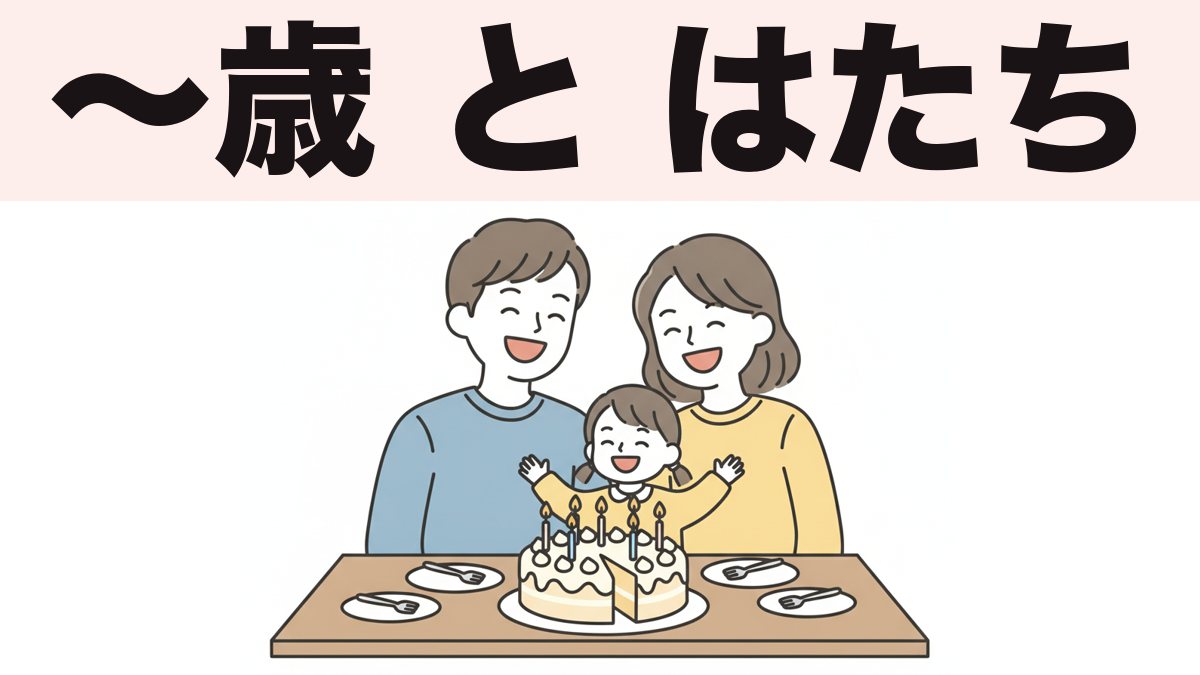
Age uses the counter 〜歳 (さい): 三十歳 is さんじゅっさい. Four numbers force a sound change — 1, 8, 10 and anything ending in 10 — and 20 is not 〜歳 at all. Twenty is 二十歳, read はたち, a word with no number in it.
年は「〜歳(さい)」で言います。「三十歳」は「さんじゅっさい」です。読み方が変わるのは4つだけです。1・8・10と、10で終わる数です。そして20だけは「歳」を使いません。「二十歳」と書いて「はたち」と読みます。数字が入っていないことばです。
This is a small, self-contained piece of vocabulary that you will use in your first conversation with almost anyone, and it has exactly enough irregularity to be worth learning properly once instead of guessing five times.
The basics
The basic pattern
Number plus 歳. That is it, for most ages.
三十歳です。 — I'm thirty. (polite) 父は六十五歳です。 — My father is sixty-five. (polite)
歳 is sometimes written 才, especially on forms and in children's writing, because 才 is a simpler kanji with the same reading in this use. Both are correct; 歳 is the standard one.
The four readings that change
| Age | Reading | What changed |
|---|---|---|
| 1歳 | いっさい | さ doubles |
| 8歳 | はっさい | さ doubles |
| 10歳 | じゅっさい (じっさい) | さ doubles |
| 20歳 | はたち | a completely different word |
Everything else is regular: 2歳 にさい, 3歳 さんさい, 4歳 よんさい, 5歳 ごさい, 6歳 ろくさい, 7歳 ななさい, 9歳 きゅうさい.
The pattern behind 1, 8 and 10 is the same one that runs through the whole counter system: those three numbers trigger a doubled consonant before さ, か, た and は sounds. Learn it once and it pays off across every counter you meet.
じゅっさい and じっさい are both accepted for 10. じゅっさい is what most people say; じっさい is the older prescriptive form and appears in dictionaries.
二十歳 is はたち
今年、二十歳になりました。 — I turned twenty this year. (polite) 来月の誕生日で三十歳になります。 — I turn thirty on my birthday next month. (polite)
はたち is a leftover from an older counting system, and it survives because turning twenty is a marked event in Japan: it is the traditional threshold of adulthood, and 成人式 (せいじんしき), the coming-of-age ceremony, is built around it. The word carries that weight, which is part of why it never regularized into にじゅっさい.
Note that 21 and above are regular again: 二十一歳 is にじゅういっさい, with the 1 doing its usual doubling.
Beyond the basics
How to ask someone's age
何歳ですか。 — How old are you? (polite, neutral — fine with children and people younger than you) おいくつですか。 — How old are you? (polite, softer — the safe adult version)
おいくつですか is the one to use with an adult. 何歳ですか is not rude, but it is direct, and asking an adult's age directly is about as socially loaded in Japan as it is elsewhere. おいくつですか softens it with the honorific お and the indirect いくつ ("how many").
With small children, 何歳? is completely normal and is what everyone says.
〜歳 vs 〜年生: age vs school year
Japanese often answers "how old is your child?" with a school year rather than a number.
小学三年生です。 — She's in third grade of elementary school. (polite)
〜年生 (ねんせい) is the counter for school years, and it is genuinely more informative in Japan because the school system is uniform. If someone answers your age question with a 年生, that is a complete answer, not a dodge.
〜代: talking about a decade
To say someone is in their thirties without naming a number, use 〜代 (だい).
三十代です。 — I'm in my thirties. (polite) 二十代の前半です。 — I'm in my early twenties. (polite)
前半 (ぜんはん, first half) and 後半 (こうはん, second half) subdivide it. 三十代後半 is "late thirties." This is the polite way to be approximate about your age, and it is very commonly used.
年上 and 年下: older and younger
兄は三歳年上です。 — My older brother is three years older than me. (polite) 私より二歳年下です。 — He's two years younger than me. (polite)
年上 (としうえ) and 年下 (としした) are nouns, and the difference in years goes in front as a plain number plus 歳. This matters more in Japanese than in English, because relative age decides which words you use for family members — see Japanese family words, where 兄 and 弟 are different words for the same relationship depending on who is older.
〜歳の時: at the age of
十五歳の時に日本に来ました。 — I came to Japan when I was fifteen. (polite)
〜歳の時 is the standard frame for an age-anchored memory, and it uses the same 〜とき that marks any point in time.
Common mistakes
- Saying にじゅっさい for twenty. It is はたち. This is the single irregular age in the system.
- Forgetting the doubled consonant. いちさい, はちさい and じゅうさい are all wrong. They are いっさい, はっさい, じゅっさい.
- Asking an adult 何歳ですか. Not rude exactly, but blunt. おいくつですか is the adult version.
- Using 年 instead of 歳. 三十年 is thirty years as a duration, not an age. The counter for age is 歳.
- Saying 三十代です when you mean exactly thirty. 〜代 is a decade range, not a number.
- Assuming 才 is wrong. It is a simplified alternative and appears on plenty of official forms. 歳 is standard; both are read さい.
The ages that break, at a glance
| Number | Age form | Reading |
|---|---|---|
| 1 | 1歳 | いっさい |
| 8 | 8歳 | はっさい |
| 10 | 10歳 | じゅっさい |
| 20 | 二十歳 | はたち |
| 21 | 21歳 | にじゅういっさい |
| 30 | 30歳 | さんじゅっさい |
| in their 30s | 30代 | さんじゅうだい |
Practice
Questions 3 and 4 are the pair: the one age that is not a number plus 歳, and the one right after it that is.
1. Say "I'm thirty," politely.
Show answer
三十歳です。 — さんじゅっさい. The 10 in 三十 triggers the doubled consonant.
2. Read 8歳 aloud.
Show answer
はっさい — 8 is one of the three numbers that double the consonant before さ.
3. Say "I turned twenty this year."
Show answer
今年、二十歳になりました。 — はたち, not にじゅっさい. The only genuinely irregular age.
4. Read 21歳 aloud.
Show answer
にじゅういっさい — Regular again, with the 1 doing its usual doubling.
5. Ask an adult their age, politely and softly.
Show answer
おいくつですか。 — The adult version. 何歳ですか is direct and fine with children.
6. Say "I'm in my early twenties," politely.
Show answer
二十代の前半です。 — 〜代 for the decade, 前半 and 後半 to halve it.
7. Say "my older brother is three years older than me."
Show answer
兄は三歳年上です。 — The gap goes in front as a plain number plus 歳.
8. Say "I came to Japan when I was fifteen."
Show answer
十五歳の時に日本に来ました。 — 〜歳の時 is the standard frame for an age-anchored memory.
9. Fix this: にじゅっさいになりました。
Show answer
二十歳(はたち)になりました。 — Twenty has its own word, and it is not built from a number.
10. Fix this: 三十年です。(meaning "I'm thirty")
Show answer
三十歳です。 — 年 is a duration. The counter for age is 歳.
FAQ
Why is twenty はたち? It is a survival from an older native Japanese counting system, kept alive by how significant turning twenty has traditionally been. The same system gives 二十日 (はつか) for the twentieth of the month.
Is it rude to ask someone's age in Japan? About as rude as anywhere else — fine with children and close friends, awkward with adults you have just met. おいくつですか softens it, and 〜代 lets people answer approximately.
What is 数え年? An older system where everyone gained a year at New Year rather than on their birthday, making you one year old at birth. It is essentially gone from daily life but appears in traditional contexts and in some temple rituals.
How do I write my age on a form? The digit plus 歳 or 才. Forms usually provide the character already, so you write only the number.
Does 歳 change for animals or objects? Animals use 歳 too. Objects do not have an age in this sense — for how old a thing is you would say 何年前のものですか ("how many years old is it?") rather than using 歳.
How do I say "what's your age group?" You would not ask that directly. If you need an approximate answer, ask something contextual instead, or let the other person volunteer 〜代. Asking for a range is not a normal question in Japanese.
Vocabulary from this article
Tap the block to select all of it, then copy. In Anki: File → Import, note type Basic, separator Tab — the first column becomes the front, the second the back.
歳	さい — years old (counter)
二十歳	はたち — twenty years old
何歳	なんさい — how old
おいくつ	おいくつ — how old (polite)
年上	としうえ — older (in age)
年下	としした — younger (in age)
代	だい — decade of age
前半	ぜんはん — first half
後半	こうはん — second half
年生	ねんせい — school year
小学	しょうがく — elementary school
成人式	せいじんしき — coming-of-age ceremony
今年	ことし — this year
兄	あに — older brother
父	ちち — father
誕生日	たんじょうび — birthday
数え年	かぞえどし — traditional age counting
二十日	はつか — the twentieth (of the month)
I'm Yuuki, a Japanese teacher based in Tokyo. I've taught on italki as a Top 1% teacher and watched over 1,500 anime. はたち is the one that surprises people, and it is a good early lesson in something true of the whole language: the words Japanese refuses to regularize are usually the ones that matter culturally.
Sources: the author's own lessons and standard reference grammars.
初めて会った人と、たいてい最初のほうで使います。変わるところがちょうど少ないので、1回きちんと覚えたほうが早いです。
基本
基本の形
数字+歳。これだけです。
三十歳です。 — I'm thirty. (polite) 父は六十五歳です。 — My father is sixty-five. (polite)
「才」と書くこともあります。書類や子どもの字でよく見ます。どちらも正しいですが、ふつうは「歳」です。
読み方が変わる4つ
| 年 | 読み方 | 変わるところ |
|---|---|---|
| 1歳 | いっさい | 「さ」が重なる |
| 8歳 | はっさい | 「さ」が重なる |
| 10歳 | じゅっさい(じっさい) | 「さ」が重なる |
| 20歳 | はたち | まったく別のことば |
ほかはふつうです。2歳 にさい、3歳 さんさい、4歳 よんさい、5歳 ごさい、6歳 ろくさい、7歳 ななさい、9歳 きゅうさい。
1・8・10は、ほかの助数詞でも同じように変わります。1回覚えると、ずっと使えます。
「じゅっさい」と「じっさい」は、どちらも正しいです。話す時は「じゅっさい」が多いです。
「二十歳」は「はたち」
今年、二十歳になりました。 — I turned twenty this year. (polite)
古い数え方が残ったことばです。日本では20歳が大人になる年で、「成人式」があります。大事な年なので、ことばも特別なまま残りました。
21からはふつうにもどります。「二十一歳」は「にじゅういっさい」です。
もう少し先へ
年の聞き方
何歳ですか。 — How old are you? (polite, neutral — fine with children) おいくつですか。 — How old are you? (polite, softer — the safe adult version)
大人には「おいくつですか」を使ってください。「何歳ですか」は失礼ではありませんが、まっすぐすぎます。「お」と「いくつ」でやわらかくなります。
小さい子どもには「何歳?」がふつうです。
「〜歳」と「〜年生」
「お子さんは何歳ですか」に、学年で答えることがよくあります。
小学三年生です。 — She's in third grade of elementary school. (polite)
日本の学校は全国で同じなので、学年のほうが分かりやすいのです。学年で答えられたら、それがちゃんとした答えです。
「〜代」
はっきり言わずに、だいたいを言う形です。
三十代です。 — I'm in my thirties. (polite) 二十代の前半です。 — I'm in my early twenties. (polite)
「前半」「後半」で半分に分けられます。「三十代後半」は「35〜39歳ぐらい」です。ていねいにぼかせるので、よく使います。
「年上」「年下」
兄は三歳年上です。 — My older brother is three years older than me. (polite) 私より二歳年下です。 — He's two years younger than me. (polite)
「年上(としうえ)」「年下(としした)」は名詞です。差は前に「〜歳」で言います。
日本語では、どちらが年上かでことばが変わります。「兄」と「弟」は同じ関係でも別のことばです。
「〜歳の時」
十五歳の時に日本に来ました。 — I came to Japan when I was fifteen. (polite)
思い出を話す時の決まった形です。
よくある間違い
- 20を「にじゅっさい」と言う。 「はたち」です。
- 重なる音を忘れる。 「いちさい」「はちさい」「じゅうさい」は間違いです。
- 大人に「何歳ですか」と聞く。 「おいくつですか」です。
- 「年」を使う。 「三十年」は長さです。年は「歳」です。
- ちょうど30なのに「三十代」と言う。 「〜代」は10年のはばです。
- 「才」を間違いだと思う。 書類でもよく使います。
変わるところ
| 数 | 形 | 読み方 |
|---|---|---|
| 1 | 1歳 | いっさい |
| 8 | 8歳 | はっさい |
| 10 | 10歳 | じゅっさい |
| 20 | 二十歳 | はたち |
| 21 | 21歳 | にじゅういっさい |
| 30 | 30歳 | さんじゅっさい |
| 30代 | 30代 | さんじゅうだい |
練習
3番と4番が組です。1つだけ特別な年と、そのすぐあとのふつうの年です。
1. 「三十歳です」と言ってください。
答えを見る
三十歳です。 — 「さんじゅっさい」です。
2. 「8歳」を読んでください。
答えを見る
はっさい — 8は音が重なります。
3. 「今年20歳になりました」と言ってください。
答えを見る
今年、二十歳になりました。 — 「はたち」です。
4. 「21歳」を読んでください。
答えを見る
にじゅういっさい — ふつうにもどります。
5. 大人に、やわらかく年を聞いてください。
答えを見る
おいくつですか。 — 大人にはこちらです。
6. 「二十代の前半です」と言ってください。
答えを見る
二十代の前半です。 — 「前半」「後半」で半分に分けます。
7. 「兄は三歳年上です」と言ってください。
答えを見る
兄は三歳年上です。 — 差は前に「〜歳」で言います。
8. 「十五歳の時に日本に来ました」と言ってください。
答えを見る
十五歳の時に日本に来ました。 — 思い出の決まった形です。
9. 直してください: にじゅっさいになりました。
答えを見る
二十歳(はたち)になりました。 — 20だけ特別です。
10. 直してください: 三十年です。(年をいう時)
答えを見る
三十歳です。 — 「年」は長さです。
よくある質問
どうして20は「はたち」ですか。 古い数え方が残っているからです。「二十日(はつか)」も同じ仲間です。
年を聞くのは失礼ですか。 ほかの国と同じくらいです。子どもや親しい人なら大丈夫、初めて会った大人には少し気をつかいます。
「数え年」は何ですか。 生まれた時が1歳で、お正月にみんな1つ増える古い数え方です。今はほとんど使いません。
書類にはどう書きますか。 数字だけでいいことが多いです。「歳」や「才」は最初から印刷されています。
動物にも「歳」を使いますか。 使います。ものには使いません。「何年前のものですか」と聞きます。
「何代ですか」と聞いてもいいですか。 あまり聞きません。相手が自分から「三十代です」と言うのを待ちます。
この記事に出た単語
このブロックを長く押して全部選び、コピーしてください。Ankiでは ファイル → 読み込み、ノートタイプは 基本、区切りは タブ にします。左が表、右が裏になります。
歳	さい — years old (counter)
二十歳	はたち — twenty years old
何歳	なんさい — how old
おいくつ	おいくつ — how old (polite)
年上	としうえ — older (in age)
年下	としした — younger (in age)
代	だい — decade of age
前半	ぜんはん — first half
後半	こうはん — second half
年生	ねんせい — school year
小学	しょうがく — elementary school
成人式	せいじんしき — coming-of-age ceremony
今年	ことし — this year
兄	あに — older brother
父	ちち — father
誕生日	たんじょうび — birthday
数え年	かぞえどし — traditional age counting
二十日	はつか — the twentieth (of the month)
日本語教師のユウキです。東京にいます。 italkiで Top 1% の教師をしています。アニメは1,500本以上見ました。「はたち」はみんな驚きます。そして、いい勉強になります。日本語が形をそろえないことばは、たいてい文化の上で大事なことばだからです。
More drills like the ones above, plus a timed JLPT-style mock test: Practice · N5上のような練習問題と、時間つきのJLPT形式のもぎ試験: 練習ページ · N5
Want to try this in a real conversation?
本当の会話で、ためしてみませんか?
30-minute trial lesson, $13. Times shown in your own timezone.
30分の体験レッスン、$13。時間はあなたのタイムゾーンで表示されます。
Book a trial lesson · $13