Japanese causative form: させる, せる, and who is making whom do what使役形(させる・せる): だれが だれに させるのか
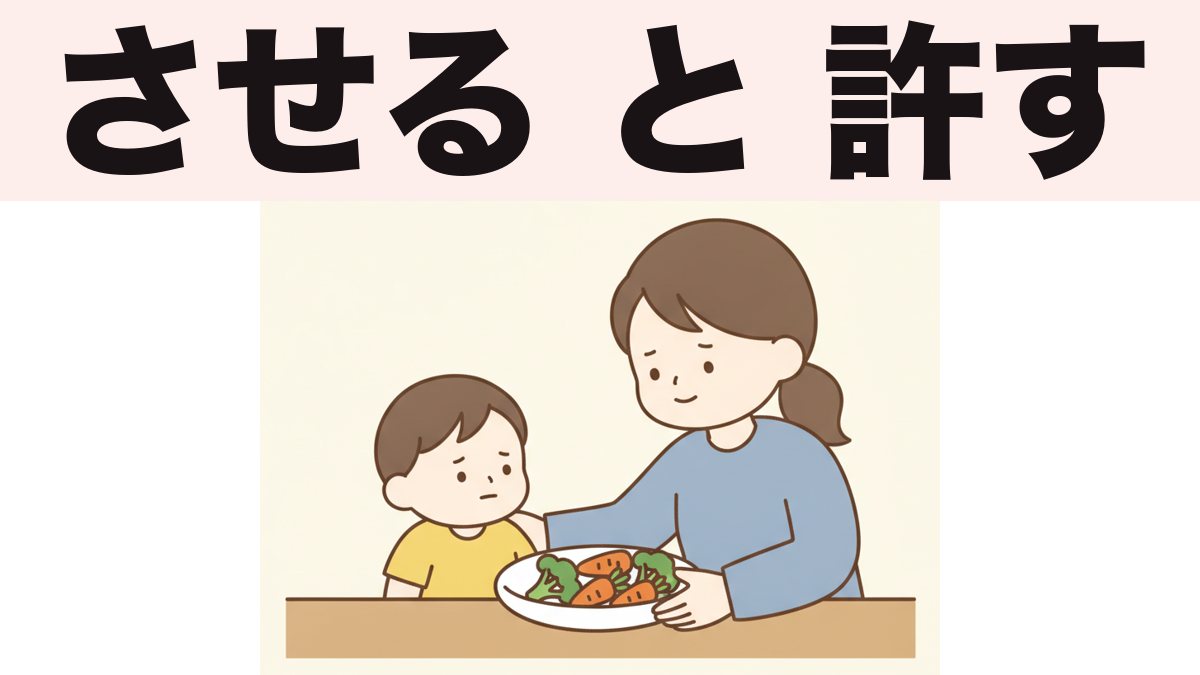
The causative form means "make someone do something" *and* "let someone do something" — the grammar is identical, and the particle you choose is what tips it one way or the other.
使役形は「人に〜させる」と「人に〜させてあげる(許す)」の両方を表します。文法はまったく同じで、どちらの意味になるかは助詞と場面で決まります。
That double meaning is why learners freeze on this form. It is not two grammar points that happen to look alike. It is one grammar point that says "the subject caused this action," and Japanese leaves it to context and particles to tell you whether the causing was forceful or generous.
The basics
How do you conjugate the causative?
Three rules, one per verb group. This is the whole mechanical part.
| Group | Rule | Example |
|---|---|---|
| Group 1 (う-verbs) | final -u → -aseru | 読む → 読ませる |
| Group 2 (る-verbs) | drop る → させる | 食べる → 食べさせる |
| する | → させる | 勉強する → 勉強させる |
| 来る | → 来させる | 来る → 来させる |
Once formed, the result is a る-verb, so it conjugates like any other: 読ませます, 読ませた, 読ませて, 読ませない.
子供に野菜を食べさせます。 — I make my child eat vegetables. (polite — the classic textbook causative) 先生は学生に作文を書かせました。 — The teacher had the students write an essay. (polite past — assignment, not force)
The one trap in Group 1: verbs ending in う take わせる, not あせる. 買う → 買わせる, 言う → 言わせる. Same irregularity you already met in the negative form (買わない), so it should feel familiar rather than new.
Which particle marks the person being made to act?
This is the real content of the lesson. There are two patterns, and which one you can use depends on whether the verb already has an object.
Pattern A — the verb has no object: person takes を
子供を泣かせました。 — I made the child cry. (polite past — 泣く takes no object, so the child gets を) 母を待たせてしまいました。 — I kept my mother waiting. (polite past — and note the てしまう marking the regret)
Pattern B — the verb already has an object: person takes に
子供に薬を飲ませました。 — I made my child take the medicine. (polite past — 薬 already holds を, so the child takes に) 学生に本を読ませます。 — I have the students read the book. (polite — same structure)
The logic is simple once you see it: a Japanese clause does not want two を. If the object already claimed を, the person doing the action gets に instead.
Does it mean "make" or "let"?
Both. The form is neutral about how willing everyone was; the situation decides.
| Sentence | Likely reading |
|---|---|
| 子供に野菜を食べさせる | Make — vegetables are rarely a treat |
| 子供にゲームをさせる | Let — the child wants this |
| 学生に宿題をさせる | Make — it is an assignment |
| 娘を留学させる | Let / send — a parent enabling something |
息子に好きなことをさせています。 — I let my son do what he likes. (polite — clearly permissive) 妹を先に行かせました。 — I let my little sister go first. (polite past — also permissive, despite identical grammar)
If you need to be unmistakably permissive, there is a dedicated way to do it, and it is the next section.
Beyond the basics
How do you clearly say "let me do it"?
Combine the causative with てください and you get させてください — "please let me do it." This is one of the highest-value phrases in the entire form, and you can start using it immediately.
私にやらせてください。 — Please let me do it. (polite — offering to take on a task) 少し考えさせてください。 — Please let me think about it a little. (polite — buys you time in any negotiation)
Notice that this is the mirror image of 〜てもいいですか. てもいいですか asks whether an action is permitted; させてください asks the other person to actively grant it. In business Japanese, させてください and its humbler cousin させていただきます are everywhere — the second one is how a company says "we will be doing this," dressed up as "we humbly receive permission to."
What is the causative-passive, and why does it sound so miserable?
Stack the causative and the passive and you get 〜させられる: "I was made to do it." The extra layer adds the speaker's resentment, and that resentment is the whole point of the form.
部長に残業させられました。 — I was made to work overtime by my manager. (polite past — complaining, and the grammar is doing the complaining) 毎日ピアノを練習させられた。 — I was made to practise piano every day. (plain past — childhood grievance)
Learners often reach for this form when they only meant the plain causative, and it changes who the sentence sympathizes with. 子供に野菜を食べさせた = "I made my child eat vegetables." 子供に野菜を食べさせられた = "my child made me eat vegetables," which is a very different household.
Is there a shorter spoken form?
Yes. For Group 1 verbs, せる often contracts to す in casual speech: 読ませる → 読ます, 待たせる → 待たす, 行かせる → 行かす.
ちょっと待たして。 — Hold on a second. (very casual — contracted 待たせて)
This is common in real speech and in casual anime dialogue, and it is the kind of form worth recognizing without producing. Use the full せる version yourself; you will never sound wrong doing so.
When does the causative sound rude?
Whenever the person you are "causing" outranks you. Saying 部長に書類を書かせました ("I made the manager write the document") reports the facts accurately and insults him in the same breath, because the grammar puts you in charge.
For anything involving a senior person, Japanese reaches for the humble side instead — usually 〜ていただきました ("I received the favour of..."). This is the same register machinery that governs the rest of polite Japanese: the facts stay the same, and the grammar re-arranges who is above whom.
部長に書類を書いていただきました。 — The manager kindly wrote the document for me. (polite — same event, correct hierarchy)
Why do textbooks teach this so late?
Because it stacks. The causative sits on the same conjugation machinery as the passive and the potential, and all three produce る-verbs that then take every other ending. Once you can build 食べさせる, you can also build 食べさせたい, 食べさせてもいい, 食べさせないで, 食べさせられた — and that combinatorial explosion is what makes the form feel harder than it is.
The form itself is three rules. The difficulty is everything you can attach afterwards.
Common mistakes
- Using を for the person when the verb already has an object. 子供を薬を飲ませた is wrong — two を in one clause. It has to be 子供に薬を飲ませた.
- Using あせる for う-ending verbs. 買う becomes 買わせる, not 買あせる. The same わ that appears in 買わない.
- Reaching for the causative-passive by accident. させられる means you were the victim. If you were the one giving instructions, you want plain させる.
- Using the causative about a senior person. Grammatically fine, socially bad. Switch to ていただく when the other person outranks you.
- Forgetting that させてください is available. Many learners build long, awkward sentences to ask permission to help, when させてください does it in one phrase.
Practice
Each answer is hidden — build your version first, then open it. Questions 3 and 4 are a pair: the verb changes, so the particle has to change with it.
1. Put 書く into the causative form.
Show answer
書かせる — Group 1 verb: the final く becomes か, then add せる. 書く → 書かせる.
2. Put 買う into the causative form.
Show answer
買わせる — verbs ending in う take わせる, not あせる. Same わ you see in the negative 買わない.
3. Fill in the particle: 子供( )泣かせました。
Show answer
を — 子供を泣かせました。泣く takes no object, so the を slot is free and the person takes it.
4. Fill in the particle: 子供( )薬を飲ませました。
Show answer
に — 子供に薬を飲ませました。薬 already holds を, and a clause will not take two を, so the person moves to に. This is the pair to question 3 — only the verb changed.
5. Put 勉強する into the causative form.
Show answer
勉強させる — する becomes させる, with no other change to the noun.
6. Say "please let me think about it" using this grammar.
Show answer
考えさせてください — causative 考えさせる, then the te-form plus ください. Literally "please make me think," which functions as "please let me think."
7. What is the difference between 私は妹に部屋を掃除させた and 私は妹に部屋を掃除させられた?
Show answer
Who did the cleaning — the first means I made my sister clean the room. The second is causative-passive: I was made to clean the room (by her). The extra られ flips the victim.
8. Something is wrong here: 学生を宿題をさせました。
Show answer
学生に宿題をさせました — 宿題 already takes を, so the students must take に. Two を in one clause is not possible.
9. Your manager wrote a document for you. Why is 部長に書類を書かせました a bad sentence?
Show answer
It puts you in charge of your manager — the causative says you made him do it. Grammatically correct, socially wrong. Use 部長に書類を書いていただきました instead.
10. Put 来る into the causative form.
Show answer
来させる — 来る is irregular and becomes 来させる (こさせる). Polite: 来させます.
FAQ
How do I know whether a sentence means "make" or "let"? Context, almost always. Ask whether the person being caused to act would have wanted to. If you need to be unambiguous about permission, use させてあげる (let someone, as a favour) or させてください (let me).
What is the difference between させる and させてあげる? させる is neutral about kindness. させてあげる explicitly frames it as doing the other person a favour: 子供に好きなことをさせてあげる = "I let my child do what they like (as a kindness)."
Why does させていただきます appear in every business email? It is the humble form of "let me do this" — literally "I will receive permission to do it." Japanese business language prefers to describe a decision as something you were permitted to do rather than something you chose, so 確認させていただきます ("I will check") is softer than 確認します.
Can I use the causative with myself as the object? Yes, and it is a useful pattern: 自分に言わせれば = "if you ask me" (literally "if I let myself say it"). But for ordinary sentences about your own actions, you do not need the causative at all.
Is 待たす correct, or is it slang? It is a genuine contraction of 待たせる, common in casual speech, especially in western Japan. Recognize it; write 待たせる.
Vocabulary from this article
Tap the block to select all of it, then copy. In Anki: File → Import, note type Basic, separator Tab — the first column becomes the front, the second the back.
食べる	たべる — to eat
読む	よむ — to read
書く	かく — to write
買う	かう — to buy
言う	いう — to say
待つ	まつ — to wait
泣く	なく — to cry
行く	いく — to go
来る	くる — to come
掃除する	そうじする — to clean
勉強する	べんきょうする — to study
練習する	れんしゅうする — to practise
留学	りゅうがく — studying abroad
残業	ざんぎょう — overtime work
部長	ぶちょう — department manager
書類	しょるい — document
野菜	やさい — vegetables
薬	くすり — medicine
宿題	しゅくだい — homework
作文	さくぶん — essay, composition
息子	むすこ — son
娘	むすめ — daughter
妹	いもうと — younger sister
I'm Yuuki, a Japanese teacher based in Tokyo. I've taught on italki as a Top 1% teacher and watched over 1,500 anime, and in lessons the conjugation is almost never the problem — it is questions 3 and 4 above, where the particle has to move because the verb already took を.
Sources: the author's own lessons and standard reference grammars.
この2つの意味があるので、学習者はここで止まります。似ている2つの文法があるのではありません。「主語がその動作を起こさせた」という1つの文法です。強く言ったのか、やさしく許したのかは、日本語では場面と助詞が決めます。
基本の形
どう作りますか?
グループごとに1つ、3つのルールだけです。
| グループ | ルール | 例 |
|---|---|---|
| グループ1(う動詞) | 最後の -u を -aseru に | 読む → 読ませる |
| グループ2(る動詞) | る をとって させる | 食べる → 食べさせる |
| する | → させる | 勉強する → 勉強させる |
| 来る | → 来させる | 来る → 来させる |
できた形はる動詞なので、あとはふつうに変えられます。読ませます、読ませた、読ませて、読ませない。
子供に野菜を食べさせます。 — I make my child eat vegetables. (ていねい) 先生は学生に作文を書かせました。 — The teacher had the students write an essay. (ていねい・過去)
グループ1の注意点は1つです。「う」で終わる動詞は「わせる」になります。買う → 買わせる、言う → 言わせる。否定形の「買わない」と同じ「わ」です。
させられる人の助詞は「を」ですか「に」ですか?
ここがこの文法の本番です。2つの形があって、動詞が目的語を持っているかどうかで決まります。
Aの形 — 動詞に目的語がないとき: 人は「を」
子供を泣かせました。 — I made the child cry. (「泣く」に目的語がないので、子供が「を」) 母を待たせてしまいました。 — I kept my mother waiting. (ていねい・過去。てしまう が後悔を表しています)
Bの形 — 動詞に目的語があるとき: 人は「に」
子供に薬を飲ませました。 — I made my child take the medicine. (薬 が「を」を持っているので、子供は「に」) 学生に本を読ませます。 — I have the students read the book. (同じ形)
理由は簡単です。日本語の1つの文は「を」を2つ持ちたくありません。目的語が「を」を取ったら、動作をする人は「に」になります。
「させる」ですか、「許す」ですか?
両方です。形はどちらでもなく、場面が決めます。
| 文 | ふつうの読み方 |
|---|---|
| 子供に野菜を食べさせる | させる(野菜はごほうびではない) |
| 子供にゲームをさせる | 許す(子供はやりたい) |
| 学生に宿題をさせる | させる(課題だから) |
| 娘を留学させる | 許す・行かせてあげる |
息子に好きなことをさせています。 — I let my son do what he likes. (ていねい。許している) 妹を先に行かせました。 — I let my little sister go first. (ていねい・過去。文法は同じでも、許している)
「許す」とはっきり言いたいときの形があります。次の節です。
もう少し先へ
「私にやらせてください」の形
使役形に「てください」をつけると「させてください」になります。この文法でいちばん役に立つ言い方です。今日から使えます。
私にやらせてください。 — Please let me do it. (ていねい。仕事を引き受けるとき) 少し考えさせてください。 — Please let me think about it a little. (ていねい。時間をもらえる)
これは 〜てもいいですか の反対側です。「てもいいですか」は「していいですか」と聞きます。「させてください」は「させてほしい」とお願いします。仕事の日本語では「させてください」と「させていただきます」がとても多く出てきます。
使役受身(させられる)は、なぜつらそうに聞こえますか?
使役と受身を重ねると「〜させられる」」「やらされた」になります。1つ足された部分が、話す人のいやな気持ちを表します。
部長に残業させられました。 — I was made to work overtime by my manager. (ていねい・過去。文法が不満を言っています) 毎日ピアノを練習させられた。 — I was made to practise piano every day. (ふつう・過去)
「させる」のつもりで「させられる」を使うと、だれがかわいそうな人かが入れかわります。「子供に野菜を食べさせた」」私が食べさせた。「子供に野菜を食べさせられた」」子供が私に食べさせた。まったくちがう家です。
話すときの短い形はありますか?
あります。グループ1では「せる」が「す」になります。読ませる → 読ます、待たせる → 待たす、行かせる → 行かす。
ちょっと待たして。 — Hold on a second. (とてもふつうの話し方。「待たせて」が短くなった形)
会話やアニメのせりふでよく聞きます。聞いて分かれば十分です。自分は長い「せる」を使ってください。それでまちがいになることはありません。
使役形が失礼になるのは、どんなときですか?
相手が自分より上の人のときです。「部長に書類を書かせました」は、事実は合っていますが、自分が部長に命令したことになります。
上の人のことを言うときは、日本語は「〜ていただきました」を使います。これはていねいさの切りかえと同じ仕組みです。事実は同じで、だれが上かを文法が並べ直します。
部長に書類を書いていただきました。 — The manager kindly wrote the document for me. (ていねい。同じことを、正しい上下で)
教科書が使役をあとで教えるのはなぜですか?
重ねられるからです。使役は、受身や可能形と同じ仕組みの上にあります。そして3つとも、できた形はる動詞なので、そのあと何でもつけられます。「食べさせる」が作れると、「食べさせたい」「食べさせてもいい」「食べさせないで」「食べさせられた」も作れます。この数の多さが、むずかしく感じさせます。
形のルールは3つだけです。むずかしいのは、そのあとにつく部分です。
よくある間違い
- 目的語があるのに、人に「を」を使う。 「子供を薬を飲ませた」はまちがいです。1つの文に「を」が2つあります。「子供に薬を飲ませた」です。
- 「う」の動詞を「あせる」にする。 買う は「買わせる」です。「買あせる」ではありません。「買わない」と同じ「わ」です。
- 使役受身をまちがえて使う。 「させられる」は、自分がやらされた側です。指示したのが自分なら「させる」です。
- 上の人に使役形を使う。 文法は合っていますが、失礼です。相手が上の人なら「ていただく」に変えます。
- 「させてください」を忘れる。 手伝いたいときに長くて変な文を作る人が多いですが、「させてください」だけで足ります。
練習
答えはかくれています。まず自分の答えを作って、それから開いてください。3番と4番は対になっています。動詞が変わると、助詞も動きます。
1. 「書く」を使役形にしてください。
答えを見る
書かせる — グループ1なので、最後の「く」が「か」になって「せる」をつけます。書く → 書かせる。
2. 「買う」を使役形にしてください。
答えを見る
買わせる — 「う」で終わる動詞は「わせる」になります。否定形の「買わない」と同じ「わ」です。
3. 助詞を入れてください: 子供( )泣かせました。
答えを見る
を — 子供を泣かせました。「泣く」に目的語がないので、「を」の場所があいていて、人がそこに入ります。
4. 助詞を入れてください: 子供( )薬を飲ませました。
答えを見る
に — 子供に薬を飲ませました。薬 がもう「を」を持っていて、1つの文に「を」は2つ置けないので、人は「に」になります。3番と動詞だけがちがいます。
5. 「勉強する」を使役形にしてください。
答えを見る
勉強させる — 「する」が「させる」になります。前の名詞は変わりません。
6. 「少し考えたいので、時間をください」を、この文法で言ってください。
答えを見る
考えさせてください — 使役形「考えさせる」のて形に「ください」をつけます。「考えさせてください」で「考える時間をください」になります。
7. 「私は妹に部屋を掃除させた」と「私は妹に部屋を掃除させられた」のちがいは何ですか。
答えを見る
だれが掃除したか — 1つめは、私が妹にさせました。2つめは使役受身で、私がやらされました。「られ」が入ると、かわいそうな人が入れかわります。
8. まちがいがあります。学生を宿題をさせました。
答えを見る
学生に宿題をさせました — 宿題 が「を」を持っているので、学生は「に」です。1つの文に「を」は2つ置けません。
9. 部長が書類を書いてくれました。「部長に書類を書かせました」が良くないのはなぜですか。
答えを見る
自分が部長に命令したことになるから — 使役形は「私がさせた」という意味です。文法は合っていますが失礼です。「部長に書類を書いていただきました」を使います。
10. 「来る」を使役形にしてください。
答えを見る
来させる — 「来る」は特別な動詞で「来させる(こさせる)」になります。ていねいな形は「来させます」。
よくある質問
「させる」か「許す」か、どうやって分かりますか。 ほとんど場面です。「その人はやりたかったか」を考えてください。はっきり「許す」と言いたいときは「させてあげる」、「させてほしい」ときは「させてください」を使います。
「させる」と「させてあげる」のちがいは何ですか。 「させる」は、やさしさについて何も言いません。「させてあげる」は、相手のためにしてあげる、という気持ちが入ります。「子供に好きなことをさせてあげる」。
仕事のメールに「させていただきます」が多いのはなぜですか。 「させてください」のへりくだった形で、「やる許しをもらう」という意味です。日本語の仕事の言葉は、自分で決めたことを「許してもらってする」と言うほうをえらびます。「確認させていただきます」は「確認します」よりやわらかいです。
自分を目的語にして使えますか。 使えます。「自分に言わせれば」」「私の考えでは」。でも、ふつうに自分の動作を言うときは使役形はいりません。
「待たす」は正しいですか。 「待たせる」が短くなった、本当にある形です。会話でよく使います。とくに西日本で多いです。聞いて分かれば十分で、書くときは「待たせる」を使ってください。
この記事に出た単語
ブロックをタップすると全部選べます。そのままコピーしてください。Anki では ファイル → 読み込み、ノートタイプ 基本、区切り タブ。1列目が表、2列目が裏になります。
食べる	たべる — to eat
読む	よむ — to read
書く	かく — to write
買う	かう — to buy
言う	いう — to say
待つ	まつ — to wait
泣く	なく — to cry
行く	いく — to go
来る	くる — to come
掃除する	そうじする — to clean
勉強する	べんきょうする — to study
練習する	れんしゅうする — to practise
留学	りゅうがく — studying abroad
残業	ざんぎょう — overtime work
部長	ぶちょう — department manager
書類	しょるい — document
野菜	やさい — vegetables
薬	くすり — medicine
宿題	しゅくだい — homework
作文	さくぶん — essay, composition
息子	むすこ — son
娘	むすめ — daughter
妹	いもうと — younger sister
私はユウキです。東京で日本語を教えています。 italki の Top 1% の先生で、アニメは1,500本以上見ました。レッスンでは、形の作り方はほとんど問題になりません。上の3番と4番、動詞がもう「を」を持っているから助詞が動く、というところでみんな止まります。
More drills like the ones above, plus a timed JLPT-style mock test: Practice · N4上のような練習問題と、時間つきのJLPT形式のもぎ試験: 練習ページ · N4
Want to try this in a real conversation?
本当の会話で、ためしてみませんか?
30-minute trial lesson, $13. Times shown in your own timezone.
30分の体験レッスン、$13。時間はあなたのタイムゾーンで表示されます。
Book a trial lesson · $13