Japanese position words: 上, 下, 中, 前, 後ろ — and the の you cannot drop場所のことば: 上・下・中・前・後ろ、そして落とせない「の」
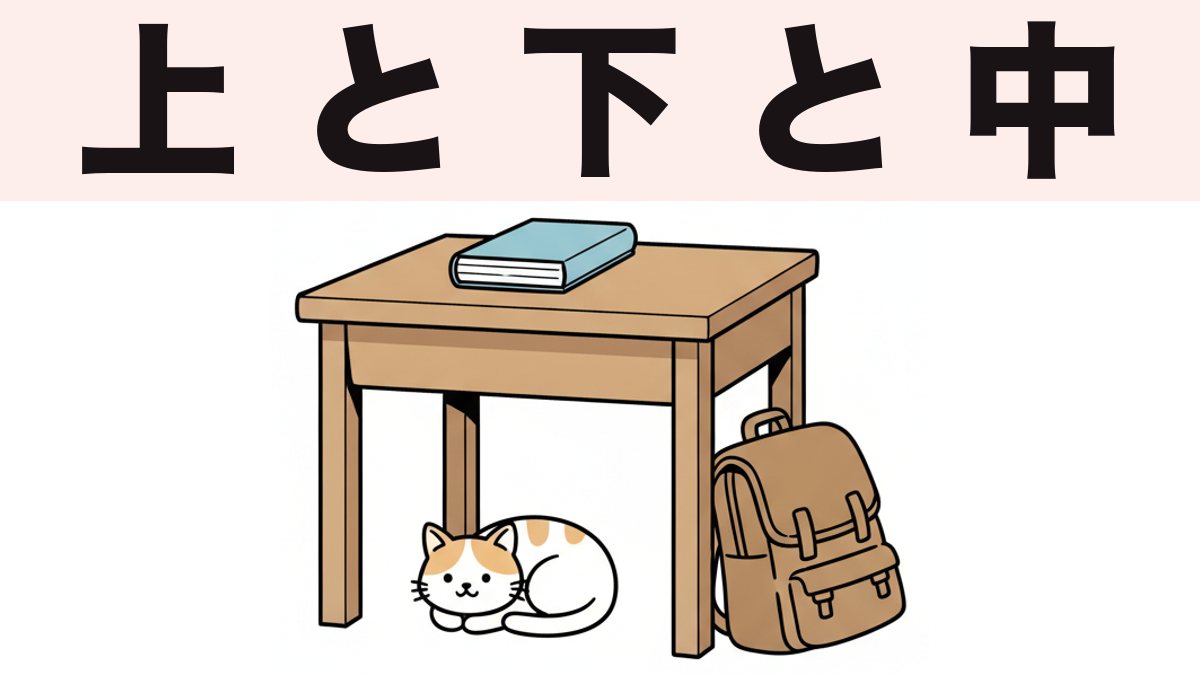
Japanese has no prepositions. Position words like 上 (above), 下 (below) and 中 (inside) are nouns, and they attach with の: 机の上 is literally "the desk's top." Get that one structural fact and the whole set follows from it.
日本語に前置詞はありません。「上」「下」「中」は名詞です。だから「の」でつなぎます。「机の上」は「机のいちばん上のところ」です。この1つが分かれば、あとは全部同じ形です。
This is one of the earliest places where Japanese refuses to map onto English, and learners who paper over it with translation end up producing sentences that are almost right for months. The fix is not memorizing more words — it is seeing that "on the desk" is a possessive in Japanese.
The basics
The words themselves
| Japanese | Reading | English |
|---|---|---|
| 上 | うえ | on, above |
| 下 | した | under, below |
| 中 | なか | inside, in |
| 外 | そと | outside |
| 前 | まえ | in front of; before |
| 後ろ | うしろ | behind |
| 右 | みぎ | right |
| 左 | ひだり | left |
| 隣 | となり | next to (same category) |
| 横 | よこ | beside (physically alongside) |
| 間 | あいだ | between |
| 近く | ちかく | near |
| 向かい | むかい | opposite, facing |
The structure: noun + の + position + に/で
机の上に本があります。 — There's a book on the desk. (polite, stating existence) 駅の前で待っています。 — I'm waiting in front of the station. (polite, an action happening there)
The pattern is always the same: the reference object, then の, then the position word, then a particle. 机の上 is a noun phrase meaning "the desk's top," and it behaves like any other place noun after that.
The の is not optional
This is the error that survives longest.
テーブルの下に猫がいます。 — There's a cat under the table. (polite)
テーブル下 is not a sentence — it looks like a compound noun and reads as "table-bottom," a technical term rather than a location. Every position word needs の between it and what it is positioned relative to. The exception is a handful of fixed compounds like 地下 (basement) and 年内 (within the year), which are separate vocabulary rather than the grammar on this page.
For the wider set of jobs の does, see the particle の — position is one of five.
Beyond the basics
に vs で: existence vs action
Once you have built 机の上, the particle that follows decides what kind of sentence you get.
机の上に本があります。 — There's a book on the desk. (に — where something exists) 机の上で本を読みます。 — I read a book on the desk. (で — where an action happens)
This is the same に/で split covered in で vs に, and position words are where it bites hardest, because English uses "on" for both. If the verb is ある, いる or a state, use に. If the verb is something you do, use で.
隣 vs 横 vs 近く: three kinds of "next to"
These three are not interchangeable, and the difference is real.
- 隣 (となり) — next to, in the same category. Two houses, two seats, two shops in a row.
- 横 (よこ) — physically alongside. Anything can be 横 of anything.
- 近く (ちかく) — near, without touching. Vague by design.
駅の隣にコンビニがあります。 — There's a convenience store next to the station. (polite — both are buildings) 本の横にペンがあります。 — There's a pen beside the book. (polite — different kinds of thing, so 横)
Saying 駅の横 about a convenience store is not wrong, but it emphasizes physical adjacency rather than "the next one along." Saying 本の隣 about a pen is odd, because a pen and a book are not the same category of thing sitting in a row. Native speakers apply this without thinking about it; learners have to think about it for a while first.
前 and 後ろ do time as well as space
食事の前に手を洗います。 — I wash my hands before eating. (polite, time) 建物の前で会いましょう。 — Let's meet in front of the building. (polite, space)
Same word, both jobs, and Japanese does not distinguish them. 後 (あと) is the time counterpart of 後ろ — 食事の後 ("after the meal") uses 後, not 後ろ, which is a distinction worth noting because both are written with the same kanji.
間: between, and 〜の間に for time
銀行と郵便局の間にあります。 — It's between the bank and the post office. (polite — note the と joining the two reference points) 夏休みの間に旅行しました。 — I travelled during the summer holiday. (polite — a span of time)
For space, you need two reference points joined by と. For time, 間 means "during," and adding に narrows it to "at some point during," which is a distinction Japanese makes and English does not.
Where the position word can be dropped
If the location is obvious, Japanese drops the position word entirely and just marks the place.
学校にいます。 — I'm at school. (polite — no 中 needed; being at a school implies inside it) 東京に住んでいます。 — I live in Tokyo. (polite — no 中)
Adding 中 to these is a common learner over-correction. 学校の中にいます is grammatical but says something more specific: "I am inside the school building," as opposed to on the grounds. Use the position word when the position is the information; drop it when the place alone is enough.
Common mistakes
- Dropping the の. テーブル下, 机上 — these read as compound nouns, not locations. It is テーブルの下.
- Using で where に belongs. With ある and いる, it is always に. 机の上で本があります is wrong.
- Adding 中 to every "in." 東京の中に住んでいます over-specifies. 東京に住んでいます is what people say.
- Using 隣 for things in different categories. 本の隣にペン sounds odd; 本の横にペン is natural.
- Using 後ろ for time. 食事の後ろ is spatial — behind the meal. The time word is 後 (あと).
- Forgetting the と in 間. 銀行の郵便局の間 is not a sentence. It is 銀行と郵便局の間.
Position words at a glance
| You want to say | Structure | Example |
|---|---|---|
| Something exists there | 〜の〜に + あります/います | 机の上に本があります |
| An action happens there | 〜の〜で + verb | 机の上で書きます |
| Next one along, same kind | 〜の隣 | 駅の隣 |
| Physically alongside | 〜の横 | 本の横 |
| Between two things | AとBの間 | 銀行と郵便局の間 |
| Before/after in time | 〜の前 / 〜の後 | 食事の前 / 食事の後 |
| Near, unspecific | 〜の近く | 駅の近く |
Practice
Questions 1 and 2 are the pair: the same position phrase with に and with で.
1. Say "there's a book on the desk," politely.
Show answer
机の上に本があります。 — Existence takes に. The の is not optional.
2. Say "I read a book on the desk," politely.
Show answer
机の上で本を読みます。 — An action takes で. Same location phrase, different sentence type.
3. Say "there's a cat under the table."
Show answer
テーブルの下に猫がいます。 — いる for a living thing, に for existence, の between テーブル and 下.
4. Say "there's a convenience store next to the station."
Show answer
駅の隣にコンビニがあります。 — 隣 because both are buildings in a row.
5. Say "there's a pen beside the book."
Show answer
本の横にペンがあります。 — 横, not 隣: a pen and a book are not the same category of thing.
6. Say "it's between the bank and the post office."
Show answer
銀行と郵便局の間にあります。 — Two reference points joined by と, then の間.
7. Say "I wash my hands before eating."
Show answer
食事の前に手を洗います。 — 前 does time as well as space.
8. Say "I live in Tokyo," the way people actually say it.
Show answer
東京に住んでいます。 — No 中. Adding it over-specifies and marks you as translating.
9. Fix this: テーブル下に猫がいます。
Show answer
テーブルの下に猫がいます。 — Without の it reads as a compound noun, not a location.
10. Fix this: 食事の後ろに散歩します。
Show answer
食事の後に散歩します。 — 後ろ is spatial ("behind"). The time word is 後, read あと.
FAQ
Why does Japanese use nouns instead of prepositions? Because the structure is possessive: "the desk's top" rather than "on the desk." Once you accept that, the の stops feeling like an extra piece you keep forgetting and starts feeling required, which it is.
Is 上 always "on top of"? Not quite — it covers "above" as well, whether or not there is contact. 机の上 can be a book resting on the desk or a lamp hanging over it. If contact matters, context supplies it.
How do I say "on the wall"? 壁に, usually with a verb like 貼る or かける rather than a position word. 壁の上 would mean on top of the wall, looking down — a different picture entirely.
What is the difference between 近く and そば? そば is closer and slightly warmer; 近く is a neutral "in the vicinity." Both are fine in most sentences, and そば also appears figuratively for being at someone's side.
Does 中 ever mean something other than "inside"? Yes — 〜中 read ちゅう or じゅう is a suffix meaning "during" or "throughout": 仕事中 ("during work"), 会議中 ("in a meeting"), 一日中 ("all day"). That is a different item from the なか on this page, and it attaches directly to the noun with no の.
Why is 隣 sometimes written となり in kana? Both are standard. The kanji is common in writing, and kana appears where a writer wants a softer look. Neither changes the meaning.
Vocabulary from this article
Tap the block to select all of it, then copy. In Anki: File → Import, note type Basic, separator Tab — the first column becomes the front, the second the back.
上	うえ — on, above
下	した — under, below
中	なか — inside
外	そと — outside
前	まえ — in front of; before
後ろ	うしろ — behind
後	あと — after (time)
右	みぎ — right
左	ひだり — left
隣	となり — next to (same category)
横	よこ — beside
間	あいだ — between; during
近く	ちかく — near
向かい	むかい — opposite, facing
机	つくえ — desk
銀行	ぎんこう — bank
郵便局	ゆうびんきょく — post office
食事	しょくじ — a meal
I'm Yuuki, a Japanese teacher based in Tokyo. I've taught on italki as a Top 1% teacher and watched over 1,500 anime. The dropped の in テーブル下 is the mistake I correct most in absolute beginners, and it always comes from the same place: thinking of "under" as a preposition instead of a noun.
Sources: the author's own lessons and standard reference grammars.
英語と形がちがうところです。訳して覚えると、何か月も「ほとんど正しいけれど少し変な文」を作り続けます。ことばを増やすのではなく、「on the desk」が日本語では「の」の文だと気づくことが大事です。
基本
ことば
| 日本語 | 読み方 | 英語 |
|---|---|---|
| 上 | うえ | on, above |
| 下 | した | under, below |
| 中 | なか | inside |
| 外 | そと | outside |
| 前 | まえ | in front of; before |
| 後ろ | うしろ | behind |
| 右 | みぎ | right |
| 左 | ひだり | left |
| 隣 | となり | next to |
| 横 | よこ | beside |
| 間 | あいだ | between |
| 近く | ちかく | near |
| 向かい | むかい | opposite |
形: 名詞+の+場所のことば+に/で
机の上に本があります。 — There's a book on the desk. (polite, stating existence) 駅の前で待っています。 — I'm waiting in front of the station. (polite, an action happening there)
いつも同じです。基準になるもの、「の」、場所のことば、助詞。「机の上」は「机のいちばん上のところ」という名詞です。
「の」は落とせません
いちばん長く残る間違いです。
テーブルの下に猫がいます。 — There's a cat under the table. (polite)
「テーブル下」は文になりません。1つのことばに見えて、専門用語のようになります。「地下」「年内」のような決まったことばは別です。
もう少し先へ
「に」と「で」
机の上に本があります。 — There's a book on the desk. (に — where something exists) 机の上で本を読みます。 — I read a book on the desk. (で — where an action happens)
英語はどちらも「on」です。日本語は分けます。「ある」「いる」なら「に」、することなら「で」です。
「隣」「横」「近く」
- 隣(となり) — 同じ種類のものが並んでいる時。家と家、席と席
- 横(よこ) — ただ「そば」。何にでも使えます
- 近く(ちかく) — 近いけれど、ついていない
駅の隣にコンビニがあります。 — There's a convenience store next to the station. (polite — both are buildings) 本の横にペンがあります。 — There's a pen beside the book. (polite — different kinds of thing, so 横)
ペンに「本の隣」はへんです。ペンと本は、並んでいる同じ種類のものではないからです。
「前」「後ろ」は時間にも使います
食事の前に手を洗います。 — I wash my hands before eating. (polite, time) 建物の前で会いましょう。 — Let's meet in front of the building. (polite, space)
時間の「あと」は「後(あと)」です。「後ろ(うしろ)」ではありません。漢字は同じですが、読み方と意味がちがいます。
「間」
銀行と郵便局の間にあります。 — It's between the bank and the post office. (polite — note the と joining the two reference points) 夏休みの間に旅行しました。 — I travelled during the summer holiday. (polite — a span of time)
場所なら、2つを「と」でつなぎます。時間なら「〜の間」で「その間ずっと」、「〜の間に」で「その間のどこか」です。
場所のことばを落とす時
分かりきっている時は、場所のことばを言いません。
学校にいます。 — I'm at school. (polite — no 中 needed) 東京に住んでいます。 — I live in Tokyo. (polite — no 中)
「東京の中に住んでいます」は言いすぎです。場所のことばは、位置が情報になる時だけ使います。
よくある間違い
- 「の」を落とす。 「テーブル下」「机上」は別のことばになります。
- 「ある」「いる」に「で」を使う。 いつも「に」です。
- 全部の「in」に「中」をつける。 「東京に住んでいます」です。
- ちがう種類のものに「隣」を使う。 「本の横にペン」です。
- 時間に「後ろ」を使う。 「食事の後」です。
- 「間」の「と」を落とす。 「銀行と郵便局の間」です。
まとめ
| 言いたいこと | 形 | 例 |
|---|---|---|
| そこにある | 〜の〜に+あります/います | 机の上に本があります |
| そこでする | 〜の〜で+動詞 | 机の上で書きます |
| 並んでいる隣 | 〜の隣 | 駅の隣 |
| ただのそば | 〜の横 | 本の横 |
| 2つの間 | AとBの間 | 銀行と郵便局の間 |
| 時間の前後 | 〜の前 / 〜の後 | 食事の前 / 食事の後 |
| 近く | 〜の近く | 駅の近く |
練習
1番と2番が組です。同じ場所で、助詞がちがいます。
1. 「机の上に本があります」と言ってください。
答えを見る
机の上に本があります。 — 「ある」なので「に」です。「の」も必要です。
2. 「机の上で本を読みます」と言ってください。
答えを見る
机の上で本を読みます。 — することなので「で」です。
3. 「テーブルの下に猫がいます」と言ってください。
答えを見る
テーブルの下に猫がいます。 — 生きものなので「いる」です。
4. 「駅の隣にコンビニがあります」と言ってください。
答えを見る
駅の隣にコンビニがあります。 — どちらも建物なので「隣」です。
5. 「本の横にペンがあります」と言ってください。
答えを見る
本の横にペンがあります。 — 種類がちがうので「横」です。
6. 「銀行と郵便局の間にあります」と言ってください。
答えを見る
銀行と郵便局の間にあります。 — 2つを「と」でつなぎます。
7. 「食事の前に手を洗います」と言ってください。
答えを見る
食事の前に手を洗います。 — 「前」は時間にも使えます。
8. 「東京に住んでいます」と、ふつうの言い方で言ってください。
答えを見る
東京に住んでいます。 — 「中」はいりません。
9. 直してください: テーブル下に猫がいます。
答えを見る
テーブルの下に猫がいます。 — 「の」がないと別のことばになります。
10. 直してください: 食事の後ろに散歩します。
答えを見る
食事の後に散歩します。 — 時間は「後(あと)」です。
よくある質問
どうして名詞なのですか。 「机の上」は「机のもちもの」のような形だからです。そう考えると「の」が必要な理由が分かります。
「上」はいつも「触っている」ですか。 ちがいます。「above」も入ります。触っているかどうかは、場面で決まります。
「壁に」は何と言いますか。 「壁に貼る」「壁にかける」です。「壁の上」は、壁のてっぺんになります。
「近く」と「そば」はちがいますか。 「そば」のほうが近くて、やわらかい感じです。人にも使えます。
「中」にほかの意味はありますか。 あります。「〜中(ちゅう/じゅう)」は「〜の間ずっと」です。「仕事中」「一日中」。この時は「の」を入れません。
「隣」をひらがなで書くのはなぜですか。 どちらでもいいです。やわらかく見せたい時にひらがなにします。
この記事に出た単語
このブロックを長く押して全部選び、コピーしてください。Ankiでは ファイル → 読み込み、ノートタイプは 基本、区切りは タブ にします。左が表、右が裏になります。
上	うえ — on, above
下	した — under, below
中	なか — inside
外	そと — outside
前	まえ — in front of; before
後ろ	うしろ — behind
後	あと — after (time)
右	みぎ — right
左	ひだり — left
隣	となり — next to (same category)
横	よこ — beside
間	あいだ — between; during
近く	ちかく — near
向かい	むかい — opposite, facing
机	つくえ — desk
銀行	ぎんこう — bank
郵便局	ゆうびんきょく — post office
食事	しょくじ — a meal
日本語教師のユウキです。東京にいます。 italkiで Top 1% の教師をしています。アニメは1,500本以上見ました。「テーブル下」の「の」落ちは、初級でいちばん多く直す間違いです。「under」を前置詞だと思っているところから来ます。
More drills like the ones above, plus a timed JLPT-style mock test: Practice · N5上のような練習問題と、時間つきのJLPT形式のもぎ試験: 練習ページ · N5
Want to try this in a real conversation?
本当の会話で、ためしてみませんか?
30-minute trial lesson, $13. Times shown in your own timezone.
30分の体験レッスン、$13。時間はあなたのタイムゾーンで表示されます。
Book a trial lesson · $13