How to watch anime with Japanese subtitles without burning outアニメを日本語字幕で見て燃え尽きない方法
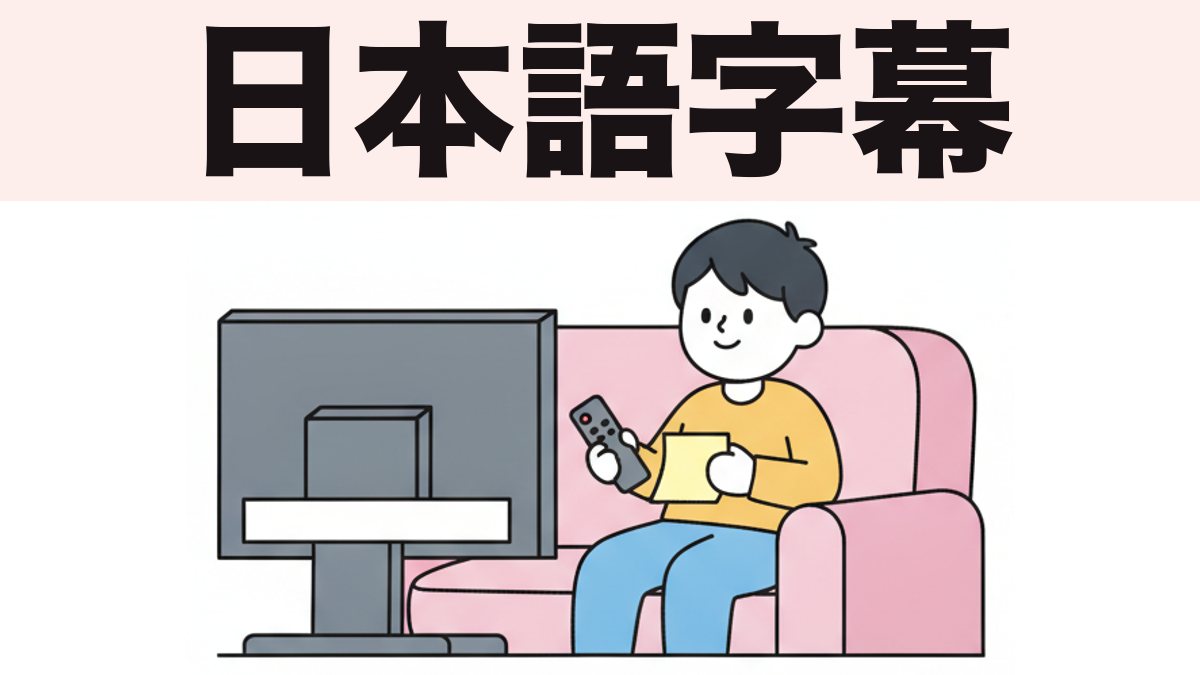
Use Japanese subtitles for one short, familiar anime scene instead of making every episode a reading test. Choose a few useful lines, connect the text to the audio, and practise using one in your own situation. Keep ordinary viewing enjoyable so that study remains something you can return to.
日本語字幕に切りかえなさい、とはみんなが言います。でも、それで好きな作品が宿題みたいになったとき、どうすればいいかは、ほとんどだれも教えてくれません。
Switching from English subtitles to Japanese can feel like starting the language again. A conversation you followed comfortably becomes a moving wall of kanji, and the pause button gets more attention than the characters. That experience does not tell you that you lack discipline. It tells you that the current task asks for more than you can comfortably handle.
This method separates watching for the story from studying the language. The times and line limits below are practical starting points, not scientifically established targets or promises of faster fluency. Adjust them to your reading speed, energy, and interest.
The basics
Give each viewing a clear job
For entertainment, watch with whatever support lets you enjoy the story. English subtitles are an option. You do not owe every episode a study session, and you do not need to watch an entire episode twice.
For study, return to a scene whose situation you already understand. Start with about thirty seconds to two minutes: a greeting, a request, or a short exchange between friends. Choose clear speech with little background noise. If the first few lines require constant dictionary work, choose a shorter or more familiar exchange.
Japanese 字幕 (じまく, subtitles) give you written language to compare with what you hear. They do not automatically make speech easy to process. You may recognize a written word but miss its sound, or hear a familiar expression without being able to read its kanji quickly.
日本語の字幕で見ます。 — I watch with Japanese subtitles.
Here, で identifies the way you watch. This is an original study example, as are all the Japanese examples in this article; none is presented as a quotation from a particular show.
Use a small, repeatable session
Try the following routine with a familiar scene. Set a timer for around fifteen minutes and stop when it rings, even if your notes are incomplete. The point of a time limit is to make the next session approachable.
| Stage | What to do | A useful stopping point |
|---|---|---|
| Understand the situation | Recall who is speaking and what they want | You can summarize the exchange |
| Read and listen | Replay with Japanese subtitles and pause as needed | You understand one short line |
| Check selectively | Look up a word that blocks that line | The meaning is clear enough to explain |
| Repeat after the audio | Pause and say the line aloud | You can say it without rushing |
| Listen without text | Hide the subtitles for that line | Notice what you can actually hear |
| Make it personal | Choose a real situation for the phrase | You have one use to try |
この場面をもう一度見ます。 — I will watch this scene once more.
場面 (ばめん) means a scene or situation. Watching the same 場面 again removes some uncertainty about the story, leaving you more room to attend to the language. It still takes effort, so repetition should have a purpose: identify a word, hear an ending, or check who is being addressed.
Treat five lines as a ceiling
Collect up to five lines, but accept one or two on a busy day. A good candidate is short enough to repeat comfortably, understandable after a small amount of checking, and useful in a situation you might actually encounter. Japanese does not normally separate words with spaces, so a rigid English-style word count is less helpful than a manageable spoken phrase.
Record the line, its meaning, the speaker and listener, and a brief situation note. Add a timestamp if you want to find it again. A sentence without context can become misleading later: a command said during an argument is not automatically a suitable request to a stranger.
ちょっと待って。 — Wait a moment.
This is a casual request you might use with a friend. Your note could say “friend is walking ahead; casual; asks them to pause.” That note teaches you more about reuse than the translation alone.
Beyond the basics
Move from reading to hearing
Once you understand a line, replay it while following the subtitles. Then hide the text and listen again. Ask a specific question: can you hear the final verb, the negative ending, or the short pause between phrases?
If you cannot, reveal the text and compare again. Do not turn this into a test you must pass before finishing. You are finding the exact place where written recognition and listening differ.
Japanese captions may differ from the audio. Before practising a line, check that the words on screen match what the speaker says. If you cannot resolve a mismatch, choose another line. Sound labels or speaker names in captions are useful context, but they are not words to repeat as dialogue.
Repeat after the audio before trying shadowing
Play a short line, pause, and repeat it. This is listen-and-repeat practice. Shadowing usually means speaking just behind the audio while it continues; it places an additional timing demand on you. You can stay with paused repetition for this routine.
Copy the wording and rhythm, but keep your voice comfortable. Dramatic shouting and exaggerated delivery belong to the performance. After a few attempts, look away and say the line from its meaning. If you need the text again, use it. Accurate, unhurried practice is a better immediate target than sounding exactly like a voice actor.
もう一度言ってください。 — Please say it again.
This is also something you can use when checking a line with a teacher. For more ways to request repetition, see how to ask someone to repeat in Japanese.
Save the relationship, not just the wording
Compare these two lines:
何してるの? — What are you doing?
何をしていますか。 — What are you doing?
The first is conversational and casual. してる is a contraction of している, and the object particle を is omitted here. The second uses a polite verb ending and includes を. Both translations are the same, but that does not make the sentences interchangeable in every relationship. Tone and circumstances can also make either question sound curious or intrusive.
Anime can use language to signal a character type, setting, or relationship. The Japan Foundation explicitly organizes its learning material around character and genre expressions; that is a useful reminder to record context alongside a phrase. See its Japanese in Anime & Manga overview. Before adopting distinctive dialogue as your everyday voice, read why anime Japanese can sound rude.
Turn one line into your own message
After understanding the original exchange, make one small change that you can explain. Keep the sentence pattern stable and change the activity, object, or time. Do not replace several unfamiliar pieces at once.
今日は少し疲れました。 — I am a little tired today.
今日は日本語を勉強しました。 — I studied Japanese today.
These are polite statements you could use when talking about your day. In the first, 疲れました describes having become tired and naturally communicates a current tired state in this context. In the second, 勉強しました reports studying. Understanding that difference matters more than simply noticing that both end in ました.
Say your chosen sentence in a suitable conversation, or record a private voice memo and listen back. Using it once is a practice attempt, not proof that you have mastered it. Revisit it another day and see whether you can still choose it without reading your notes.
Common mistakes
Pausing for every unfamiliar word
Not every unknown word deserves a flashcard. Ask whether it prevents you from understanding the line you selected. If an unfamiliar name or specialist term is peripheral, leave it alone for this session. If the whole exchange depends on unfamiliar vocabulary, change scenes.
Keep a short “check later” list if that helps you let go, but do not create an obligation to research everything. A growing backlog can make a small routine feel unfinished before you even start.
Treating an English subtitle as a word-by-word key
An English subtitle may express the scene naturally without matching Japanese word order or spelling out every grammatical detail. Use it to understand the situation, then inspect the Japanese line on its own. If an English translation contains “I” but the Japanese does not, avoid inventing a missing Japanese pronoun in your notes.
Likewise, do not assume that every English word must have an independent Japanese equivalent. Check the complete expression and what it does in the exchange.
Confusing recognition with independent listening
Knowing what a line says after reading it is useful, but it does not show that you could understand it from sound alone. Include a brief listen with the text hidden. Report the result honestly: “I heard the request ending, but missed the main verb” is actionable progress.
Repeating memorized audio also differs from understanding an unfamiliar speaker. This routine should sit alongside ordinary reading, grammar study, and conversations; it does not need to carry your entire Japanese education.
Making the routine too large
If five lines take forty minutes and leave you drained, reduce the target. One understandable sentence is an acceptable session. You can also take a break without replacing that break with another study task.
少し休みましょう。 — Let us take a short break.
Here, 休みましょう is a polite suggestion to rest together. It is also a useful reminder for planning: an enjoyable viewing session can remain just that. You do not need to recover missed study time by doubling tomorrow's workload.
A manageable week might contain one scene session and a brief review on another day. Increase difficulty only when that feels comfortable. Change one variable at a time: a slightly longer exchange, less text support, or a less familiar situation.
Practice
Work through these nine questions using the routine and examples above. Some answers concern study choices rather than grammar; explain your reasoning before opening the answer.
1. You enjoy an episode with English subtitles but feel exhausted afterward. Do you need to replay the whole episode in Japanese immediately?
Show answer
No. Leave entertainment viewing as it is and choose one short, familiar scene for a separate study session when you have energy.
2. Which is a better first candidate: a short request you understand after one lookup, or a dramatic speech containing several unknown structures?
Show answer
The short request. It is easier to connect meaning, audio, and a possible real use without turning the session into extensive research.
3. Fill the gap: 日本語の字幕_見ます。 Which particle expresses the way you watch?
Show answer
で. It marks the means or manner here: watching with Japanese subtitles.
4. What relationship note should you save beside ちょっと待って。?
Show answer
It is a casual request, suitable in contexts such as speaking to a friend. Do not label it as a universally polite request.
5. What fuller form is contracted in 何してるの??
Show answer
してる is contracted from している. The example also omits the object particle を.
6. You can read a line confidently but miss it when the subtitles are hidden. What should you try next?
Show answer
Reveal the text, replay a short segment, and identify the word or ending you missed. Then listen without text again. Reduce the segment if necessary.
7. Is playing a line, pausing, and then saying it shadowing as described here?
Show answer
No. That is listen-and-repeat practice. Shadowing involves following just behind the continuing audio.
8. You want to ask a teacher to say a line again. Which example from this article could you use?
Show answer
もう一度言ってください。 This asks the listener to say it again using a polite request form.
9. Your five-line session consistently takes too long. Name two reasonable adjustments.
Show answer
Choose only one or two lines, and use a shorter or more familiar scene. You could also set a time limit and stop without completing every note.
For help checking which saved lines fit everyday conversation, Book a trial lesson · $13 and bring your scene notes; you can also use the Japanese practice page between sessions.
FAQ
Do I need to understand every subtitle? No. For this routine, understand the few lines you choose to practise, including their basic context. Leave the rest of the scene as background. If none of the lines becomes understandable with limited checking, select easier material instead of increasing the workload.
Can beginners use this method? Yes, with very short expressions and support, although moving captions can be demanding while you are learning kana. This article is aimed roughly at N4 learners who know some basic grammar; that is an editorial guide, not a claim that anime dialogue has an N4 difficulty rating. Beginners can start with one greeting.
Should I remove English subtitles permanently? No permanent switch is required. English can support understanding the story, while Japanese text supports examining a selected line. Briefly hiding all subtitles gives you a separate listening check. Choose the support that fits the specific job of that viewing.
What if Japanese subtitles are unavailable? Choose a different scene or learning resource with accessible Japanese text and audio. Do not spend your entire planned session searching. The Japan Foundation lists learning resources, including materials connected to anime and manga, on its learning materials page. Check the available text and playback options before choosing a resource for this routine.
How can I tell whether I am improving? Return to a saved line after a few days. Check whether you understand it without reading, explain who could say it to whom, and use it appropriately in a new situation. These are separate abilities, so record them separately. One difficult review is a reason to adjust your practice, not a verdict on your potential.
Vocabulary from this article
All of these words appear earlier in the explanations or examples. Readings are provided here so that your study notes can connect written forms with pronunciation.
| Word | Reading | Meaning in this article |
|---|---|---|
| 字幕 | じまく | subtitles |
| 日本語 | にほんご | Japanese language |
| 場面 | ばめん | scene; situation |
| もう一度 | もういちど | once more; again |
| 今日 | きょう | today |
| 少し | すこし | a little |
| 勉強 | べんきょう | study |
For a tab-separated vocabulary import, copy the following entries. The columns contain the word, reading, and meaning.
字幕	じまく	subtitles
日本語	にほんご	Japanese language
場面	ばめん	scene; situation
もう一度	もういちど	once more; again
今日	きょう	today
少し	すこし	a little
勉強	べんきょう	study
Sources
- The Japan Foundation: Japanese in Anime & Manga, site overview — describes the resource and its focus on character- and genre-based expressions. This supports the advice to pay attention to who uses a phrase.
- The Japan Foundation: Learning Materials — official directory of Japanese learning resources, including anime and manga material.
- Seiichi Makino and Michio Tsutsui, A Dictionary of Basic Japanese Grammar, The Japan Times — a reference for basic forms discussed here, including requests with ください and polite verb forms.
The session lengths, five-line ceiling, and review questions are practical suggestions for organizing study. These sources do not establish a guaranteed learning rate or a required number of repetitions.
アドバイスそのものは正しいです。でも、いつもの伝え方だと、9日でやめてしまう人がほとんどです。
なぜ、よくあるやり方はうまくいかないのか
日本語字幕をオンにすると、3つのことが一度に起きます。
漢字を速く読めません。何度も止めてしまいます。そして、本当に見たかった作品が、楽しめなくなります。
だから1週間で終わり、悪い気持ちになって、少し失敗した感じで英語字幕にもどります。でも、これはがんばりが足りなかったからではありません。やり方そのものに無理があったのです。
いちばんの問題はこれです。日本語字幕を読むことは、聞くスピードで行う「読む練習」です。 むずかしい作業を2つ重ねて、しかもペースは自分では決められません。
2つの作業に分ける
同じ話を2回、ちがう目的で見ます。
1回目: ふつうに見る。 英語字幕でも、字幕なしでもいいです。楽しんでください。これは勉強の時間ではないので、罪悪感を持つ必要はありません。
2回目: 材料をさがす。 日本語字幕で、1つの場面だけ、2、3分。自由に止めていいです。これが勉強の時間です。
1話まるごと日本語で読もうとしなくていいです。目標は、5つのセリフを持ち帰ることです。
5つのセリフのルール
選んだ場面から、この3つすべてに当てはまるセリフを 5つ 選びます。
- 一度見ただけで意味がわかった
- 自分が言っているところを想像できる
- だいたい10語以内
かっこいいセリフでなくていいです。むずかしいセリフでなくていいです。使えるセリフを選びます。
意味がわかるのに文法の説明が必要なセリフは、そのままにしておきます。準備ができたころに、また出てきます。作品は、思っているよりずっと同じセリフをくり返すからです。
声に出して言う
ここが、多くの人が飛ばしてしまう部分です。飛ばすと、たくさん理解できるのに、ほとんど話せない学習者になってしまいます。
セリフを再生します。止めます。リズムと音の高さを、できるだけまねしながら言います。大げさに感じる部分もふくめてです。口が自然に動くようになるまで、3、4回くり返します。
5つのセリフをまねするのに、4分くらいです。それが、1時間読むよりも話す力を伸ばしてくれます。
今週 1つ使ってみる
5つのセリフのうち1つは、家の外に出す必要があります。言語パートナー、先生、友だちに言ってみる。または、音声メモに録って送ってみる。
一度使ったセリフは、自分のものになります。分かるだけのセリフは、まだお客さんのままです。
ふつうの1週間だとこうなります
- 楽しみで3話見る ― 勉強ではない
- 1つの場面から材料をさがす ― 12分
- 5つのセリフを声に出す ― 4分
- 1つを人に使ってみる ― 30秒
実際の作業は20分もかかりません。何年も続けられるやり方で、これがどんなテクニックよりも大切です。上達する人というのは、ただ単に3年後もまだ何かを続けている人だからです。
難しくするタイミング
5つのセリフが簡単に感じたら、10個に増やさないでください。もっと むずかしい 5つを選びます。長い文や、だれが、だれに、どうていねいに話しているかを考える必要のあるセリフです。
ここでは、量より深さです。うすいセリフを10個覚えても消えていきます。とっさに、速く言える5つのセリフは、その後すべてがつながっていく型になります。
レッスンでは
5つのセリフを持ってきてください。それだけで、1回のレッスンぶんの材料になります。しかも、どんな教科書の章よりも良い材料です。自分で選んだから、そして意味をもう気にかけているからです。
More drills like the ones above, plus a timed JLPT-style mock test: Practice · N4上のような練習問題と、時間つきのJLPT形式のもぎ試験: 練習ページ · N4
Want to try this in a real conversation?
本当の会話で、ためしてみませんか?
30-minute trial lesson, $13. Times shown in your own timezone.
30分の体験レッスン、$13。時間はあなたのタイムゾーンで表示されます。
Book a trial lesson · $13