ことができる vs the potential form: two ways to say "I can" in Japaneseことができる と 可能形: 「〜できる」の2つの言い方
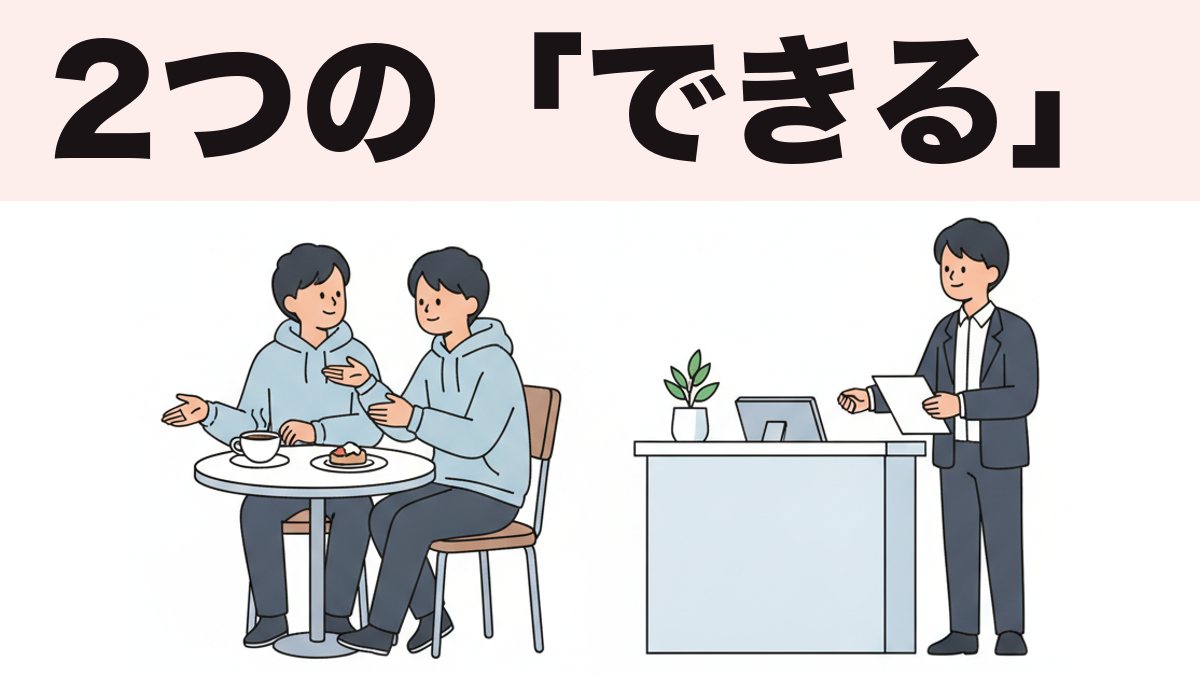
Japanese has two ways to say "I can do it": the potential form (話せます) and ことができます (話すことができます). They mean the same thing, but they are not interchangeable — and one of them quietly changes your particle.
日本語には「〜できる」の言い方が2つあります。可能形(話せます)と、ことができます(話すことができます)です。意味は同じですが、使う場面がちがいます。そして片方は、助詞が静かに変わります。
Textbooks usually teach these a chapter apart, so learners end up with one of them and never find out the other exists. Then they meet a sign or a form that uses the one they skipped. Both are worth owning, and the choice between them is mostly about register, with one grammatical trap hiding underneath.
The basics
What does ことができる literally mean?
Break it apart and there is no word for "can" in it at all:
- こと — a nominalizer: "the act of", "the thing of"
- が — marks that act as the subject
- できる — to be possible, to be doable
So 泳ぐことができます is literally "the act of swimming is possible." It describes an ability as a fact about the world, which is exactly why it reads as formal and slightly detached — it is talking about the action rather than about you.
私は日本語を話すことができます。 — I can speak Japanese. (polite, formal or written register) ここで写真を撮ることができます。 — You can take photos here. (polite, the register signs and notices use)
How do you build it?
Dictionary form + ことができる. Nothing conjugates except できる at the end, which is the easiest verb pattern in the language to attach.
話す → 話すことができる → 話すことができます 食べる → 食べることができる → 食べることができます する → することができる
Because the main verb never changes, this pattern is a genuine safety net: if you have not drilled the potential form yet, you can still express every "I can" sentence you need with a dictionary form you already know.
And the potential form?
The potential form conjugates the verb itself, and it is what people actually say.
| Group | Rule | Examples |
|---|---|---|
| Group 1 (godan, う-verbs) | final う-sound → え-sound + る | 話す → 話せる / 読む → 読める / 泳ぐ → 泳げる / 行く → 行ける |
| Group 2 (ichidan, る-verbs) | drop る, add られる | 食べる → 食べられる / 見る → 見られる |
| Group 3 (irregular) | memorize both | する → できる / 来る → 来られる |
Note that する becomes できる — which is the same できる sitting at the end of ことができる. The two patterns are cousins, not rivals.
私は日本語が話せます。 — I can speak Japanese. (polite, the everyday version) 辛いものが食べられません。 — I can't eat spicy food. (polite negative, extremely common)
Beyond the basics
Which one should you actually use?
The potential form in speech, ことができる in writing and in formal or emphatic moments. That is the whole rule, and it holds up about ninety percent of the time.
If you say 話すことができます to a friend, you sound like you are reading from a brochure. If you write 話せます on an official application, it is not wrong, but ことができます looks more finished. The longer form also adds weight when you want it: 私にもできることがあります lands harder than a bare potential form because it draws attention to the act itself.
英語で説明することができますか。 — Would it be possible to explain in English? (polite, formal — a request to staff or an office) 英語で説明できますか。 — Can you explain in English? (polite, everyday — same meaning, lighter)
The particle changes — this is the real trap
With the potential form, the object usually takes が instead of を. With ことができる, it stays を.
日本語が話せます。 — I can speak Japanese. (potential form takes が) 日本語を話すことができます。 — I can speak Japanese. (ことができる keeps を)
Both を and が are acceptable with the potential form, and you will hear 日本語を話せます from native speakers. But が is the textbook-correct and more natural choice, and it is the one graders and forms expect. Getting this backwards — 日本語がを話すことができます, or dropping が where it belongs — is the single most common error I see on this grammar point.
The reason is structural: in ことができる, the subject slot is already taken by こと, so the object has nowhere to go but を. In the potential form, the ability itself is the predicate, and the thing you are able to do slides into the subject slot.
What happens in casual speech?
The potential form shrinks, and ichidan verbs lose their ら.
辛いもの食べれない。 — I can't eat spicy stuff. (casual — 食べられない with ら dropped) 明日、来れる? — Can you come tomorrow? (casual — 来られる → 来れる)
This is called ら抜き言葉 ("ra-dropping"), and it is everywhere in speech and anime while still being marked as incorrect in writing and in exams. Know it so you can hear it; do not put it in an email. ことができる, by contrast, never contracts — another reason it belongs to the written register. Which situations license the casual version is the usual question, covered in casual vs. polite Japanese.
How do the negative and past work?
Only the ending changes, in both patterns, because できる and られる are both ichidan verbs.
| Potential form | ことができる | |
|---|---|---|
| Present | 話せます | 話すことができます |
| Negative | 話せません | 話すことができません |
| Past | 話せました | 話すことができました |
| Past negative | 話せませんでした | 話すことができませんでした |
去年は日本に行くことができませんでした。 — I wasn't able to go to Japan last year. (polite past negative, formal) チケットが取れなかった。 — I couldn't get a ticket. (casual past negative)
What about 日本語ができる, with no verb at all?
That is a third pattern, and it is the shortest of the three: noun + が + できる, where the verb is implied.
彼は中国語ができます。 — He can speak Chinese. (polite — "speak" is understood) 運転ができません。 — I can't drive. (polite — noun + できる)
This works with nouns that describe an activity — 日本語, 運転, 料理, テニス. It is the most natural way to talk about skills, and it saves you a conjugation entirely.
飲みません or 飲めません — "don't" and "can't" are one letter apart
English uses "I don't drink" for both a choice and an inability, and lets tone sort it out. Japanese puts the difference in the verb, and the two forms are separated by a single vowel.
お酒は飲みません。 — I don't drink. (polite; a choice or a habit — you decline) お酒は飲めません。 — I can't drink. (polite; an inability — your body, your medication, your religion)
The same split runs through every verb you own:
肉を食べません。 — I don't eat meat. (a choice — vegetarian by decision) 肉が食べられません。 — I can't eat meat. (an inability — an allergy, or you simply cannot get it down)
Which one you choose carries real social weight. At a Japanese dinner table 飲めません ends the conversation kindly, because nobody presses someone who physically cannot. 飲みません invites a "just one?" because a choice can be changed. If you want the refusal to stick without explaining yourself, the potential form is the one to reach for.
Notice the particle moving in the second pair: 肉を食べません but 肉が食べられません. That is the same particle shift covered above, and it is the most reliable sign of which form a speaker used when the vowel goes by quickly.
Common mistakes
- Using を with the potential form by default. 日本語を話せます is tolerated; 日本語が話せます is what you want.
- Conjugating the verb inside ことができる. It is 話すことができます, never 話せることができます — that stacks two potentials.
- Using ことができる with a friend. Grammatically fine, socially stiff. Use the potential form.
- Writing ら抜き言葉. 食べれる is fine to say and wrong to write. In anything graded or official, 食べられる.
- Forgetting that する becomes できる. 勉強することができる is correct, but 勉強できる is what people say — and it is not a shortcut, it is the standard form.
- Treating られる as only potential. 食べられる also means "to be eaten" (passive). Context separates them, which is precisely why ことができる exists as an unambiguous alternative.
Practice
Each answer is hidden — work out your version first, then open it. If you get the particle right on every one of these, this grammar point is done.
1. Put 読む into the potential form, polite.
Show answer
読めます — Group 1 verb, so the final む becomes め and you add る: 読む → 読める → 読めます.
2. Fill in the particle: 私は日本語( )話せます。
Show answer
が — 私は日本語が話せます。The potential form pulls the object into the subject slot. を is heard in speech but が is the form to use.
3. Fill in the particle: 私は日本語( )話すことができます。
Show answer
を — 私は日本語を話すことができます。Here こと already occupies the subject slot, so the object keeps を. This is the pair to question 2 — the particle is the only thing that moves.
4. Rewrite 泳げます using ことができます.
Show answer
泳ぐことができます — go back to the dictionary form (泳ぐ), then attach ことができます. Do not start from the potential form: 泳げることができます stacks two potentials and is wrong.
5. Something is wrong here: 明日、来れることができますか。
Show answer
明日、来ることができますか。 — two errors stacked. 来れる is already potential (and is ら抜き言葉 besides), so ことができる on top is doubled. The everyday spoken version would simply be 明日、来られますか。
6. Make it negative, polite: 辛いものを食べる。
Show answer
辛いものが食べられません。 — potential form 食べられる, negative 食べられない, polite 食べられません. Note the particle moved to が. The ことができる version is 辛いものを食べることができません。
7. Say "I couldn't get a ticket" in casual past negative.
Show answer
チケットが取れなかった。 — 取る → 取れる → 取れない → 取れなかった. Only the ending carries the tense; the potential part stays put.
8. Which of these belongs on a public notice: ここで写真を撮れます/ここで写真を撮ることができます?
Show answer
ここで写真を撮ることができます — signs, notices, and forms use the long written form. 撮れます is correct Japanese but reads as conversational for a public notice.
9. Rewrite 運転することができません in the shortest natural way.
Show answer
運転ができません。 — 運転 is an activity noun, so noun + が + できる works and no verb conjugation is needed at all. 運転できません is equally natural.
10. 食べられる has two meanings. What are they, and how would you avoid the ambiguity?
Show answer
"can eat" (potential) and "to be eaten" (passive). Context normally settles it, but when it genuinely matters you use 食べることができる, which can only mean ability. That is the one job the long form does better than the short one.
FAQ
Is ことができる ever wrong where the potential form works? Not grammatically, but it can be socially wrong — it sounds stiff in casual conversation. The reverse is also true: the potential form on a formal application looks unfinished rather than incorrect.
Which should a beginner learn first? ことができる, because nothing conjugates — you attach it to a dictionary form you already know. Then learn the potential form properly, because it is what you will hear.
Is 食べれる really wrong? It is standard in speech and marked as incorrect in writing. Treat it the way you would treat "gonna" in English: recognize it, say it, don't write it.
Why does する become できる instead of しられる? Historical irregularity, like most of Group 3. The upside is that it gives you できる, which then powers both noun + できる and the ことができる pattern — one irregular form doing three jobs.
Can I use ことができる with adjectives? No. こと attaches to verbs here. For "I can be quiet," you need a verb — 静かにすることができます — not the adjective on its own.
Does 〜られる ever attach to a Group 1 verb? Not for the potential. 話される is passive or honorific, not "can speak." Group 1 verbs form the potential with the え-sound: 話せる. Mixing these up is a good reason to keep your te-form and verb groups straight.
Vocabulary from this article
Tap the block to select all of it, then copy. In Anki: File → Import, note type Basic, separator Tab — the first column becomes the front, the second the back.
話す	はなす — to speak
読む	よむ — to read
泳ぐ	およぐ — to swim
食べる	たべる — to eat
行く	いく — to go
来る	くる — to come
見る	みる — to see, to watch
取る	とる — to take, to get (a ticket)
撮る	とる — to take (a photo)
説明する	せつめいする — to explain
運転	うんてん — driving
料理	りょうり — cooking, a dish
写真	しゃしん — photograph
辛い	からい — spicy
去年	きょねん — last year
明日	あした — tomorrow
英語	えいご — English (language)
日本語	にほんご — Japanese (language)
中国語	ちゅうごくご — Chinese (language)
できる	できる — to be able, to be possible
こと	こと — thing, act (nominalizer)
I'm Yuuki, a Japanese teacher based in Tokyo. I've taught on italki as a Top 1% teacher and watched over 1,500 anime, and the particle swap in questions 2 and 3 above is the thing I correct most often on this grammar point — students learn both patterns and then use one pattern's particle with the other's structure.
Sources: the author's own lessons and standard reference grammars.
教科書は、この2つを別の章で教えます。だから多くの人は片方だけを覚えて、もう片方があることを知りません。そのあと、看板や申込書でもう片方に出会います。どちらも持っておく価値があります。えらび方は、ほとんど「かたさ」の問題です。でも下に1つ、文法のわながあります。
基本の形
ことができる の意味は?
分けて考えると、「できる」という意味の言葉は入っていません。
- こと — 動詞を名詞にする言葉。「〜すること」
- が — その「こと」が主語だとしめす
- できる — 可能だ、やれる
だから「泳ぐことができます」は、そのままの意味だと「泳ぐこと が 可能です」です。能力を、世の中の事実のように言っています。だから、かたくて、少し他人ごとのように聞こえます。あなたのことではなく、その動作のことを話しているからです。
私は日本語を話すことができます。 — I can speak Japanese. (ていねい・かたい/書く日本語) ここで写真を撮ることができます。 — You can take photos here. (ていねい・看板やお知らせの形)
作り方は?
辞書の形 + ことができる。最後の「できる」以外は、何も形が変わりません。
話す → 話すことができる → 話すことができます 食べる → 食べることができる → 食べることができます する → することができる
前の動詞が変わらないので、この形は本当の「安全網」です。可能形をまだ練習していなくても、知っている辞書の形だけで、必要な「〜できる」の文が全部言えます。
可能形は?
可能形は、動詞そのものを変えます。そして、人が実際に言うのはこちらです。
| グループ | ルール | 例 |
|---|---|---|
| グループ1(う動詞) | 最後の「う」の音 → 「え」の音 + る | 話す → 話せる / 読む → 読める / 泳ぐ → 泳げる / 行く → 行ける |
| グループ2(る動詞) | 「る」をとって「られる」 | 食べる → 食べられる / 見る → 見られる |
| グループ3(不規則) | 2つ覚える | する → できる / 来る → 来られる |
「する」が「できる」になることに注目してください。これは「ことができる」の最後にある「できる」と同じものです。2つの形は、ライバルではなく親せきです。
私は日本語が話せます。 — I can speak Japanese. (ていねい・ふだんの形) 辛いものが食べられません。 — I can't eat spicy food. (ていねいな否定・とてもよく使う)
もっと深く
どちらを使えばいい?
話すときは可能形。書くときと、かたい場面や強く言いたいときは、ことができる。これでほぼ全部です。
友だちに「話すことができます」と言うと、パンフレットを読んでいるように聞こえます。正式な申込書に「話せます」と書いても、まちがいではありませんが、「ことができます」のほうが仕上がって見えます。長い形は、強く言いたいときにも効きます。「私にもできることがあります」は、動作そのものに目を向けさせるので、可能形だけより重く届きます。
英語で説明することができますか。 — Would it be possible to explain in English? (ていねい・かたい/お店や役所で) 英語で説明できますか。 — Can you explain in English? (ていねい・ふだん/同じ意味で軽い)
助詞が変わる — ここが本当のわな
可能形では、目的語がふつう「を」ではなく「が」になります。「ことができる」では、「を」のままです。
日本語が話せます。 — I can speak Japanese. (可能形は「が」) 日本語を話すことができます。 — I can speak Japanese. (ことができる は「を」のまま)
可能形では「を」も「が」も使えて、日本人も「日本語を話せます」と言います。でも「が」が教科書の正しい形で、より自然です。試験や申込書が求めるのもこちらです。これを逆にしてしまうのが、この文法でいちばん多いまちがいです。
理由は形にあります。「ことができる」では、主語の場所がもう「こと」に取られています。だから目的語は「を」しかありません。可能形では、「できること」自体が述語になるので、できる対象が主語の場所に入ります。
会話では、どうなる?
可能形は短くなります。そして、る動詞は「ら」が落ちます。
辛いもの食べれない。 — I can't eat spicy stuff. (カジュアル・食べられない の「ら」が落ちた形) 明日、来れる? — Can you come tomorrow? (カジュアル・来られる → 来れる)
これを「ら抜き言葉」と言います。話す日本語とアニメではどこにでもありますが、書く日本語と試験ではまちがいとされています。聞いて分かるようにしておいて、メールには書かないでください。「ことができる」は短くなりません。これも、書く日本語のものだという印です。どこで使っていいかは、ていねいな日本語とタメ口の記事 を見てください。
否定と過去は?
どちらの形も、最後だけが変わります。「できる」も「られる」も、る動詞だからです。
| 可能形 | ことができる | |
|---|---|---|
| 今 | 話せます | 話すことができます |
| 否定 | 話せません | 話すことができません |
| 過去 | 話せました | 話すことができました |
| 過去の否定 | 話せませんでした | 話すことができませんでした |
去年は日本に行くことができませんでした。 — I wasn't able to go to Japan last year. (ていねいな過去の否定・かたい) チケットが取れなかった。 — I couldn't get a ticket. (カジュアルな過去の否定)
動詞なしの「日本語ができる」は?
これは3つめの形で、いちばん短いです。名詞 + が + できる。動詞は言いません。
彼は中国語ができます。 — He can speak Chinese. (ていねい・「話す」は言わなくても分かる) 運転ができません。 — I can't drive. (ていねい・名詞 + できる)
活動を表す名詞で使えます(日本語、運転、料理、テニス)。自分のできることを話すのに、いちばん自然な形です。そして動詞の形を変える作業がまるごと要りません。
「飲みません」と「飲めません」— 一文字のちがい
英語は "I don't drink" を、えらんでいない時にも、できない時にも使います。日本語は動詞で分けます。ちがうのは、母音ひとつだけです。
お酒は飲みません。 — I don't drink. (ていねい・えらばない。しゅうかん) お酒は飲めません。 — I can't drink. (ていねい・できない。体・薬・宗教など)
どの動詞でも同じです。
肉を食べません。 — I don't eat meat. (えらんで食べない) 肉が食べられません。 — I can't eat meat. (アレルギーなど、食べられない)
このちがいは、場面でも大きく効きます。日本の食事の席で「飲めません」と言うと、話はやさしく終わります。できない人にはすすめないからです。「飲みません」だと「一杯だけ」と言われます。えらんだことは変えられるからです。説明したくない時は、可能形の方を使ってください。
2つめの組で助詞が動いていることにも注目してください。「肉を食べません」「肉が食べられません」。上で説明した助詞の入れかわりと同じで、速い会話で母音が聞き取れない時、どちらを言ったかはこの助詞で分かります。
よくある間違い
- 可能形にいつも「を」を使う。 「日本語を話せます」は許されますが、ほしいのは「日本語が話せます」です。
- ことができる の中の動詞を変える。 「話すことができます」です。「話せることができます」は可能形が二重で、まちがいです。
- 友だちに ことができる を使う。 文法は正しいですが、かたすぎます。可能形を使ってください。
- ら抜き言葉を書く。 「食べれる」は言うのはよくて、書くのはだめです。試験や正式な文では「食べられる」。
- 「する」が「できる」になるのを忘れる。 「勉強することができる」も正しいですが、人が言うのは「勉強できる」です。これは手抜きではなく、標準の形です。
- 「られる」を可能の意味だけだと思う。 「食べられる」は「食べられてしまう」(受身)の意味にもなります。前後で分かりますが、まさにそのために「ことができる」があります。
練習
答えはかくれています。まず自分の答えを作って、それから開いてください。全部の助詞が合っていれば、この文法はもう大丈夫です。
1. 「読む」をていねいな可能形にしてください。
答えを見る
読めます — グループ1の動詞なので、最後の「む」が「め」になって「る」をつけます。読む → 読める → 読めます。
2. 助詞を入れてください: 私は日本語( )話せます。
答えを見る
が — 私は日本語が話せます。可能形は、目的語を主語の場所に引き寄せます。「を」も聞きますが、使うのは「が」です。
3. 助詞を入れてください: 私は日本語( )話すことができます。
答えを見る
を — 私は日本語を話すことができます。ここでは「こと」がもう主語の場所にいるので、目的語は「を」のままです。2番と組になっていて、動くのは助詞だけです。
4. 「泳げます」を「ことができます」で書きかえてください。
答えを見る
泳ぐことができます — 辞書の形(泳ぐ)にもどして、「ことができます」をつけます。可能形から始めないでください。「泳げることができます」は可能形が二重でまちがいです。
5. ここに間違いがあります: 明日、来れることができますか。
答えを見る
明日、来ることができますか。 — まちがいが2つ重なっています。「来れる」はもう可能形で(しかも ら抜き言葉)、その上に「ことができる」が乗っています。会話なら「明日、来られますか。」で十分です。
6. ていねいな否定にしてください: 辛いものを食べる。
答えを見る
辛いものが食べられません。 — 可能形「食べられる」、否定「食べられない」、ていねい「食べられません」。助詞が「が」に動いていることに注意。「ことができる」版は「辛いものを食べることができません。」です。
7. 「チケットが取れなかった」をカジュアルな過去の否定で言ってください。
答えを見る
チケットが取れなかった。 — 取る → 取れる → 取れない → 取れなかった。時間を持つのは最後だけで、可能形の部分は動きません。
8. お知らせの看板に合うのはどちら: ここで写真を撮れます/ここで写真を撮ることができます?
答えを見る
ここで写真を撮ることができます — 看板、お知らせ、申込書は長い書き言葉の形を使います。「撮れます」も正しい日本語ですが、お知らせとしては会話っぽく読めます。
9. 「運転することができません」を、いちばん短い自然な形に書きかえてください。
答えを見る
運転ができません。 — 「運転」は活動の名詞なので、名詞 + が + できる が使えて、動詞の形を変える必要がありません。「運転できません」も同じくらい自然です。
10. 「食べられる」には意味が2つあります。何と何ですか。まちがいを避けるには?
答えを見る
「食べることができる」(可能)と「食べられてしまう」(受身)です。 ふつうは前後で分かりますが、どうしても大事なときは「食べることができる」を使います。これは可能の意味しかありません。長い形が短い形よりうまくやれる、たった1つの仕事です。
FAQ
可能形が使える場面で、ことができる がまちがいになることはありますか。 文法としてはありません。でも、場面としては合わないことがあります。カジュアルな会話ではかたすぎます。逆も同じで、正式な申込書に可能形を書くと、まちがいではなく「仕上がっていない」感じに見えます。
初級の人は、どちらを先に覚えるべきですか。 「ことができる」です。何も形が変わらないので、もう知っている辞書の形につけるだけです。そのあとで可能形をしっかりやります。実際に耳で聞くのはそちらだからです。
「食べれる」は本当にまちがいですか。 話す日本語では標準で、書く日本語ではまちがいとされています。英語の "gonna" と同じあつかいにしてください。聞いて分かる、言ってもいい、書かない。
なぜ「する」は「しられる」ではなく「できる」になるのですか。 グループ3の多くと同じで、昔からの不規則です。いい面もあります。そのおかげで「できる」が手に入り、それが「名詞+できる」と「ことができる」の両方を動かします。1つの不規則な形が、3つの仕事をしています。
ことができる は形容詞にも使えますか。 使えません。ここでの「こと」は動詞につきます。「静かにできます」と言いたいときは、動詞が必要です(静かにすることができます)。形容詞だけではつけられません。
「〜られる」がグループ1の動詞につくことはありますか。 可能の意味ではありません。「話される」は受身か尊敬で、「話せる」の意味ではありません。グループ1の可能形は「え」の音です(話せる)。ここを混ぜないために、て形と動詞のグループ をはっきりさせておくといいです。
この記事に出た単語
ブロックをタップすると全部選べます。そのままコピーしてください。Anki では ファイル → 読み込み、ノートタイプ 基本、区切り タブ。1列目が表、2列目が裏になります。
話す	はなす — to speak
読む	よむ — to read
泳ぐ	およぐ — to swim
食べる	たべる — to eat
行く	いく — to go
来る	くる — to come
見る	みる — to see, to watch
取る	とる — to take, to get (a ticket)
撮る	とる — to take (a photo)
説明する	せつめいする — to explain
運転	うんてん — driving
料理	りょうり — cooking, a dish
写真	しゃしん — photograph
辛い	からい — spicy
去年	きょねん — last year
明日	あした — tomorrow
英語	えいご — English (language)
日本語	にほんご — Japanese (language)
中国語	ちゅうごくご — Chinese (language)
できる	できる — to be able, to be possible
こと	こと — thing, act (nominalizer)
私はユウキです。東京で日本語を教えています。 italki の Top 1% の先生で、アニメは1,500本以上見ました。上の2番と3番の助詞の入れかえは、この文法でいちばん多く直すところです。2つの形を覚えたあと、片方の助詞をもう片方の形に使ってしまう人がとても多いです。
More drills like the ones above, plus a timed JLPT-style mock test: Practice · N4上のような練習問題と、時間つきのJLPT形式のもぎ試験: 練習ページ · N4
Want to try this in a real conversation?
本当の会話で、ためしてみませんか?
30-minute trial lesson, $13. Times shown in your own timezone.
30分の体験レッスン、$13。時間はあなたのタイムゾーンで表示されます。
Book a trial lesson · $13