難しい and 大変: "difficult" and "tough" are not the same complaint難しいと大変: 同じ「hard」でも、言っていることがちがう
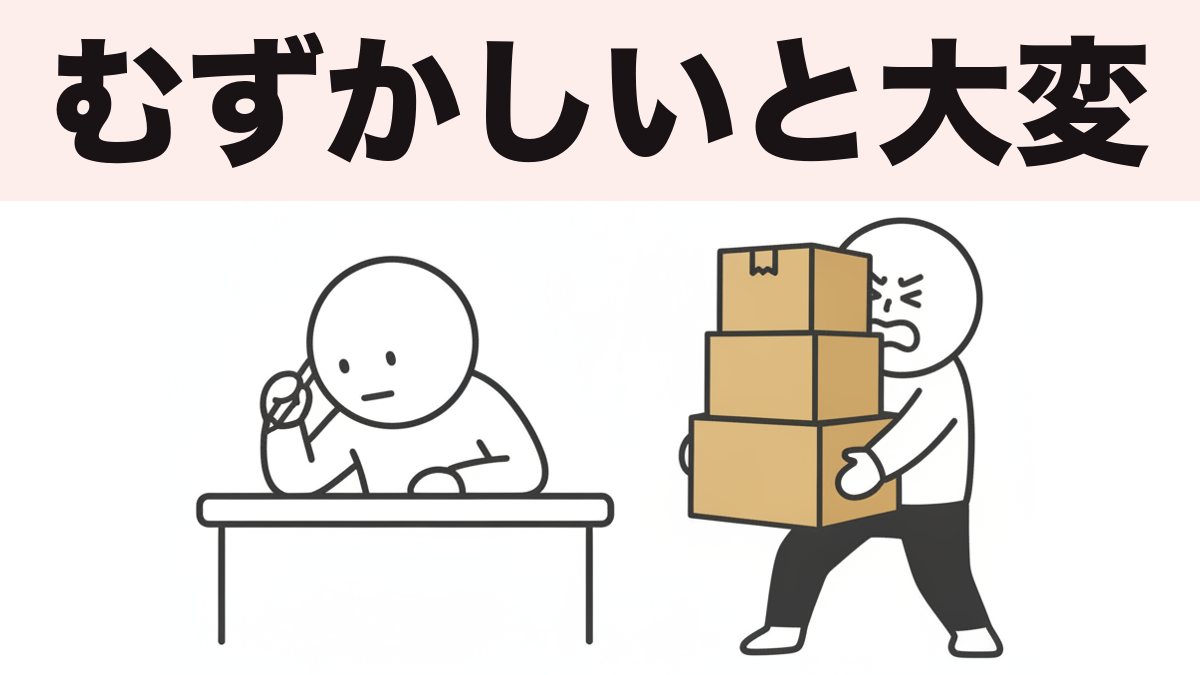
難しい means something is hard to do *correctly* — a skill problem. 大変 means something is hard to *get through* — a burden problem. A task can be one, the other, both, or neither, and choosing wrong changes what you are complaining about.
「難しい」は「正しくやるのがむずかしい」、つまり力の話です。「大変」は「終わらせるのが大変」、つまり量やふたんの話です。一つのことが、どちらか、両方、どちらでもない、のどれにもなります。えらびまちがえると、言いたいことがかわります。
English blurs this with "hard", which covers both. Japanese keeps them apart, and the split shows up constantly: in lessons, at work, and in the sympathy people offer each other. Once you have it, a whole row of related words — ややこしい, 面倒くさい, きつい — slots in around it.
The basics
難しい — hard to do right
A question of skill, understanding or precision. It says the thing requires ability you may not have.
日本語の敬語は難しいです。 — Japanese honorific language is difficult. (polite) この問題は難しかった。 — That question was hard. (casual)
It is an い-adjective: 難しくない, 難しかった, 難しそう. The opposite is 簡単 (かんたん), "easy, simple", which is a な-adjective — a mismatch worth noticing.
大変 — hard to get through
A question of load. It says the thing takes a lot out of you, regardless of whether it requires skill.
引っ越しは大変でした。 — Moving house was a lot. (polite) 子育ては大変です。 — Raising children is hard work. (polite)
Moving boxes is not difficult — anyone can carry a box — but it is unquestionably 大変. That is the distinction in one example.
大変 is also an adverb
Separately from the adjective, 大変 means "very", in formal register.
大変ありがとうございます。 — Thank you very much. (formal, business) 大変申し訳ございません。 — I'm terribly sorry. (formal, apologising)
This is not a different word being confusing — it is the same word doing an intensifier's job, and it appears constantly in customer-facing Japanese.
Beyond the basics
大変 as sympathy
On its own, 大変ですね is a complete, standard response to someone describing a hard situation. It is one of the most useful two-word replies a learner can carry.
大変ですね。 — That sounds rough. (polite — offering sympathy) それは大変でしたね。 — That must have been hard. (polite, past)
Replying 難しいですね to someone's tough week would be strange — it would mean their week required more skill than they had. 大変 is the sympathy word.
ややこしい — complicated, tangled
Not difficulty, but complexity. Something with too many parts that are easy to confuse.
手続きがややこしい。 — The procedure is convoluted. (casual)
A form with fourteen boxes is ややこしい, not 難しい. The distinction matters because ややこしい carries mild irritation — it implies the complexity is unnecessary.
面倒くさい — can't be bothered
The most-used word in this family, and the one textbooks avoid. It describes something as a hassle, and the complaint is about willingness rather than ability.
洗い物が面倒くさい。 — Washing up is such a hassle. (casual) 面倒くさい。 — Ugh, I can't be bothered. (casual — a complete sentence)
It shortens to めんどい in fast speech. Note that it is not polite to use about work someone has asked you to do, for the obvious reason.
きつい — physically or emotionally severe
Harsh, punishing, too much. It covers physical strain, harsh schedules and harsh words.
このスケジュールはきつい。 — This schedule is brutal. (casual)
きつい also means "tight" for clothing — この靴はきつい, "these shoes are too tight" — which is the same idea of pressure applied from outside.
The one that means "sorry, that's a no"
難しい has a second life as a refusal. When a Japanese colleague says a proposal is 難しい, they are usually not describing a technical obstacle.
それはちょっと難しいですね。 — That would be difficult. (polite — in practice, "no")
This is a soft no, and hearing it as an invitation to solve the difficulty is a classic cross-cultural misfire. It belongs to the same family of indirect refusals as ちょっと trailing off, covered in how to say no in Japanese.
When "hard" attaches to a verb ("hard to read", "hard to say"), Japanese uses 〜にくい instead. See 〜やすい and 〜にくい.
Common mistakes
- Using 難しい for a heavy but simple task. Carrying boxes all day is 大変, not 難しい.
- Using 大変 to describe a hard exam question. The question is 難しい; the exam week might be 大変.
- Replying 難しいですね to someone's bad news. The sympathy word is 大変ですね.
- Treating 難しい in a meeting as a technical problem. It is usually a polite refusal.
- Using 面倒くさい about a task someone assigned you. It is honest and it is rude. 大変 is the safe version.
The difficulty scale
| Word | What kind of hard | Example |
|---|---|---|
| 難しい | Hard to do correctly — skill | 敬語は難しい |
| 大変 | Hard to get through — burden | 引っ越しは大変 |
| ややこしい | Complicated, easy to confuse | 手続きがややこしい |
| 面倒くさい | A hassle — willingness | 洗い物が面倒くさい |
| きつい | Severe, punishing | スケジュールがきつい |
| 簡単 | Easy | この問題は簡単 |
FAQ
Which one do I use for learning Japanese? Both, for different parts. 漢字は難しい is about difficulty; 毎日勉強するのは大変 is about the grind.
Is 大変 negative? As an adjective, yes — it describes something demanding. As an adverb it is neutral and formal, just meaning "very".
How do I say "that sounds tough" to a friend? 大変だね casually, 大変ですね politely. Both are complete, natural replies.
Is 面倒くさい rude? It is casual and complaining. Fine with friends about your own chores, risky about anything someone has asked of you.
What is the difference between 難しい and 複雑? 複雑 (ふくざつ) means complex — many interacting parts. It is more neutral and technical than ややこしい, which adds irritation.
If a colleague says 難しいですね, should I offer solutions? Usually not. Treat it as a polite no unless they follow it with an actual obstacle you could remove.
Practice
Build each answer before opening it. Questions 1 and 2 are a pair — the same English word, two different claims.
1. Describe honorific language as difficult.
Show answer
敬語は難しいです — a skill problem. This is the pair to question 2.
2. Describe moving house as hard.
Show answer
引っ越しは大変でした — a burden problem, not a skill problem. This is the pair to question 1.
3. A friend describes a terrible week. Reply with sympathy.
Show answer
大変だね(polite: 大変ですね)— 難しいですね would say their week required skill they lacked.
4. Say "the procedure is convoluted."
Show answer
手続きがややこしい — too many confusable parts, with a note of irritation.
5. Say "washing up is such a hassle," casually.
Show answer
洗い物が面倒くさい — about willingness, not ability.
6. Say "this schedule is brutal."
Show answer
このスケジュールはきつい — きつい is severity, and it also means "tight" for clothes.
7. Thank a customer very formally.
Show answer
大変ありがとうございます — here 大変 is an adverb meaning "very".
8. A colleague says それはちょっと難しいですね. What did they mean?
Show answer
No — it is a polite refusal, not a request for help solving a problem.
9. What is the opposite of 難しい?
Show answer
簡単(かんたん) — note it is a な-adjective while 難しい is an い-adjective.
10. Something is wrong here: 箱を一日運んで、難しかった。
Show answer
箱を一日運んで、大変だった — carrying boxes takes no skill. It is a burden, so 大変.
Vocabulary from this article
Tap the block to select all of it, then copy. In Anki: File → Import, note type Basic, separator Tab — the first column becomes the front, the second the back.
難しい	むずかしい — difficult (skill)
大変	たいへん — tough, demanding; very
簡単	かんたん — easy, simple
ややこしい	ややこしい — convoluted, confusing
面倒くさい	めんどうくさい — a hassle, bothersome
きつい	きつい — severe, harsh; tight
複雑	ふくざつ — complex
敬語	けいご — honorific language
引っ越し	ひっこし — moving house
手続き	てつづき — procedure, paperwork
子育て	こそだて — raising children
問題	もんだい — problem, question
洗い物	あらいもの — washing up
運ぶ	はこぶ — to carry
箱	はこ — box
靴	くつ — shoes
I'm Yuuki, a Japanese teacher based in Tokyo. I've taught on italki as a Top 1% teacher and watched over 1,500 anime. 大変ですね is the reply I most want students to have ready — it is two words, it is always appropriate, and it is what a Japanese conversation expects when someone has just told you something hard.
Sources: the author's own lessons and standard reference grammars.
英語はどちらも "hard" です。日本語は分けます。レッスンでも、しごとでも、人をなぐさめるときにも出ます。これが分かると、「ややこしい」「面倒くさい」「きつい」も自然に入ってきます。
基本
難しい
力・りかい・せいかくさの話です。「できる力がいる」という意味です。
日本語の敬語は難しいです。 — Japanese honorific language is difficult. (polite) この問題は難しかった。 — That question was hard. (casual)
「い」の形容詞です。「難しくない」「難しかった」「難しそう」。反対は「簡単(かんたん)」で、こちらは「な」の形容詞です。
大変
量・ふたんの話です。「力がいるかどうか」は関係ありません。
引っ越しは大変でした。 — Moving house was a lot. (polite) 子育ては大変です。 — Raising children is hard work. (polite)
はこを運ぶのは、むずかしくありません。だれでもできます。でも「大変」です。これがちがいです。
「大変」は副詞にもなる
形容詞とはべつに、「とても」という意味でも使います。かたい言い方です。
大変ありがとうございます。 — Thank you very much. (formal, business) 大変申し訳ございません。 — I'm terribly sorry. (formal, apologising)
お客さまに使う日本語でよく出ます。
もう少しくわしく
なぐさめの「大変」
「大変ですね」だけで、りっぱな返事になります。とても役に立つ二語です。
大変ですね。 — That sounds rough. (polite — offering sympathy) それは大変でしたね。 — That must have been hard. (polite, past)
つらい一週間の話に「難しいですね」と言うと、へんです。「あなたには力がたりなかった」という意味になります。
ややこしい
むずかしさではなく、ふくざつさです。部分が多くて、まちがえやすいものです。
手続きがややこしい。 — The procedure is convoluted. (casual)
らんが十四こあるようしは「ややこしい」です。少しイライラした気もちが入ります。
面倒くさい
この中でいちばんよく使う言葉です。教科書には出ません。「やりたくない」という意味です。
洗い物が面倒くさい。 — Washing up is such a hassle. (casual) 面倒くさい。 — Ugh, I can't be bothered. (casual — a complete sentence)
はやい会話では「めんどい」になります。人にたのまれたしごとには使わない方がいいです。
きつい
体にも心にもきびしい、という意味です。
このスケジュールはきつい。 — This schedule is brutal. (casual)
服や靴の「きつい」も同じ言葉です。「外から力がかかる」という意味です。
ことわる「難しい」
「難しい」には、もう一つの使い方があります。しごとの場面で「難しいですね」と言われたら、たいてい「できません」という意味です。
それはちょっと難しいですね。 — That would be difficult. (polite — in practice, "no")
やわらかい「いいえ」です。「では、どうすればできますか」と返すのは、よくあるすれちがいです。→ 「いいえ」の言い方
よくあるまちがい
- 重いだけのしごとに「難しい」を使う。 はこを運ぶのは「大変」です。
- しけんの問題に「大変」を使う。 問題は「難しい」、しけんの一週間は「大変」です。
- わるい知らせに「難しいですね」と返す。 なぐさめは「大変ですね」です。
- 会議の「難しい」をぎじゅつの話だと思う。 たいていことわりです。
- たのまれたしごとに「面倒くさい」を使う。 正直ですが、失礼です。
むずかしさの表
| 言葉 | どんな「hard」 | 例 |
|---|---|---|
| 難しい | 正しくやるのがむずかしい(力) | 敬語は難しい |
| 大変 | 終わらせるのが大変(ふたん) | 引っ越しは大変 |
| ややこしい | ふくざつで、まちがえやすい | 手続きがややこしい |
| 面倒くさい | やりたくない | 洗い物が面倒くさい |
| きつい | きびしい | スケジュールがきつい |
| 簡単 | かんたん | この問題は簡単 |
よくある質問
日本語の勉強はどちら? 両方です。「漢字は難しい」はむずかしさ、「毎日勉強するのは大変」はふたんです。
「大変」はマイナスの言葉? 形容詞のときはそうです。副詞のときは「とても」で、ふつうです。
友だちに「つらそうだね」と言うには? 「大変だね」、丁寧には「大変ですね」です。
「面倒くさい」は失礼? 自分のことならだいじょうぶです。たのまれたことには使わない方がいいです。
「難しい」と「複雑」のちがいは? 「複雑(ふくざつ)」は部分が多いという意味です。「ややこしい」よりおちついた言葉です。
同りょうが「難しいですね」と言ったら? たいていことわりです。ぐたいてきなもんだいを言わないかぎり、そう考えてください。
練習
答えを見る前に、自分で作ってください。1番と2番はペアです。
1. 敬語は「むずかしい」と言う。
答えを見る
敬語は難しいです — 力の話です。2番とペアです。
2. 引っ越しは「大変だった」と言う。
答えを見る
引っ越しは大変でした — ふたんの話です。1番とペアです。
3. 友だちのつらい一週間の話に返事をする。
答えを見る
大変だね(丁寧なら「大変ですね」)— 「難しいですね」はへんです。
4. 「手続きがふくざつだ」と言う。
答えを見る
手続きがややこしい — まちがえやすく、少しイライラした言い方です。
5. 「洗い物がいやだ」とカジュアルに言う。
答えを見る
洗い物が面倒くさい — 力ではなく、気もちの話です。
6. 「このスケジュールはきびしい」と言う。
答えを見る
このスケジュールはきつい — 服や靴にも使います。
7. お客さまにとても丁寧にお礼を言う。
答えを見る
大変ありがとうございます — ここの「大変」は「とても」です。
8. 同りょうが「それはちょっと難しいですね」と言いました。意味は?
答えを見る
できません — やわらかいことわりです。
9. 「難しい」の反対は?
答えを見る
簡単(かんたん) — 「な」の形容詞です。
10. まちがいをなおす: 箱を一日運んで、難しかった。
答えを見る
箱を一日運んで、大変だった — はこを運ぶのに力はいりません。ふたんです。
この記事に出た単語
上のブロックをタップしてぜんぶ選んで、コピーしてください。Ankiでは ファイル → インポート、ノートタイプは 基本、区切りは タブ です。左が表、右がうらになります。
難しい	むずかしい — difficult (skill)
大変	たいへん — tough, demanding; very
簡単	かんたん — easy, simple
ややこしい	ややこしい — convoluted, confusing
面倒くさい	めんどうくさい — a hassle, bothersome
きつい	きつい — severe, harsh; tight
複雑	ふくざつ — complex
敬語	けいご — honorific language
引っ越し	ひっこし — moving house
手続き	てつづき — procedure, paperwork
子育て	こそだて — raising children
問題	もんだい — problem, question
洗い物	あらいもの — washing up
運ぶ	はこぶ — to carry
箱	はこ — box
靴	くつ — shoes
More drills like the ones above, plus a timed JLPT-style mock test: Practice · N4上のような練習問題と、時間つきのJLPT形式のもぎ試験: 練習ページ · N4
Want to try this in a real conversation?
本当の会話で、ためしてみませんか?
30-minute trial lesson, $13. Times shown in your own timezone.
30分の体験レッスン、$13。時間はあなたのタイムゾーンで表示されます。
Book a trial lesson · $13