Transitive and intransitive verbs: 開ける vs 開く, and why Japanese prefers the second他動詞と自動詞: 開ける と 開く、そして日本語が後ろを好む理由
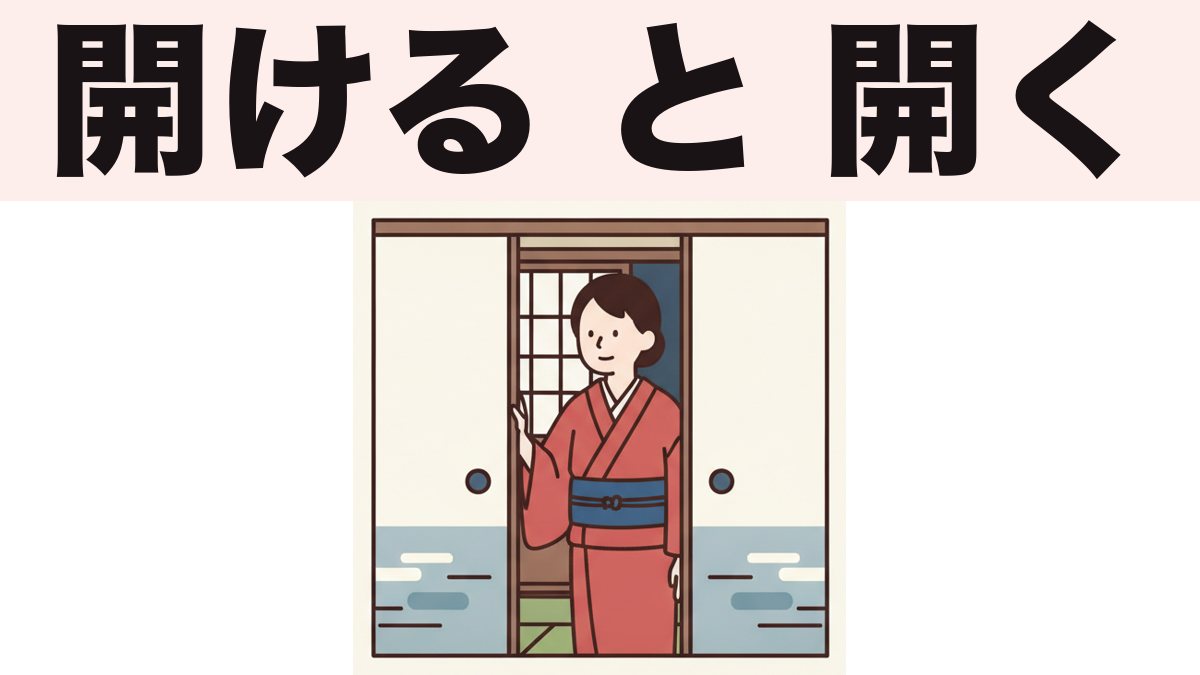
Japanese splits into pairs what English does with one verb. 開ける is "to open something" and 開く is "for something to open" — and the choice is not stylistic. One takes を and names a person; the other takes が and does not. Japanese reaches for the second far more often than English does.
英語が1つの動詞でやることを、日本語は2つに分けます。「開ける」は「何かを開ける」、「開く」は「何かが開く」です。えらび方は好みではありません。一方は「を」をとって人を出し、もう一方は「が」をとって人を出しません。そして日本語は、英語よりずっと後ろの方をよく使います。
There are around three hundred of these pairs, and no rule predicts them perfectly. But there are strong patterns, and there is one insight that makes the whole category make sense: Japanese would often rather say that something happened than say who did it.
The basics
The two kinds
他動詞 (transitive) — someone does it to something. Takes を. 自動詞 (intransitive) — it happens. Takes が.
私がドアを開けました。 — I opened the door. (を — I did it) ドアが開きました。 — The door opened. (が — it happened)
Both sentences are natural Japanese. English has to work harder to get the second one — "the door opened" sounds slightly odd unless something dramatic is going on — whereas in Japanese it is the more ordinary sentence of the two.
The pairs you will meet first
| Transitive (を) | Intransitive (が) | Meaning |
|---|---|---|
| 開ける | 開く | open |
| 閉める | 閉まる | close |
| 始める | 始まる | begin |
| つける | つく | turn on |
| 消す | 消える | turn off, disappear |
| 入れる | 入る | put in / go in |
| 出す | 出る | take out / go out |
| 止める | 止まる | stop |
| 落とす | 落ちる | drop / fall |
| 決める | 決まる | decide / be decided |
| 変える | 変わる | change |
| 直す | 直る | fix / be fixed |
| 割る | 割れる | break |
| 見つける | 見つかる | find / be found |
電気をつけてください。 — Please turn on the light. (transitive) 電気がつきました。 — The light came on. (intransitive)
The endings that hint at which is which
No rule covers every pair, but three patterns cover most of them.
| Pattern | Usually | Example |
|---|---|---|
| ends in -す | transitive | 出す, 消す, 落とす, 直す |
| ends in -aru | intransitive | 閉まる, 始まる, 決まる, 変わる |
| ends in -eru paired with -aru | transitive | 閉める, 始める, 決める, 変える |
So if you meet a new verb ending in す, bet transitive. If it ends in ある-shaped -aru, bet intransitive. You will be right most of the time, and wrong often enough that you should still learn them in pairs.
Beyond the basics
Japanese prefers the intransitive
This is the cultural half, and it is why the category matters beyond a conjugation table.
お皿が割れました。 — The plate broke. (the normal thing to say) お皿を割りました。 — I broke the plate. (an admission)
Both are correct. The first is what you say when a plate breaks. The second specifically puts you in it, and it is closer to a confession than a description. Where English says "I broke your glass," Japanese will often say グラスが割れちゃって… — "the glass broke, and…" — and everyone understands what happened without anyone naming a culprit.
This is not evasiveness so much as a different default. Japanese describes situations; English assigns agents. Once you notice it, a lot of sentences that seemed oddly passive start making sense.
〜ている and 〜てある split along the same line
The two forms that describe states pick different halves of the pair.
ドアが開いている。 — The door is open. (intransitive + ている — just describing it) ドアが開けてある。 — The door has been opened. (transitive + てある — someone did it deliberately)
〜てある always uses the transitive verb and implies intention and preparation. 〜ている with the intransitive just reports the state. This is the same split covered in 〜ている, and the verb pairs are what make it possible.
窓が閉まっています。 — The window is closed. 窓が閉めてあります。 — The window has been closed (by someone, on purpose).
Watch what happens to the particle
The particle flips with the verb, and it is the fastest way to check yourself.
✗ ドアを開きました。 。○ ドアが開きました。 — The door opened. ○ ドアを開けました。 — I opened the door.
を with an intransitive verb is the classic error. If the verb is the "it happens" one, the thing takes が, and there is no を in the sentence at all. This is the same が territory as ある and いる.
There is one genuine exception worth knowing: verbs of motion take を for the path travelled — 公園を歩く ("walk through the park"), 橋を渡る ("cross the bridge"). That を is not an object; it marks a route.
How does it sound in anime?
The intransitive forms carry a lot of dramatic narration, precisely because they describe events with no visible agent:
ドアが開いた。 — The door opened. 火が消えた。 — The fire went out. 何かが変わった。 — Something changed.
Each of those would need an agent in English, or a passive. Japanese just lets the event be an event. It is one of the reasons Japanese narration can feel atmospheric in a way that is genuinely hard to translate — nothing is being done to anything; things are simply happening.
Common mistakes
- ドアを開きました. Intransitive verbs take が, not を. 開く is "it opens."
- 電気をつく. つく is intransitive. To turn a light on, つける: 電気をつける.
- Learning them one at a time. Always learn the pair. Half a pair is worse than useless, because it feels like you know the verb.
- Assuming the transitive version is the normal one. In Japanese the intransitive is often the default, especially for accidents and for anything you would rather not confess to.
- Using 〜てある with the intransitive. 開いてある is not a thing; it is either 開いている or 開けてある.
- Reading を with 歩く or 渡る as an object. That を marks a path, not a thing being acted on.
Practice
Answers are hidden — build yours first, then open. Questions 1 and 2 are a pair: one door, two ways of describing what happened to it.
1. Say "I opened the door."
Show answer
ドアを開けました — 開ける is transitive, so the door takes を and you are the one doing it.
2. Say "the door opened."
Show answer
ドアが開きました — 開く is intransitive, so the door takes が and nobody is named. This is the pair to question 1: same event, and Japanese usually prefers this one.
3. Something is wrong here: ドアを開きました。
Show answer
ドアが開きました or ドアを開けました — を with an intransitive verb is the classic error. Pick the verb, and the particle follows.
4. Say "please turn on the light."
Show answer
電気をつけてください — つける is the transitive one. つく is "it comes on": 電気がつきました.
5. A new verb ends in す. Transitive or intransitive?
Show answer
Probably transitive — 出す, 消す, 落とす, 直す. Verbs in -aru (閉まる, 始まる, 決まる) are usually intransitive. Not a perfect rule, but a good bet.
6. You broke a plate. What would a Japanese speaker normally say?
Show answer
お皿が割れました — the intransitive. お皿を割りました is correct but specifically puts you in it, closer to a confession than a description.
7. What is the difference between ドアが開いている and ドアが開けてある?
Show answer
Whether someone did it on purpose — 開いている (intransitive + ている) just reports the door is open. 開けてある (transitive + てある) says someone opened it and left it that way deliberately.
8. Something is wrong here: ドアが開いてあります。
Show answer
開いています or 開けてあります — 〜てある always takes the transitive verb. 〜ている takes the intransitive.
9. Why does 公園を歩く have を with an intransitive verb?
Show answer
That を marks a path, not an object — verbs of motion use it for the route travelled: 橋を渡る, 道を走る. It is a different を entirely.
10. Why does Japanese narration feel so agentless?
Show answer
The intransitive is often the default — 火が消えた, 何かが変わった. Japanese describes situations; English assigns agents. The verb pairs are what make that possible.
FAQ
How many pairs do I need to learn? The fourteen in the table above cover most daily situations. Beyond that, learn each new pair when you meet it — and always both halves at once, because half a pair will let you build a sentence that is confidently wrong.
Is there a real rule, or just patterns? Just patterns, unfortunately. The pairs come from Old Japanese morphology that has been worn down over centuries, so the endings rhyme without being predictable. Native speakers learn them as vocabulary too.
Why does English not have this? It does, in a few places — "raise" and "rise," "lay" and "lie," "fell" and "fall." Speakers famously mix those up, which is a fair preview of how this feels. Japanese simply has three hundred of them and keeps them straight.
Does the passive relate to this? It overlaps. Where English uses a passive to avoid naming an agent, Japanese often reaches for an intransitive verb instead: ドアが開いた rather than "the door was opened." The passive exists too, and it carries a different feel — often one of being affected.
Which one goes with 自分で? The transitive: 自分でドアを開けました ("I opened the door myself"). 自分で means you personally did it, so it needs the verb that names a doer.
What about 見つける and 見つかる? A useful pair precisely because English collapses them: 見つけました is "I found it," 見つかりました is "it was found" or "it turned up." When a lost item surfaces, Japanese uses the second — the item did the surfacing.
Vocabulary from this article
Tap the block to select all of it, then copy. In Anki: File → Import, note type Basic, separator Tab — the first column becomes the front, the second the back.
開ける	あける — to open (something)
開く	あく — to open (by itself)
閉める	しめる — to close (something)
閉まる	しまる — to close (by itself)
始める	はじめる — to begin (something)
始まる	はじまる — to begin (by itself)
消す	けす — to turn off, to erase
消える	きえる — to go out, to disappear
入れる	いれる — to put in
入る	はいる — to go in
出す	だす — to take out
出る	でる — to go out
止める	とめる — to stop (something)
止まる	とまる — to stop (by itself)
落とす	おとす — to drop
落ちる	おちる — to fall
割る	わる — to break (something)
割れる	われる — to break (by itself)
見つける	みつける — to find
見つかる	みつかる — to be found
他動詞	たどうし — transitive verb
自動詞	じどうし — intransitive verb
電気	でんき — light, electricity
皿	さら — plate
渡る	わたる — to cross
I'm Yuuki, a Japanese teacher based in Tokyo. I've taught on italki as a Top 1% teacher and watched over 1,500 anime. This is the category where learners suddenly sound native or suddenly do not — because saying お皿を割りました when everyone else would say 割れました is grammatically perfect and socially louder than you meant.
Sources: the author's own lessons and standard reference grammars.
このペアは300くらいあって、完ぺきに予想できるルールはありません。でも強いパターンはありますし、1つ分かると全部が分かることがあります。日本語は「だれがやったか」より「何が起きたか」を言いたがる、ということです。
基本
2つの種類
他動詞 — だれかが何かにする。「を」をとります。 。自動詞 — それが起きる。「が」をとります。
私がドアを開けました。 — I opened the door. (「を」— 私がやりました) ドアが開きました。 — The door opened. (「が」— 起きました)
どちらも自然な日本語です。英語は2つめが言いにくくて、"the door opened" は少し変に聞こえます。日本語では、こちらの方がふつうの文です。
はじめに出会うペア
| 他動詞(を) | 自動詞(が) | 意味 |
|---|---|---|
| 開ける | 開く | open |
| 閉める | 閉まる | close |
| 始める | 始まる | begin |
| つける | つく | turn on |
| 消す | 消える | turn off, disappear |
| 入れる | 入る | put in / go in |
| 出す | 出る | take out / go out |
| 止める | 止まる | stop |
| 落とす | 落ちる | drop / fall |
| 決める | 決まる | decide |
| 変える | 変わる | change |
| 直す | 直る | fix |
| 割る | 割れる | break |
| 見つける | 見つかる | find |
電気をつけてください。 — Please turn on the light. 電気がつきました。 — The light came on.
見分けるヒントになる語び
全部には当てはまりませんが、3つのパターンでほとんどカバーできます。
| 形 | だいたい | 例 |
|---|---|---|
| -す で終わる | 他動詞 | 出す・消す・落とす・直す |
| -aru で終わる | 自動詞 | 閉まる・始まる・決まる・変わる |
| -eru(-aru と対) | 他動詞 | 閉める・始める・決める・変える |
新しい動詞が「す」で終わっていたら他動詞、「〜ある」の形なら自動詞、と考えてください。だいたい当たります。でもはずれることもあるので、やっぱりペアで覚えてください。
もう少し先へ
日本語は自動詞を好みます
ここが文法表より大事な半分です。
お皿が割れました。 — The plate broke. (ふつうの言い方) お皿を割りました。 — I broke the plate. (じぶんのせいだと言っています)
どちらも正しいです。でも、お皿がわれた時に言うのは1つめです。2つめは自分を入れるので、せつめいというより告白に近いです。英語が "I broke your glass" と言うところで、日本語は「グラスが割れちゃって…」と言います。だれの名前も出ないのに、何があったかはみんな分かります。
これはごまかしではなく、ちがう出発点です。日本語は「じょうきょう」を書き、英語は「だれがやったか」を書きます。気づくと、変に受け身に見えていた文が分かるようになります。
〜ている と 〜てある も、同じ線で分かれます
状たいを表す2つの形が、ペアのちがう方を使います。
ドアが開いている。 — The door is open. (自動詞+ている・見たまま) ドアが開けてある。 — The door has been opened. (他動詞+てある・だれかがわざと)
「〜てある」はいつも他動詞で、「じゅんびした」という意味が入ります。「〜ている」は自動詞で、状たいを言うだけです。このペアがあるから、その区べつができます。
窓が閉まっています。 — The window is closed. 窓が閉めてあります。 — The window has been closed (だれかが、わざと)。
助詞を見れば分かります
動詞といっしょに助詞が変わります。自分でたしかめるのに、いちばん早い方法です。
✗ ドアを開きました。 。○ ドアが開きました。 — The door opened. ○ ドアを開けました。 — I opened the door.
自動詞に「を」をつけるのが、いちばん多い間ちがいです。「起きる」方の動詞なら、そのものは「が」で、文の中に「を」はありません。
1つだけ本当のれいがいがあります。動く動詞は、通る道に「を」をつけます。「公園を歩く」「橋を渡る」。この「を」は目的語ではなく、道を表しています。
アニメではどう聞こえますか?
自動詞は、ナレーションによく出ます。だれがやったか出さずに、できごとを書けるからです。
ドアが開いた。 — The door opened. 火が消えた。 — The fire went out. 何かが変わった。 — Something changed.
英語なら、だれかを出すか、受け身にしないといけません。日本語は、できごとをできごとのままにできます。日本語のナレーションが訳しにくい理由の1つです。何もだれかにされていなくて、ただ起きています。
よくある間違い
- ドアを開きました。 自動詞は「が」です。「開く」は「それが開く」です。
- 電気をつく。 「つく」は自動詞です。「電気をつける」にします。
- 1つずつ覚えること。 いつもペアで覚えてください。半分だけだと、知っているつもりになって、あぶないです。
- 他動詞がふつうだと思うこと。 日本語では自動詞がふつうのことが多いです。とくに事この時です。
- 自動詞に「〜てある」。 「開いてある」はありません。「開いている」か「開けてある」です。
- 「公園を歩く」の「を」を目的語だと思うこと。 これは道の「を」です。
練習
答えはかくれています。まず自分の答えを作ってから開いてください。1番と2番は対になっています。
1. 「私がドアを開けた」と言ってください。
答えを見る
ドアを開けました — 「開ける」は他動詞なので、ドアが「を」で、やったのは自分です。
2. 「ドアが開いた」と言ってください。
答えを見る
ドアが開きました — 「開く」は自動詞なので、ドアが「が」で、だれも出ません。1番と対で、日本語はふつうこちらを使います。
3. 直してください: ドアを開きました。
答えを見る
ドアが開きました/ドアを開けました — 自動詞に「を」はつきません。動詞を決めれば、助詞も決まります。
4. 「電気をつけてください」と言ってください。
答えを見る
電気をつけてください — 「つける」が他動詞です。「つく」は「ついた」で、「電気がつきました」です。
5. 新しい動詞が「す」で終わっています。他動詞ですか、自動詞ですか。
答えを見る
たぶん他動詞です — 出す・消す・落とす・直す。「-aru」なら自動詞(閉まる・始まる・決まる)です。完ぺきなルールではありませんが、よく当たります。
6. お皿をわってしまいました。日本の人はふつう何と言いますか。
答えを見る
お皿が割れました — 自動詞です。「お皿を割りました」も正しいですが、自分を入れるので、せつめいより告白に近くなります。
7. 「ドアが開いている」と「ドアが開けてある」はどうちがいますか。
答えを見る
わざとかどうか — 「開いている」は見たままです。「開けてある」は、だれかが開けて、そのままにしました。
8. 直してください: ドアが開いてあります。
答えを見る
開いています/開けてあります — 「〜てある」はいつも他動詞、「〜ている」は自動詞です。
9. 「公園を歩く」の「を」は何ですか。
答えを見る
道の「を」です — 動く動詞は、通る道に「を」をつけます。「橋を渡る」「道を走る」。目的語ではありません。
10. 日本語のナレーションに「だれが」が出ないのはなぜですか。
答えを見る
自動詞がふつうだからです — 火が消えた、何かが変わった。日本語はじょうきょうを書き、英語はだれがやったかを書きます。
よくある質問
いくつ覚えればいいですか。 上の表の14組で、毎日の場面はほとんどカバーできます。あとは出会うたびに、必ず両方いっしょに覚えてください。
本当のルールはありますか。 パターンだけです。古い日本語の形が、長い時間でけずられてできたペアなので、音はにていても予想はできません。日本の人もことばとして覚えています。
英語にはないのですか。 少しあります。"raise / rise"、"lay / lie"、"fell / fall"。英語の人もよくまちがえます。日本語はそれが300組ある、というだけです。
受け身と関係ありますか。 重なります。英語が「だれがやったか」をかくすために受け身を使うところで、日本語は自動詞を使うことが多いです。受け身もありますが、「えいきょうを受けた」という気もちが入ります。
「自分で」といっしょに使うのはどちらですか。 他動詞です。「自分でドアを開けました」。「自分で」は「その人がやった」なので、人を出す動詞が必要です。
「見つける」と「見つかる」はどうですか。 英語が1つにしているので、役に立つペアです。「見つけました」は「私が見つけた」、「見つかりました」は「出てきた」です。なくしたものが出てきた時は、2つめを使います。
この記事に出た単語
ブロックをタップすると全部選べます。そのままコピーしてください。Anki では ファイル → 読み込み、ノートタイプ 基本、区切り タブ。1列目が表、2列目が裏になります。
開ける	あける — to open (something)
開く	あく — to open (by itself)
閉める	しめる — to close (something)
閉まる	しまる — to close (by itself)
始める	はじめる — to begin (something)
始まる	はじまる — to begin (by itself)
消す	けす — to turn off, to erase
消える	きえる — to go out, to disappear
入れる	いれる — to put in
入る	はいる — to go in
出す	だす — to take out
出る	でる — to go out
止める	とめる — to stop (something)
止まる	とまる — to stop (by itself)
落とす	おとす — to drop
落ちる	おちる — to fall
割る	わる — to break (something)
割れる	われる — to break (by itself)
見つける	みつける — to find
見つかる	みつかる — to be found
他動詞	たどうし — transitive verb
自動詞	じどうし — intransitive verb
電気	でんき — light, electricity
皿	さら — plate
渡る	わたる — to cross
私はユウキです。東京で日本語を教えています。 italki の Top 1% の先生で、アニメは1,500本以上見ました。ここは、急に日本語らしく聞こえるか、急にそうでなくなるかの分かれ目です。みんなが「割れました」と言う場面で「お皿を割りました」と言うと、文法は完ぺきなのに、思ったより大きな声になってしまいます。
More drills like the ones above, plus a timed JLPT-style mock test: Practice · N4上のような練習問題と、時間つきのJLPT形式のもぎ試験: 練習ページ · N4
Want to try this in a real conversation?
本当の会話で、ためしてみませんか?
30-minute trial lesson, $13. Times shown in your own timezone.
30分の体験レッスン、$13。時間はあなたのタイムゾーンで表示されます。
Book a trial lesson · $13