書き言葉 and 話し言葉: the Japanese you speak is not the Japanese you write書き言葉と話し言葉: 話す日本語と書く日本語はちがう
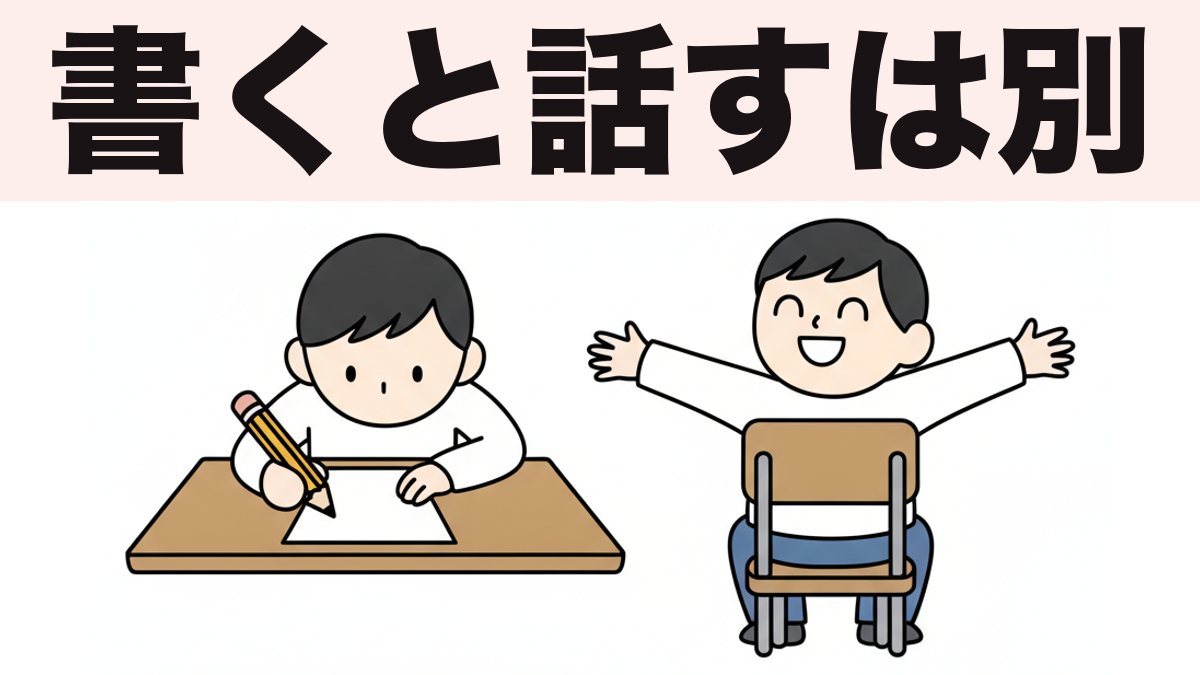
Japanese separates writing and speech far more sharply than English does, and the gap is not about politeness — a です/ます essay can still be full of spoken Japanese.
日本語は、話すことばと書くことばを英語よりずっとはっきり分けます。これは「ていねいさ」の話ではありません。「です・ます」で書いても、中身が話しことばのことがあります。
This catches learners late. You spend two years getting comfortable in conversation, then write your first essay or a real email, and a Japanese reader says it sounds childish or chatty without being able to say exactly why. The reason is almost never grammar mistakes. It is that a set of words you use fifty times a day belongs to 話し言葉 (spoken language) and has a written twin you have never been taught.
The basics
What actually separates 書き言葉 from 話し言葉?
Not formality. Politeness is the です/だ axis, described in です and だ — that is about who you are talking to. 書き言葉 vs 話し言葉 is about which channel the sentence travels down, and the two axes are independent.
That means all four combinations exist:
明日行きますね。 — I'll go tomorrow, okay? (polite, but pure spoken Japanese — ね does not survive into writing) 明日伺う予定である。 — I am scheduled to visit tomorrow. (plain form, but unmistakably written)
A polite spoken sentence is not automatically a good written one. That is the whole problem in one line.
The four habits that give a learner away
Almost every "this reads as spoken" correction comes from one of these four:
- Contractions. 〜てる for 〜ている, 〜ちゃう for 〜てしまう, 〜なきゃ for 〜なければ.
- Conversational connectives. でも, だから, じゃあ, それで.
- Sentence-final particles. ね, よ, かな, さ.
- Casual intensifiers. すごく, ちょっと, いっぱい, めっちゃ.
すごく面白いと思うけど、でも高いんですよね。 — It's really interesting, but it's expensive though. (spoken, and fine in speech) 非常に興味深いが、価格が高い。 — It is highly interesting, but the price is high. (written)
Same sentence, same meaning, same opinion. Nothing became more polite. It became written.
The conversion list you actually need
| Spoken 話し言葉 | Written 書き言葉 | English |
|---|---|---|
| でも | しかし/だが | but |
| だから | したがって/そのため | therefore |
| じゃあ/じゃ | では | well then |
| けど/けれど | が | although |
| 〜から(reason) | 〜ため | because |
| すごく/とても | 非常に | very |
| ちょっと | 少し | a little |
| いっぱい/たくさん | 多く | many |
| だんだん | 次第に | gradually |
| もっと | さらに | more |
| いろんな | さまざまな | various |
| みたいな | のような | like, such as |
| 〜てる | 〜ている | -ing |
| 〜ちゃう | 〜てしまう | end up -ing |
| 〜なきゃ | 〜なければ | must |
| やっぱり | やはり | as expected |
| どっち | どちら | which |
Most of these are one-for-one swaps you can do at the end, like a spell check. The 〜から to 〜ため swap is the one that changes the grammar around it — see から and ので for what each one is doing in the first place.
Beyond the basics
です/ます or だ/である?
An essay, a report or an article normally uses である体 — the plain form with である for the copula. A letter, an email or a school composition normally uses です/ます体. What you must not do is mix them inside one text.
アニメは日本の重要な輸出産業である。 — Anime is an important Japanese export industry. (である体, essay) アニメは日本の重要な輸出産業です。 — Same sentence. (です体, letter or blog)
Pick one before you start writing and hold it to the end. Switching mid-text is the single most visible structural error in student essays, and unlike vocabulary it is not something a reader can charitably ignore.
ら抜き and い抜き: the two missing letters
Spoken Japanese quietly deletes letters that writing puts back.
- ら抜き言葉 — 見れる instead of 見られる, 食べれる instead of 食べられる. Extremely common in speech, wrong in formal writing.
- い抜き言葉 — 食べてる instead of 食べている, 知ってる instead of 知っている.
今、見てるところです。 — I'm watching it right now. (spoken) 現在、視聴しているところである。 — I am currently viewing it. (written)
If you learned Japanese mostly by ear, ら抜き will feel more correct than the real form. It is worth checking every potential verb in anything you submit.
Hedging: how written Japanese says "I think"
〜と思います is not wrong in writing, but it is thin. Written Japanese has a set of hedges that sound considered rather than casual:
〜のではないだろうか。 — Might it not be that...? (the standard essay hedge, softer than a flat claim) 〜と考えられる。 — It can be thought that... (analysis, no named thinker) 〜と言われている。 — It is said that... (hearsay or general belief, and it does not commit you)
That last one is the single most useful phrase in the list. It lets you state a widely held view without claiming it as a verified fact, which is exactly what you want when you do not have a source to cite.
Fact and opinion take different endings
This one is invisible to English speakers and obvious to Japanese readers. A fact does not take a thinking verb.
調査結果は、若者の視聴時間が増えていることを示している。 — The survey results show that viewing time among young people is increasing. (fact — 示している, not 思います) この傾向は今後も続くのではないだろうか。 — Might this trend not continue? (opinion, hedged)
Writing 増えていると思います about a number you just cited reads as though you are unsure whether your own data is real. Facts get 〜となっている, 〜が示している, 〜である. Opinions get the hedges above.
The vocabulary of describing data
If you ever present in Japanese — a class report, a work meeting — this small set does most of the work:
縦軸は売上、横軸は年を表しています。 — The vertical axis shows sales, the horizontal axis shows the year. (presentation) 全体の約三割を占めている。 — It accounts for about thirty percent of the total. (polite written)
縦軸, 横軸, 割合, 占める, 増加, 減少, 調査結果. Seven words, and a graph slide writes itself.
Where the line blurs
Blogs, LINE messages, novels in first person and most of the internet sit somewhere in between, and that is not an error. A blog that uses 非常に and である reads as stiff and unfriendly. The skill is not "always write formally" — it is knowing which channel you are in, the same judgement call as switching between keigo and casual speech.
Dialogue inside a novel is written as speech, so it keeps ね, けど and 〜てる. Narration around it does not.
Common mistakes
- Mixing です/ます and だ/である in one text. More damaging than any single word choice, and the easiest to fix by rereading the last word of every sentence.
- Assuming polite means written. 〜ですね、〜ですよ are polite and spoken. Politeness markers do not launder a conversational particle.
- Leaving ね and よ in an email. They ask for a reaction, and a reader who is not in the room cannot give one.
- Using 〜と思います for everything. Three paragraphs of と思います reads as an opinion with no argument behind it. Alternate with 〜と考えられる and 〜のではないだろうか.
- Writing ら抜き in a formal document. 見れる sounds native in conversation and looks careless on paper.
- Translating "like" as みたいな. In writing it is のような. みたいな in an essay is the equivalent of writing "like, sort of" in English.
Practice
Answers are hidden — rewrite the sentence yourself first, then open. Questions 4 and 5 are a pair: the same sentence, once as fact and once as opinion.
1. Rewrite for an essay: 「でも、値段が高いです。」
Show answer
しかし、価格が高い。 — でも becomes しかし, 値段 becomes the more written 価格, and です becomes the plain である体 ending.
2. Rewrite for an essay: 「みんなすごく見てると思う。」
Show answer
多くの人が視聴していると考えられる。 — すごく to 多く, 見てる to 視聴している (い抜き restored), と思う to the analytical と考えられる.
3. What is wrong with 「アニメは人気である。でも、問題もあります。」?
Show answer
Two things. — である体 and です/ます体 are mixed, and でも is spoken. Fix: アニメは人気である。しかし、問題もある。
4. You have just cited a survey showing viewing time rose. Write the fact sentence.
Show answer
調査結果は、視聴時間が増加していることを示している。 — A fact takes 示している, not a thinking verb. Writing 増えたと思います about your own cited data undercuts it.
5. Now add your own prediction about that trend.
Show answer
この傾向は今後も続くのではないだろうか。 — An opinion takes a hedge. のではないだろうか is the standard essay form and is softer than a flat 続く.
6. Rewrite: 「食べれる人はいっぱいいるけど…」
Show answer
食べられる人は多くいるが… — ら抜き 食べれる becomes 食べられる, いっぱい becomes 多く, けど becomes が.
7. Why does 〜と言われている appear so often in Japanese essays?
Show answer
It states a widely held view without claiming it as verified fact. — It lets you use general knowledge when you have no source to cite, and it does not commit you personally.
8. Rewrite for a report: 「だから、だんだん変わっちゃった。」
Show answer
したがって、次第に変化してしまった。 — だから to したがって, だんだん to 次第に, 変わっちゃった to 変化してしまった.
9. A novel's dialogue line reads 「行かなきゃ」。 Should an editor change it?
Show answer
No. — Dialogue is written as speech. Contractions, ね and けど all belong inside quotation marks; the narration around them does not.
10. Describe a graph: the vertical axis is sales, the horizontal is the year.
Show answer
縦軸は売上、横軸は年を表している。 — 表している is the standard verb for what a chart shows. 縦軸 and 横軸 are the two words that make a Japanese slide sound professional.
FAQ
Is 書き言葉 the same as keigo? No. Keigo is about the relationship between you and the listener. 書き言葉 is about the channel. A text message to your boss can be full of keigo and still be entirely spoken Japanese, and an essay in plain である体 is written Japanese with no keigo in it at all.
Do I have to use である in everything I write? No. である体 is for essays, reports and articles. Emails, letters and most blogs use です/ます. Choose by document type, then stay consistent.
Is ら抜き actually wrong? It is standard in speech across most of Japan and non-standard in formal writing. Treat it as a register issue rather than a grammar error: correct in conversation, risky in anything graded or published.
Can I use 〜と思います in an essay? Yes, but sparingly. It is fine once, to mark a clearly personal conclusion. Three times a page and the essay reads as an unsupported opinion. Rotate in 〜と考えられる and 〜のではないだろうか.
What about LINE and social media? Spoken Japanese, in writing. Contractions, particles and emoji all belong. Applying essay rules to a LINE message reads as cold, which is a real mistake in the other direction.
How do I practise this without a teacher? Take a paragraph of your own casual Japanese and convert it with the table above, then read both out loud. The conversion is mechanical enough that you can drill it alone, and hearing them back to back is what makes the difference stick.
Vocabulary from this article
Tap the block to select all of it, then copy. In Anki: File → Import, note type Basic, separator Tab — the first column becomes the front, the second the back.
書き言葉	かきことば — written language
話し言葉	はなしことば — spoken language
非常に	ひじょうに — extremely, highly
少し	すこし — a little
多く	おおく — many, much
次第に	しだいに — gradually
さらに	さらに — furthermore, more
さまざま	さまざま — various
しかし	しかし — however
したがって	したがって — therefore
価格	かかく — price
視聴	しちょう — viewing (TV, video)
増加	ぞうか — increase
減少	げんしょう — decrease
調査結果	ちょうさけっか — survey results
縦軸	たてじく — vertical axis
横軸	よこじく — horizontal axis
割合	わりあい — proportion, percentage
占める	しめる — to account for, to occupy
傾向	けいこう — tendency, trend
表す	あらわす — to show, to express
変化	へんか — change
I'm Yuuki, a Japanese teacher based in Tokyo. I've taught on italki as a Top 1% teacher and watched over 1,500 anime. This is the correction I make most often with advanced students, and it is never about their grammar — it is that nobody warned them their conversational Japanese had a written twin.
Sources: the author's own lessons and standard reference grammars.
これに気づくのはおそいです。2年くらい会話をがんばって、はじめて作文やメールを書きます。すると日本人に「子どもっぽい」「おしゃべりみたい」と言われます。でも、どこが悪いのか説明してもらえません。文法のまちがいではないからです。毎日50回使っていることばが「話し言葉」で、それには「書き言葉」のそっくりさんがある、というだけの話です。
基本
書き言葉と話し言葉は、何がちがう?
ていねいさではありません。ていねいさは「です/だ」の話で、です と だ で説明しています。これは「だれに言うか」です。書き言葉と話し言葉は「どこを通るか」です。この2つは別のじくです。
だから、4つの組み合わせが全部あります。
明日行きますね。 — I'll go tomorrow, okay? (ていねい。でも完全な話し言葉。「ね」は書き言葉に残らない) 明日伺う予定である。 — I am scheduled to visit tomorrow. (ふつう形。でもはっきり書き言葉)
ていねいな話しことばは、そのままではいい文章になりません。問題はこれだけです。
学習者がすぐ分かってしまう4つのくせ
「話しことばっぽい」と言われる原因は、ほとんどこの4つです。
- 短くした形。 「〜てる」(〜ている)、「〜ちゃう」(〜てしまう)、「〜なきゃ」(〜なければ)。
- 会話のつなぎことば。 でも、だから、じゃあ、それで。
- 文の終わりの助詞。 ね、よ、かな、さ。
- カジュアルな強めことば。 すごく、ちょっと、いっぱい、めっちゃ。
すごく面白いと思うけど、でも高いんですよね。 — It's really interesting, but it's expensive though. (話し言葉。会話ならこれでいい) 非常に興味深いが、価格が高い。 — It is highly interesting, but the price is high. (書き言葉)
同じ意味、同じ意見です。ていねいになったのではありません。書きことばになったのです。
言いかえの表
| 話し言葉 | 書き言葉 | 英語 |
|---|---|---|
| でも | しかし/だが | but |
| だから | したがって/そのため | therefore |
| じゃあ/じゃ | では | well then |
| けど/けれど | が | although |
| 〜から(理由) | 〜ため | because |
| すごく/とても | 非常に | very |
| ちょっと | 少し | a little |
| いっぱい/たくさん | 多く | many |
| だんだん | 次第に | gradually |
| もっと | さらに | more |
| いろんな | さまざまな | various |
| みたいな | のような | like, such as |
| 〜てる | 〜ている | -ing |
| 〜ちゃう | 〜てしまう | end up -ing |
| 〜なきゃ | 〜なければ | must |
| やっぱり | やはり | as expected |
| どっち | どちら | which |
ほとんどは、最後に1つずつ入れかえるだけです。「〜から」→「〜ため」だけは、まわりの文の形も変わります。それぞれの意味は から と ので を見てください。
もう少し先へ
「です・ます」か「だ・である」か
作文・レポート・記事はふつうである体(ふつう形+「である」)です。手紙・メール・学校の作文はふつうです・ます体です。やってはいけないのは、1つの文章の中でまぜることです。
アニメは日本の重要な輸出産業である。 — Anime is an important Japanese export industry. (である体・作文) アニメは日本の重要な輸出産業です。 — 同じ文。 (です体・手紙やブログ)
書く前にどちらか決めて、最後まで変えません。とちゅうで変わるのは、学生の作文でいちばん目立つまちがいです。
ら抜きことばと、い抜きことば
話す時、日本語は文字を落とします。書く時はもどします。
- ら抜き言葉 — 「見られる」→「見れる」、「食べられる」→「食べれる」。会話では普通ですが、かたい文章ではまちがいです。
- い抜き言葉 — 「食べている」→「食べてる」、「知っている」→「知ってる」。
今、見てるところです。 — I'm watching it right now. (話し言葉) 現在、視聴しているところである。 — I am currently viewing it. (書き言葉)
耳から日本語を覚えた人は、「見れる」の方が正しく感じます。出す文章では、可能形を全部見直してください。
「思います」の代わりに使えることば
「〜と思います」も書けますが、うすく聞こえます。書き言葉には、考えた感じのする言い方があります。
〜のではないだろうか。 — Might it not be that...? (作文の定番。言い切るよりやわらかい) 〜と考えられる。 — It can be thought that... (分析。だれが考えたかは言わない) 〜と言われている。 — It is said that... (一般的な話。自分の意見にはならない)
最後の1つがいちばん便利です。出典がない時に、「みんなが言っていること」として書けます。
事実と意見は、終わり方がちがう
これは英語の人には見えませんが、日本人にはすぐ分かります。事実には「思う」を使いません。
調査結果は、若者の視聴時間が増えていることを示している。 — The survey results show that viewing time among young people is increasing. (事実事実「示している」) この傾向は今後も続くのではないだろうか。 — Might this trend not continue? (意見。やわらかく)
自分が出した数字に「増えていると思います」と書くと、「自分のデータを信じていない」ように読めます。事実は「〜となっている」「〜が示している」「〜である」。意見は上の言い方です。
データを説明することば
日本語で発表する時(授業のレポート、会社の会議)、このことばだけで足ります。
縦軸は売上、横軸は年を表しています。 — The vertical axis shows sales, the horizontal axis shows the year. (発表) 全体の約三割を占めている。 — It accounts for about thirty percent of the total. (ていねいな書き言葉)
縦軸、横軸、割合、占める、増加、減少、調査結果。7つで、グラフの説明はできます。
line(線)がぼやける場所
ブログ、LINE、小説の一人称、インターネットの多くは、その中間です。それはまちがいではありません。ブログに「非常に」「である」を使うと、かたくて冷たく読めます。大事なのは「いつもかたく書く」ことではなく、「今どこにいるか」が分かることです。これは 敬語とタメ口の切りかえ と同じ判断です。
小説のセリフは「話しことばとして書いたもの」なので、「ね」「けど」「〜てる」が残ります。まわりの地の文には残りません。
よくあるまちがい
- 1つの文章で「です・ます」と「だ・である」をまぜる。 1語のまちがいよりずっと目立ちます。文の最後だけ読み直せば直せます。
- ていねいていねい書き言葉だと思う。 「〜ですね」「〜ですよ」はていねいで、しかも話し言葉です。
- メールに「ね」「よ」を残す。 相手の反応を求めることばです。目の前にいない人は答えられません。
- 全部「〜と思います」で終わる。 1ページに3回出ると、理由のない意見に読めます。「〜と考えられる」「〜のではないだろうか」と交ぜてください。
- かたい文章にら抜きを書く。 「見れる」は会話では自然、紙の上ではざつに見えます。
- "like" を「みたいな」と訳す。 書き言葉は「のような」です。
練習
答えはかくしてあります。先に自分で書きかえてから開けてください。4と5は同じ話の、事実と意見です。
1. 作文の形に: 「でも、値段が高いです。」
答えを見る
しかし、価格が高い。 — 「でも」→「しかし」、「値段」→「価格」、「です」→である体の終わり方。
2. 作文の形に: 「みんなすごく見てると思う。」
答えを見る
多くの人が視聴していると考えられる。 — 「すごく」→「多く」、「見てる」→「視聴している」、「と思う」→「と考えられる」。
3. 「アニメは人気である。でも、問題もあります。」の問題点は?
答えを見る
2つあります。 — である体とです体がまざっています。それから「でも」は話し言葉です。直すと「アニメは人気である。しかし、問題もある。」
4. 調査で視聴時間が増えたと分かりました。事実の文を書いてください。
答えを見る
調査結果は、視聴時間が増加していることを示している。 — 事実には「示している」を使います。「増えたと思います」では自分のデータを弱くします。
5. その傾向について、自分の予想を書いてください。
答えを見る
この傾向は今後も続くのではないだろうか。 — 意見はやわらかく。「のではないだろうか」は作文の定番です。
6. 書きかえ: 「食べれる人はいっぱいいるけど…」
答えを見る
食べられる人は多くいるが… — ら抜きを直し、「いっぱい」→「多く」、「けど」→「が」。
7. 日本語の作文に「〜と言われている」がよく出るのは、なぜですか。
答えを見る
一般的な話を、事実だと言い切らずに書けるからです。 — 出典がない時に使えて、自分の意見にもなりません。
8. レポートの形に: 「だから、だんだん変わっちゃった。」
答えを見る
したがって、次第に変化してしまった。 — 「だから」→「したがって」、「だんだん」→「次第に」、「変わっちゃった」→「変化してしまった」。
9. 小説のセリフに「行かなきゃ」とあります。直すべきですか。
答えを見る
いいえ。 — セリフは話しことばとして書くものです。「」の中では短い形も「ね」も「けど」も使えます。地の文はちがいます。
10. グラフの説明: 縦が売上、横が年です。
答えを見る
縦軸は売上、横軸は年を表している。 — グラフの説明は「表している」。「縦軸」「横軸」の2語で発表らしくなります。
よくある質問
書き言葉は敬語と同じですか。 ちがいます。敬語は「相手との関係」です。書き言葉は「どこを通るか」です。上司へのメッセージが敬語だらけでも、中身は全部話し言葉のことがあります。
書く時はいつも「である」ですか。 いいえ。である体は作文・レポート・記事です。メール・手紙・多くのブログは「です・ます」です。文章の種類で決めて、最後まで変えません。
ら抜きは本当にまちがいですか。 会話では日本中で普通です。かたい文章では標準ではありません。「まちがい」より「場所ちがい」と考えてください。
作文に「〜と思います」を使ってもいいですか。 はい、少しなら。自分の結論を1回はっきり書く時はいいです。3回出ると弱くなります。
LINEやSNSは? 文字で書く話しことばです。短い形も助詞も絵文字も入ります。ここに作文のルールを使うと、冷たく読めます。これも別のまちがいです。
先生なしで練習するには? 自分のカジュアルな日本語を1段落書いて、上の表で全部入れかえます。そして両方を声に出して読みます。入れかえは機械的なので1人でできます。2つ続けて聞くと、体に残ります。
この記事に出た単語
このブロックをタップして全部えらんでから、コピーしてください。Ankiでは File → Import、ノートタイプは Basic、区切りは Tab。左が表、右が裏になります。
書き言葉	かきことば — written language
話し言葉	はなしことば — spoken language
非常に	ひじょうに — extremely, highly
少し	すこし — a little
多く	おおく — many, much
次第に	しだいに — gradually
さらに	さらに — furthermore, more
さまざま	さまざま — various
しかし	しかし — however
したがって	したがって — therefore
価格	かかく — price
視聴	しちょう — viewing (TV, video)
増加	ぞうか — increase
減少	げんしょう — decrease
調査結果	ちょうさけっか — survey results
縦軸	たてじく — vertical axis
横軸	よこじく — horizontal axis
割合	わりあい — proportion, percentage
占める	しめる — to account for, to occupy
傾向	けいこう — tendency, trend
表す	あらわす — to show, to express
変化	へんか — change
ユウキです。東京で日本語を教えています。 italki の Top 1% 講師で、アニメは1,500本以上見ました。上級の生徒にいちばん多くするのが、この直しです。文法の問題ではありません。「会話の日本語には、書くための双子がいる」と、だれも教えてくれなかっただけです。
More drills like the ones above, plus a timed JLPT-style mock test: Practice · N3上のような練習問題と、時間つきのJLPT形式のもぎ試験: 練習ページ · N3
Want to try this in a real conversation?
本当の会話で、ためしてみませんか?
30-minute trial lesson, $13. Times shown in your own timezone.
30分の体験レッスン、$13。時間はあなたのタイムゾーンで表示されます。
Book a trial lesson · $13