What actually happens in a first Japanese lessonはじめての日本語レッスンで、実際に何が起きるか
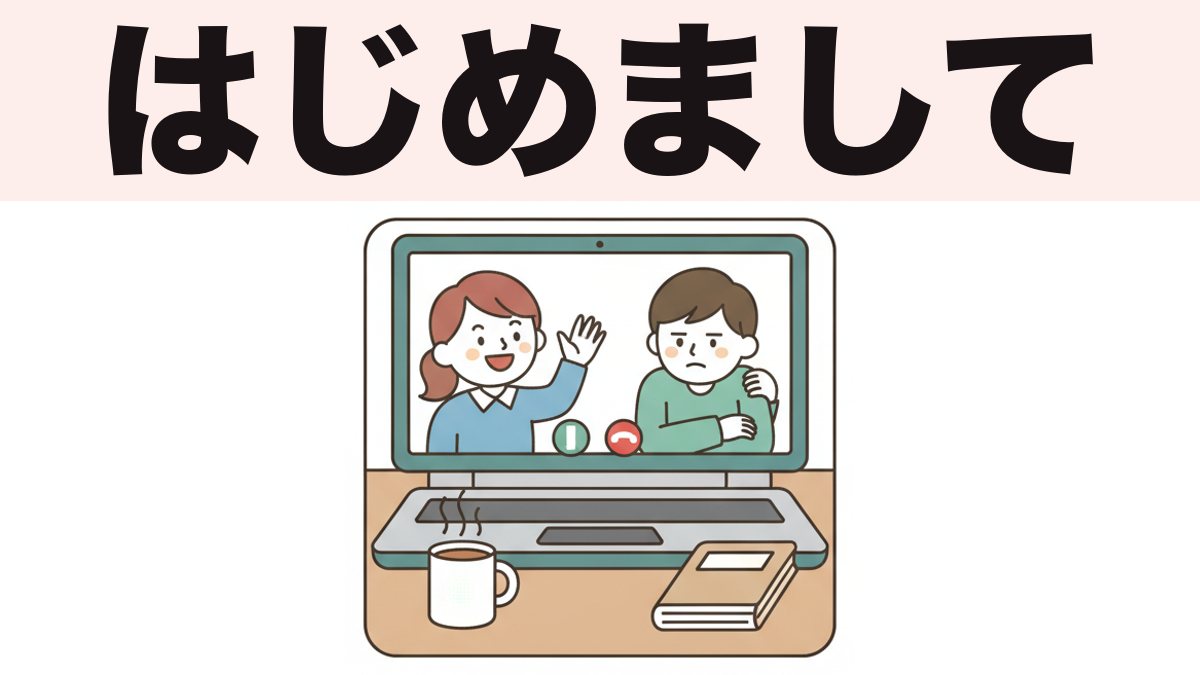
Your first Japanese lesson is a guided conversation that helps us find a useful starting point for you. In this 30-minute trial, we begin with what you can already say, learn ways to ask for help, and practice something connected to your interests. You do not need to arrive with a polished introduction or a completed textbook chapter.
はじめてのレッスンをためらう1番の理由は、お金でも時間でもありません。何を聞かれるかわからないことです。
Booking can feel harder when you cannot picture the lesson itself. Will you have to read kanji aloud? What happens if you understand a question but cannot answer? Can you use English? This walkthrough explains the approach I use, including what to do when the words disappear.
The timings below are a rough guide to this trial lesson, rather than a schedule every Japanese teacher follows. If you are starting from zero, we can spend longer on a greeting. If you already speak comfortably, we can move into a more demanding conversation. The purpose is to find a task that gives you something useful to practice.
The basics
Before the lesson: bring a reason, if you have one
You do not need to prepare a speech or buy a textbook for this first meeting. If you want to bring something, choose one reason you are learning: an upcoming trip, a series you enjoy, or a person you want to speak with. You can explain that reason in English.
Check the joining instructions in your booking confirmation and make sure your microphone works. Those small practical steps can make arriving easier. There is no need to turn preparation into another language assignment.
You might want to say that this is your first lesson. Here is a useful sentence to recognize, even if you cannot produce it independently yet:
日本語のレッスンは初めてです。 — This is my first Japanese lesson.
The word 初めて means “for the first time.” You do not need to learn every part of this sentence before joining. Hearing a phrase, understanding it with help, and trying it yourself can all happen during the lesson.
Minutes 0–5: find a comfortable starting point
We begin with simple questions and adjust from your responses. This is an informal check of what you can do, not a placement exam with a score. A teacher can learn something from a short answer, a request for repetition, or an explanation that you have never studied Japanese.
A name is enough for an initial exchange:
お名前は何ですか? — What is your name?
アレックスです。 — I am Alex.
In お名前, the prefix お makes the reference to the other person's name polite. In this context, 何 is read nan. When you answer, your name plus です is enough; you do not have to begin every sentence with 私は, “as for me.”
If you already know some Japanese, the conversation may continue with your interests. A small answer gives us material to build on:
アニメが好きです。 — I like anime.
You do not have to explain a complicated plot. Naming a show or saying what you like is a workable beginning. For more examples, see the guide to a Japanese self-introduction.
Minutes 5–10: learn how to get help
Two questions make the rest of the lesson easier. One asks about the meaning of Japanese you hear. The other asks for Japanese you do not yet know.
「練習」はどういう意味ですか? — What does “renshuu” mean?
「ticket」は日本語で何ですか? — How do you say “ticket” in Japanese?
The first question contains 意味, “meaning.” The second contains 日本語, “Japanese,” and asks for an expression in that language. The answer to “ticket” depends on the situation: a train ticket may be 切符, while a concert ticket is commonly チケット. That context is exactly the kind of detail we can work through together.
You can read these questions from the screen. Using a visible prompt still lets you ask a real question and understand an answer. Memorizing them can come later.
| What you need | Useful Japanese pattern | What it asks the teacher to do |
|---|---|---|
| Understand a word you heard | 「…」はどういう意味ですか? | Explain the meaning |
| Find a Japanese expression | 「…」は日本語で何ですか? | Supply a Japanese word or phrase |
| Hear the same words again | もう一度お願いします。 | Repeat the previous words |
| Make the speech slower | もう少しゆっくり話してください。 | Speak a little more slowly |
These requests solve different problems. Repeating a word does not necessarily explain its meaning, and translating a word does not necessarily make it easier to hear. Choose the help you need at that moment. The article on asking what something means in Japanese develops the first pattern further.
Beyond the basics
Minutes 10–25: practice something you actually want to say
The middle of the lesson connects the language to your reason for learning. For a traveler, that could mean ordering a drink or asking about a ticket. For someone interested in anime, it could mean discussing a character or looking at a short line together. These are possible activities, not a promise to cover all of them in one session.
Suppose your goal is to order something at a cafe. We can begin with a short request:
コーヒーをください。 — Coffee, please.
First, you hear a model. Then you try it with support. Next, we change one element, such as the item you want, and try the exchange again. This makes the sentence a usable choice instead of a string of sounds you can only repeat in one order.
If you already know the basic request, the task can become more detailed: listening to a follow-up question, choosing an option, or asking for clarification. Knowing a phrase on paper and responding to another speaker are related skills, but they are not identical. The lesson gives us a chance to see which part needs attention.
A useful correction is small enough to act on. If one word is difficult to hear or pronounce, we can isolate it and return to the sentence. You do not need to solve every pronunciation issue before continuing the conversation. The immediate aim is to make the next attempt clearer.
What happens when you freeze
A pause does not end the lesson. It tells us to slow down, offer a choice, repeat the question, or provide a model. You can also signal what you need yourself:
もう一度お願いします。 — Once more, please.
もう少しゆっくり話してください。 — Please speak a little more slowly.
In the first request, もう一度 means “once more.” In the second, ゆっくり means “slowly,” and 話してください asks someone to speak. Both are useful during a lesson with a teacher.
You can also make the difficulty explicit:
すみません、分かりません。 — Sorry, I do not understand.
Here, すみません softens the interruption. You do not need to apologize repeatedly for being a learner; the phrase simply gives you a polite way to stop and ask for support. If the request itself is too difficult, say what you need in English. English is available during this lesson.
For additional ways to handle a missed sentence, read how to ask someone to repeat in Japanese. You only need one dependable request to begin with.
Minutes 25–30: choose one next step
Near the end, we review what you tried and choose a manageable next action. That might be practicing your introduction aloud, reusing a clarification question, or repeating a short exchange with a different item. It should connect to something you actually did during the lesson.
This review is also a chance to talk about what kind of support fits your situation. A complete beginner may want more guided practice. Someone who understands plenty of Japanese may want regular conversation and targeted feedback. A first meeting can suggest a direction without defining your entire study plan.
You could express a simple preference like this:
会話を練習したいです。 — I want to practice conversation.
会話 means “conversation,” and 練習 means “practice.” The ending たい expresses a wish to do something. You can borrow this sentence as a whole; understanding every grammatical detail is not a prerequisite for using it with support.
After the lesson: use the notes selectively
In the approach described here, you receive written notes covering the language from the lesson. That lets you concentrate on the exchange instead of trying to transcribe every sentence while speaking. If writing a quick reminder helps you, it is fine to do so.
When you review, choose a small target. Read one useful sentence, look away, and try saying it in a situation where it makes sense. Then check the notes. If you cannot remember it, use the prompt and try again. A short review of something relevant is a practical next step; you do not need to turn the notes into a large new project.
Ready to try the process? Book a trial lesson · $13, and use the practice activities if you would like a small speaking task beforehand. Check the booking page for current availability and terms.
Common mistakes
Treating the opening questions as a performance
A memorized introduction can be helpful, but it can also hide where you need support. If you finish a long speech and cannot understand the next question, that is useful information for the teacher. You do not have to keep performing at the level of the speech. Give a short, honest answer and let the conversation adapt.
Answering yes when the question was unclear
Saying はい can feel like the easiest way to keep an exchange moving. However, if you have missed the question, the teacher may assume you understood and move ahead. Asking for repetition gives the teacher a clearer signal. Use もう一度お願いします when you want another chance to hear the same words.
Mixing up meaning and translation
If the teacher says 練習 and you do not know the word, ask what it means. If you know the English word “practice” but need the Japanese expression, ask how to say it in Japanese. These are opposite directions through the same gap in vocabulary. The table above helps you choose the appropriate question.
Waiting until you know more before speaking
You do not need a particular number of kanji or a finished beginner course for this trial. We can start with listening and short spoken responses. If you have studied for years, there is also no need to review every chapter before coming back. Tell me what feels easy and what feels rusty so we can choose a realistic task.
Expecting every error to be corrected immediately
Stopping after every word can make a short conversation difficult to finish. Some corrections are useful right away, especially when meaning is unclear; others can wait until you finish your thought. If you want more immediate correction, say so. The first lesson is also a chance to discuss how you like feedback.
Practice
These exercises rehearse situations from the lesson. Try answering aloud before opening each answer. For the Japanese questions, reading from the earlier examples is fine on your first attempt.
1. You are joining your first Japanese lesson. How can you say that using 初めて?
Show answer
日本語のレッスンは初めてです。 — This is my first Japanese lesson. You can use the complete sentence as a ready-made introduction.
2. The teacher asks your name. Answer using Alex as the example name.
Show answer
アレックスです。 — I am Alex. Your name plus です is enough in this context.
3. You heard the Japanese word 練習 but do not know its meaning. Which question should you ask?
Show answer
「練習」はどういう意味ですか? — What does “renshuu” mean? Ask about meaning because you already have the Japanese word.
4. You want the Japanese expression for the English word “ticket.” Ask for it.
Show answer
「ticket」は日本語で何ですか? — How do you say “ticket” in Japanese? Add the situation if necessary, since a train ticket and a concert ticket may use different words.
5. You missed what the teacher said. Ask to hear it once more.
Show answer
もう一度お願いします。 — Once more, please. This asks for repetition without claiming you understood.
6. The teacher repeats the sentence, but the speed is still difficult. Ask for slower speech.
Show answer
もう少しゆっくり話してください。 — Please speak a little more slowly. This identifies speed as the problem.
7. Order coffee using the short request from the lesson example.
Show answer
コーヒーをください。 — Coffee, please. You can later substitute a different item to practice making your own choice.
8. Tell the teacher that you want to practice conversation.
Show answer
会話を練習したいです。 — I want to practice conversation. This gives the teacher a useful starting point for discussing your goals.
9. After the lesson, you have notes containing several new expressions. Suggest one manageable review activity.
Show answer
Choose one sentence you expect to use, read it aloud, then try saying it without looking. Check the notes and repeat with support if needed. Other small activities connected to your lesson are also valid.
FAQ
Do I need to study before the first lesson? No advance study is required for this trial. Check your joining instructions and audio, and bring a reason for learning if you have one. You can explain that reason in English. The lesson itself is where we find an appropriate starting point.
Do I need to read hiragana already? No. We can begin with spoken models and short exchanges. Learning hiragana will support later study, but you do not need to postpone this first conversation until you can read it. Tell the teacher when written Japanese is unfamiliar so the support matches your needs.
Can I use English when I get stuck? Yes, English is available in this lesson. You can try a Japanese request for help when you feel ready, or explain the problem in English. The goal is to get you back into a useful exchange, so struggling silently is unnecessary.
Will every first lesson follow these exact timings? No. The minute ranges describe a rough plan for this 30-minute trial. We may spend more time finding a comfortable starting point or move more quickly into practice. Other teachers may organize a first lesson differently, so this article should not be read as a universal format.
Will one lesson make me confident in Japanese? One meeting gives you a sample of the learning process and a small next step; it cannot guarantee confidence or fluency. A useful outcome might be asking for repetition independently or completing a short exchange with help. Those are concrete things you can practice again.
Vocabulary from this article
Every entry below appears earlier in the article. The readings help you recognize the words used in the examples; you do not need to memorize the whole list before attending.
| Japanese | Reading | Meaning in this article |
|---|---|---|
| 日本語 | にほんご | Japanese language |
| 初めて | はじめて | for the first time |
| 名前 | なまえ | name |
| 好き | すき | liked; expressing that you like something |
| 意味 | いみ | meaning |
| 練習 | れんしゅう | practice |
| 切符 | きっぷ | ticket, especially for transport |
| もう一度 | もういちど | once more |
| ゆっくり | ゆっくり | slowly |
| 会話 | かいわ | conversation |
The same vocabulary is provided below as tab-separated text for flashcard import.
日本語	にほんご	Japanese language
初めて	はじめて	for the first time
名前	なまえ	name
好き	すき	liked; expressing that you like something
意味	いみ	meaning
練習	れんしゅう	practice
切符	きっぷ	ticket, especially for transport
もう一度	もういちど	once more
ゆっくり	ゆっくり	slowly
会話	かいわ	conversation
Sources
- Eri Banno et al., GENKI: An Integrated Course in Elementary Japanese I, third edition, The Japan Times Publishing. Reference for beginner introductions, polite sentence patterns, and requests. It does not prescribe the lesson schedule described here.
- Seiichi Makino and Michio Tsutsui, A Dictionary of Basic Japanese Grammar, The Japan Times. Reference for grammatical patterns such as です, ください, and たい used in the example sentences.
- The original version of this article, “What actually happens in a first Japanese lesson,” dated July 29, 2026, and the site lesson booking page. Sources for the teacher-specific trial format and service information; the example exchanges and practice exercises illustrate that format.
だから、順番にぜんぶ説明します。わたしの体験レッスンを予約すると、こういう流れになります。
前準備は必要ありません
何も勉強しておく必要はありません。何かを予習する必要もありません。確認メールに届くビデオ通話のリンク以外、何もインストールする必要もありません。
もし1つだけ持ってくるなら、日本語を勉強している理由を持ってきてください。好きな作品、旅行の予定、大切な人、好きなゲーム。これは、どんなレベル分けテストよりも、わたしにとって役立ちます。
0〜5分 いまのレベルを知る
やさしい質問から始めて、答えられなくなるまで、少しずつむずかしくしていきます。
いやな感じに聞こえるかもしれませんが、実際はそうではなく、3分くらいで終わります。答えの正しさを見ているのではなく、「どこまでできるか」の境目をさがしています。レッスンは、その境目から始まるからです。
まったくの初心者なら、最初の質問は「名前は?」です。そこから始めます。これはとても普通の始め方で、わたしの生徒の3人に1人くらいは、ここから始めます。
5〜10分 2つの文
まずはじめに、この2つを覚えてもらいます。
〜は どういう いみですか? — What does 〜 mean? 〜は 日本語で なんですか? — How do you say 〜 in Japanese?
生徒はみんな、最初の10分でこの2つを覚えます。この2文があることで、そのあとのレッスンを「日本語について」ではなく「日本語で」進められるようになるからです。
10〜25分 あなた自身の題材
ここが、人によってまったく変わる部分です。
好きな作品がきっかけで来た人とは、そのセリフを使います。10月に東京に行く人とは、実際に使う場面の会話を作ります ― ホテル、改札、レストランなど。日本人のパートナーの家族に会う予定がある人とは、そこで必要な文から始めます。
郵便局についての教科書の章、というようなものはここにはありません。この15分間、あなたはたくさん話すことになります。うまく話せなくても、それでいいのです。それが目的です。
25〜30分 次にやること
わたしが思ったことを、正直に伝えます。もし、まだレッスンが必要ないと思えば、そう言います。すでにしっかりした基礎があって、ただ話す相手が必要なだけの人もいて、そういう場合はそのまま伝えます。
そして、次までにやる小さなことを1つだけ決めます。計画ではなく、1つのことだけです。
レッスンのあと ノート
レッスンでやったことを、日本語をそのまま書いたノートとして渡します。レッスン中にメモを取る必要はありません。むしろ、取らないでほしいです。メモを取ることは、話さないための方法でもあるからです。
みんなが心配する3つのこと
「発音がはずかしい」 最初はみんなそうです。わたしの英語もそうでした。発音は、聞いてもらって、直してもらうことで上手になります。そのためには、まずはずかしい部分が起きる必要があります。
「頭が真っ白になりそう」 たぶん、1、2回はなります。そのための、さっきの2つの文です。道具を持ったまま止まるのは、ただの一時停止です。
「もう何年も勉強していない」 それなら、これは試験ではなく、30分の会話です。何もテストされませんし、追いつかなければいけないこともありません。
具体的な情報
- 30分、13ドル。予約のときにカードで支払います
- Google Meet を使います。リンクは確認メールに届きます
- キャンセルは12時間前まで無料。間に合えば、無料でもう一度予約できるリンクを送ります
- レッスンは日本語で行いますが、必要なときはいつでも英語も使えます
予約する
いちばんむずかしいレッスンは、最初の1回です。そして、そのむずかしさは、ちょうど30分だけです。
More drills like the ones above, plus a timed JLPT-style mock test: Practice · N5上のような練習問題と、時間つきのJLPT形式のもぎ試験: 練習ページ · N5
Want to try this in a real conversation?
本当の会話で、ためしてみませんか?
30-minute trial lesson, $13. Times shown in your own timezone.
30分の体験レッスン、$13。時間はあなたのタイムゾーンで表示されます。
Book a trial lesson · $13