Japanese honorifics: さん, くん, ちゃん, さま and when to use nothing at allさん・くん・ちゃん・さま: 名前のあとに付ける言葉の使い分け
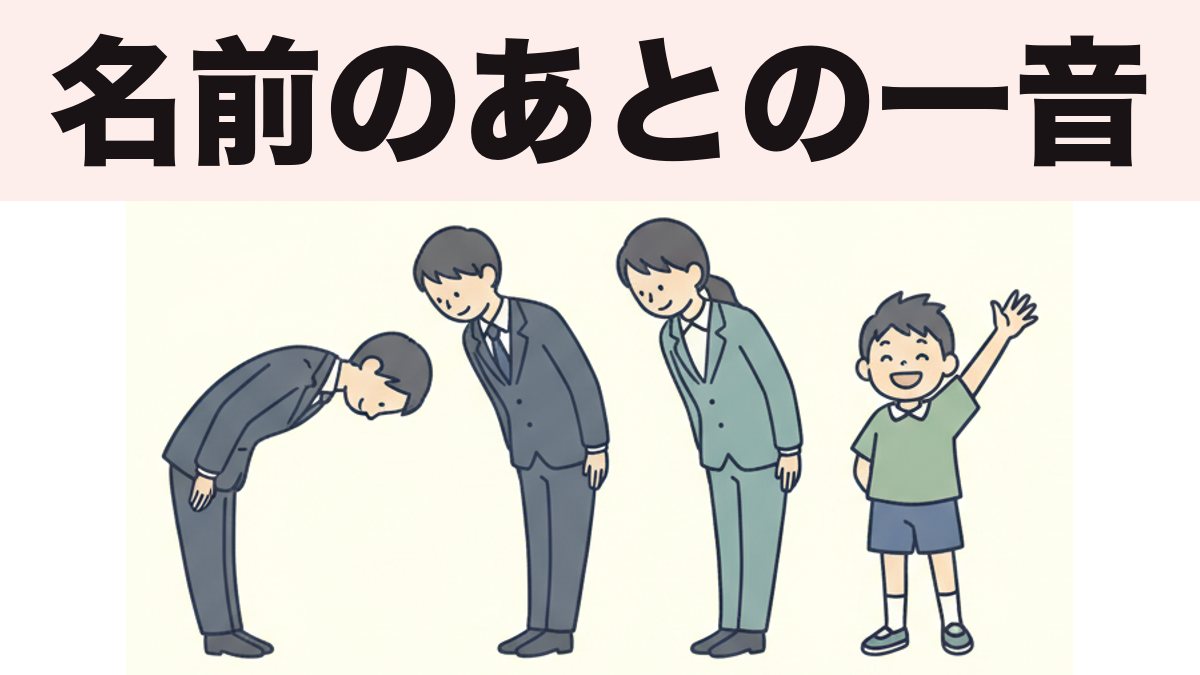
さん is the one you use until someone tells you otherwise; くん and ちゃん add closeness and can only be used downward or sideways; さま puts the other person above you; and using none of them is a statement, not a neutral option.
「さん」は、まようときの答えです。「くん」「ちゃん」は、したしさをあらわしますが、上の人には使いません。「さま」は相手を上におきます。そして、何も付けないのも、一つの「えらんだ形」です。
Almost every learner arrives with the list already memorised from anime, and almost every learner still gets it wrong in the first real conversation — because the list is not the hard part. The hard part is that in Japanese, not choosing is impossible. Every time you say someone's name you are attaching a label to the relationship, including when you attach nothing.
The basics
What is an honorific actually doing?
It is marking the relationship between you and the person named, in the same breath as the name. English has almost nothing like it — "Mr." and "Dr." come closest, but they are titles about a person's role, not about the gap between two people.
田中さん、おはようございます。 — Good morning, Tanaka-san. (polite, a colleague or neighbour) 田中、ちょっと来い。 — Tanaka, get over here. (no honorific, sharp — a boss or a senior with authority)
Those two sentences name the same person. The second one is not "more casual"; it is a completely different claim about who you are to each other.
The four you will hear every day
- さん — the default. Neutral, polite, usable for almost anyone: colleague, stranger, shopkeeper, classmate, someone older, someone younger. When you do not know what to use, this is the answer.
- くん — warm, used downward or sideways, historically toward boys and young men but also used by a boss toward junior staff of any gender in many companies.
- ちゃん — affectionate. Children, close friends, family members, pets, and sometimes adults you are genuinely close to.
- さま — formal and elevated. Customers, deities, the addressee on an envelope, and anyone you want to place clearly above yourself.
お客さま、こちらへどうぞ。 — This way please, sir/madam. (service Japanese, very common) ゆうきくん、宿題は? — Yuuki-kun, what about your homework? (a teacher to a young student) みかちゃん、遊ぼう! — Mika-chan, let's play! (children, or close friends)
How do you attach one?
Straight onto the end of the name, with nothing in between, and it works on the family name, the given name, or a shortened nickname.
佐藤さんはもう帰りました。 — Sato-san has already gone home. (polite, about a third person) けんちゃん、それ取って。 — Ken-chan, pass me that. (casual, close)
Which part of the name you attach it to matters as much as which honorific you pick. Family name + さん is the normal distance for adults. Given name + さん is noticeably closer and is not automatic just because you know someone's given name.
Beyond the basics
Why you must never use one on yourself
This is the single most common beginner error and it sounds strange in a way that is hard to unhear.
❌ 私は田中さんです。 — ("I am Mr. Tanaka.") ✅ 私は田中です。 — I'm Tanaka. (correct self-introduction)
Honorifics elevate or soften the other person. Pointing one at yourself does the opposite of humility. The same logic extends further than names: when you talk about your own family to an outsider you also drop the polite forms, which is why 兄 and お兄さん are two different words for the same brother — covered in Japanese family words.
呼び捨て — dropping the honorific on purpose
Calling someone by their bare name is called 呼び捨て (yobisute), literally "call and throw away". Between close friends it is intimacy. From a stranger it is aggression. From a senior to a junior it can be either, depending entirely on tone.
さやか、行くぞ。 — Sayaka, let's go. (no honorific — established closeness, or a rude stranger)
Anime uses this constantly as a plot device: the moment a character stops saying 〜さん and starts saying the bare name is the moment the relationship changes, and it is often not commented on because Japanese viewers do not need it explained.
先生, 先輩 and the honorifics that are also words
Some honorifics are nouns in their own right and replace さん rather than stacking with it.
山田先生、質問があります。 — Yamada-sensei, I have a question. (to a teacher, doctor, or licensed professional) 山田先輩、お疲れさまです。 — Yamada-senpai, good work. (to someone senior in the same group)
山田先生さん is wrong — 先生 already carries the respect. The 先輩 half of this pair has its own rules, including the fact that 後輩 is never used as a form of address, which is unpacked in 先輩 and 後輩.
ちゃん on grown adults
ちゃん on an adult is not automatically childish. It marks a specific kind of closeness — long friendship, family, or a deliberately soft register — and it is extremely common between adult women who are close. It is also how a lot of nicknames form, by shortening the name first and then attaching it.
ゆっちゃん、久しぶり! — Yu-chan, it's been ages! (close friends, adult)
The risk is one-directional. A close friend calling you ちゃん is warm; you calling your new coworker ちゃん on day one is presumptuous, and there is no polite way to walk that back.
Which name does it attach to — and which name comes first?
Japanese name order is family name first, given name second: 山田太郎 is Mr. Taro Yamada, and 山田 is the family name. This is the opposite of English order, and it is the reason so much confusion attaches to honorifics in the first place — learners attach さん to the wrong half of the name.
山田さんはエンジニアです。 — Yamada-san is an engineer. (polite — 山田 is the family name)
Three practical consequences:
- Default to family name + さん. 山田さん, not 太郎さん. Given name + さん is noticeably closer and is not automatic.
- Forms often ask for them separately. 姓 (せい) or 名字 (みょうじ) is the family name; 名 (な) or 下の名前 is the given name.
- Your own name gets reordered. Japanese speakers writing your name in katakana will often keep your original order, but Japanese people introducing themselves in English frequently flip their own to match English convention — which means the same person can appear as both 山田太郎 and "Taro Yamada" in the same week.
If someone introduces themselves with only one name, it is almost always the family name. Asking 下のお名前は? ("and your given name?") is a normal follow-up question, though in most social and work contexts you will never need it.
What subtitles do with all of this
Almost always: delete it. English subtitles strip honorifics because English has nowhere to put them, which means an entire layer of who-is-who information disappears before it reaches you.
This is one of the best arguments for listening past the subtitles. The names are the easiest words in any Japanese audio to catch, and the syllable stuck on the end of them is free relationship data that the translation threw away.
Common mistakes
- Attaching さん to your own name. 私は田中さんです is the error that most reliably marks a first-week learner.
- Using ちゃん or くん to be friendly with someone senior. It reads as talking down, not as warmth. 部長ちゃん is not a joke you can make.
- Stacking them. 先生さん, 社長さん to your own boss's face, 田中さんちゃん — one per name.
- Assuming くん means "male". In many offices a manager uses くん for junior staff regardless of gender; in schools it skews male but is not a rule of grammar.
- Using さま for a person in front of you casually. Outside service work and formal writing, calling an acquaintance 〜さま sounds sarcastic — which is exactly how anime uses it for comic effect.
The set at a glance
| Honorific | Direction | Feel | Typical use |
|---|---|---|---|
| さま | Upward, formal | Elevated, ceremonial | Customers, envelopes, deities |
| さん | Neutral | Safe, polite | Almost anyone — the default |
| くん | Downward or sideways | Familiar, brisk | Junior staff, young men, classmates |
| ちゃん | Downward or sideways | Affectionate, soft | Children, close friends, family, pets |
| (none) | Level or downward | Intimate, or blunt | Close friends, family; rude from a stranger |
| 先生 / 先輩 | Upward | Role-based respect | Teachers, doctors; seniors in your group |
FAQ
What honorific should I use if I have no idea? さん, attached to the family name. It is correct for strangers, colleagues, shop staff, classmates and people older or younger than you. It is almost impossible to offend anyone with it.
Can I use さん with a foreign name? Yes, and people will use it with yours. Sarah-san, Müller-san and David-san are all completely normal. It attaches to whatever the name is.
Is it rude if someone calls me by my bare name? Not necessarily — many Japanese people drop honorifics with non-Japanese friends precisely because they assume you do not use them in your own language. The context is usually friendly, not dismissive.
When do I switch from さん to something closer? Wait to be invited, or follow. If someone starts calling you by your given name, matching them is safe. Moving first is the risky direction.
Why do anime characters say 〜さま about villains? Because さま is about placement, not affection. A subordinate says 〜さま about a feared boss for the same reason a shop assistant says お客さま: it puts the other person above the speaker.
Does ちゃん have a male equivalent I should use instead? くん is the closest, but they are not a matched pair — ちゃん is about affection and くん is about familiar authority, which is why a mother says ちゃん to a small son and a manager says くん to a grown employee.
Practice
Build each answer before opening it. Questions 3 and 4 are a pair — the difference between them is the whole point of this article.
1. Introduce yourself as Tanaka.
Show answer
私は田中です — never attach an honorific to your own name. 私は田中さんです elevates yourself.
2. Greet a colleague named Sato politely.
Show answer
佐藤さん、おはようございます — さん on the family name is the safe default for a colleague.
3. Address your teacher, whose name is Yamada.
Show answer
山田先生 — 先生 replaces さん. This is the pair to question 4.
4. Something is wrong here: 山田先生さん、質問があります。
Show answer
山田先生、質問があります — 先生 already carries the respect, so さん is not added on top. This is the pair to question 3.
5. A shop assistant is calling out to a customer. What do they attach?
Show answer
お客さま — さま is standard service Japanese. お客さん exists and is softer, but さま is what you hear in shops and hotels.
6. Something is wrong here: 部長ちゃん、これお願いします。
Show answer
部長、これお願いします — ちゃん only goes downward or sideways. Pointing it at a manager reads as mockery, and 部長 works as an address on its own.
7. You are writing a name on an envelope. Which one goes on it?
Show answer
さま(様) — written correspondence uses 様 as standard, even for people you would say さん to in person.
8. Your close friend since childhood is called Mika. What is natural?
Show answer
みかちゃん, or just みか — ちゃん for affectionate closeness, or 呼び捨て if the friendship is old enough that no marker is needed.
9. What is the term for calling someone by their bare name?
Show answer
呼び捨て(よびすて) — literally "call and throw away". Intimate between friends, aggressive from a stranger.
10. Your new coworker's given name is Yuki. You met yesterday. What do you call them?
Show answer
family name + さん — knowing someone's given name does not license using it. Wait to be invited, or follow what they call you.
Vocabulary from this article
Tap the block to select all of it, then copy. In Anki: File → Import, note type Basic, separator Tab — the first column becomes the front, the second the back.
名前	なまえ — name
呼ぶ	よぶ — to call, to address
呼び捨て	よびすて — calling someone without an honorific
先生	せんせい — teacher, doctor, licensed professional
先輩	せんぱい — someone senior in your group
後輩	こうはい — someone junior in your group
お客	おきゃく — customer, guest
部長	ぶちょう — department head
宿題	しゅくだい — homework
質問	しつもん — question
関係	かんけい — relationship
失礼	しつれい — rudeness, discourtesy
丁寧	ていねい — polite, careful
親しい	したしい — close, familiar
兄	あに — my older brother
久しぶり	ひさしぶり — it's been a long time
I'm Yuuki, a Japanese teacher based in Tokyo. I've taught on italki as a Top 1% teacher and watched over 1,500 anime. Honorifics are the part my students arrive knowing best and using worst — the list is easy, but the habit of attaching one to your own name takes a surprisingly long time to break.
Sources: the author's own lessons and standard reference grammars.
アニメでリストはもうおぼえている人が多いです。でも、はじめての会話でまちがえます。むずかしいのはリストではありません。日本語では「えらばない」ということができないからです。名前を言うたびに、二人の関係に名ふだを付けています。何も付けないときも同じです。
基本
名前のあとの言葉は何をしている?
あなたと、その人の関係を、名前と同時にあらわしています。英語には、ほとんど同じものがありません。
田中さん、おはようございます。 — Good morning, Tanaka-san. (polite, a colleague or neighbour) 田中、ちょっと来い。 — Tanaka, get over here. (no honorific, sharp — a boss or a senior with authority)
同じ人の名前です。でも二つ目は「カジュアル」ではありません。関係のせつめいが、まったくちがいます。
よく使う四つ
- さん — きほんの形。だれにでも使えます。まようときはこれです。
- くん — したしい形。下の人や、よこの人に使います。男の子に多いですが、会社では下のスタッフに広く使います。
- ちゃん — かわいい、やわらかい形。子ども、なかのいい友だち、家ぞく、ペット。
- さま — とても丁寧な形。お客さま、手紙のあて名、神さま。
お客さま、こちらへどうぞ。 — This way please, sir/madam. (service Japanese, very common) ゆうきくん、宿題は? — Yuuki-kun, what about your homework? (a teacher to a young student) みかちゃん、遊ぼう! — Mika-chan, let's play! (children, or close friends)
付け方
名前のすぐあとに付けます。あいだに何も入れません。名字にも、下の名前にも、あだ名にも付きます。
佐藤さんはもう帰りました。 — Sato-san has already gone home. (polite, about a third person) けんちゃん、それ取って。 — Ken-chan, pass me that. (casual, close)
どこに付けるかも大事です。大人どうしは「名字+さん」がふつうのきょりです。「下の名前+さん」は、かなり近い形です。
もう少しくわしく
自分の名前には付けない
これはいちばん多いまちがいです。
❌ 私は田中さんです。 ✅ 私は田中です。 — I'm Tanaka. (correct self-introduction)
これらの言葉は「相手」を上げるためのものです。自分に向けると、ぎゃくの意味になります。同じ考え方で、自分の家ぞくの話をするときも形がかわります。→ 日本語の家ぞくの言葉
呼び捨て
何も付けずに名前だけで呼ぶことを「呼び捨て」と言います。友だちならしたしさです。知らない人ならしつれいです。
さやか、行くぞ。 — Sayaka, let's go. (no honorific — established closeness, or a rude stranger)
アニメではよく使われます。「さん」をやめて名前だけになったとき、関係がかわったという合図です。せつめいはされません。
先生・先輩
これらは、それ自体が言葉です。「さん」の代わりになります。
山田先生、質問があります。 — Yamada-sensei, I have a question. (to a teacher, doctor, or licensed professional) 山田先輩、お疲れさまです。 — Yamada-senpai, good work. (to someone senior in the same group)
「山田先生さん」はまちがいです。「先生」にもう丁寧さが入っています。→ 先輩と後輩
大人に使う「ちゃん」
大人に「ちゃん」を使うのは、子どもっぽいという意味ではありません。長い友だち、家ぞく、やわらかい言い方です。大人の女の人どうしでとても多いです。
ゆっちゃん、久しぶり! — Yu-chan, it's been ages! (close friends, adult)
ただし、方向は一つです。友だちが言うのはあたたかいです。会った日に新しい同りょうに言うのは、行きすぎです。
字まくはどうしているか
ほとんど消しています。英語に入れる場所がないからです。だれとだれがどんな関係か、という大事な情報が、あなたに届く前になくなっています。
だから、耳で聞くねうちがあります。名前は聞き取りやすいです。そのあとの一音は、ただでもらえる関係の情報です。
よくあるまちがい
- 自分の名前に「さん」を付ける。「私は田中さんです」は、はじめの一週間のまちがいです。
- 上の人に「ちゃん」「くん」を使う。 あたたかくはなりません。下に見ている形になります。
- 重ねる。「先生さん」「田中さんちゃん」。一つだけです。
- 「くん」」男の人だと思う。 会社では下のスタッフに広く使います。
- ふつうの場面で「さま」を使う。 サービスの仕事と手紙いがいでは、ひにくに聞こえます。
ひとめで見る表
| 形 | 方向 | かんじ | 使う場面 |
|---|---|---|---|
| さま | 上へ・とても丁寧 | かしこまった形 | お客・手紙・神さま |
| さん | まんなか | 安全・丁寧 | ほとんどだれにでも |
| くん | 下・よこ | したしい | 下のスタッフ・男の子・同きゅう生 |
| ちゃん | 下・よこ | やわらかい | 子ども・友だち・家ぞく・ペット |
| (なし) | よこ・下 | とても近い、または強い | 友だち・家ぞく。知らない人ならしつれい |
| 先生・先輩 | 上へ | 役わりへの尊敬 | 先生・医者・グループの先ぱい |
よくある質問
わからないときは何を使う? 名字+「さん」です。知らない人、同りょう、店の人、同きゅう生、年上、年下。ほとんど失礼になりません。
外国の名前にも「さん」を付ける? はい。Sarahさん、Müllerさん、Davidさん、ぜんぶふつうです。あなたの名前にも付きます。
名前だけで呼ばれたら、しつれい? そうとはかぎりません。外国の友だちには、わざと何も付けない人が多いです。あなたの国のやり方に合わせているだけです。
いつ近い呼び方にかえる? さそわれるまで待つか、相手に合わせます。自分から先に近づくのが、あぶない方向です。
アニメでわるものに「さま」を使うのはなぜ? 「さま」は好きかどうかではなく、位置の言葉だからです。こわい上の人にも使います。
「ちゃん」の男の人の形は「くん」? 近いですが、同じペアではありません。「ちゃん」は愛じょう、「くん」はしたしい上下です。
練習
答えを見る前に、自分で作ってください。3番と4番はペアです。
1. 田中として自己しょうかいする。
答えを見る
私は田中です — 自分の名前には付けません。「私は田中さんです」は自分を上げてしまいます。
2. 同りょうの佐藤さんに丁寧にあいさつする。
答えを見る
佐藤さん、おはようございます — 名字+さんが同りょうへの安全な形です。
3. 先生(山田)に呼びかける。
答えを見る
山田先生 — 「先生」が「さん」の代わりになります。4番とペアです。
4. まちがいをなおす: 山田先生さん、質問があります。
答えを見る
山田先生、質問があります — 「先生」にもう丁寧さが入っているので「さん」は付けません。3番とペアです。
5. 店の人がお客に呼びかける。何を付ける?
答えを見る
お客さま — サービスの日本語のきほんです。「お客さん」もありますが、店やホテルでは「さま」です。
6. まちがいをなおす: 部長ちゃん、これお願いします。
答えを見る
部長、これお願いします — 「ちゃん」は下かよこにしか使いません。「部長」だけで呼びかけになります。
7. 手紙のあて名に書くのはどれ?
答えを見る
さま(様) — 手紙は「様」がきほんです。ふだん「さん」と言う相手にも使います。
8. 子どものころからの友だち、みか。自然な呼び方は?
答えを見る
みかちゃん、または みか — やわらかい「ちゃん」か、ふるい友だちなら呼び捨てです。
9. 名前だけで呼ぶことを何と言う?
答えを見る
呼び捨て(よびすて) — 友だちならしたしさ、知らない人ならしつれいです。
10. きのう会った新しい同りょう。下の名前は「ゆき」。何と呼ぶ?
答えを見る
名字+さん — 下の名前を知っていても、使ってよいことにはなりません。さそわれるまで待ちます。
この記事に出た単語
上のブロックをタップしてぜんぶ選んで、コピーしてください。Ankiでは ファイル → インポート、ノートタイプは 基本、区切りは タブ です。左が表、右がうらになります。
名前	なまえ — name
呼ぶ	よぶ — to call, to address
呼び捨て	よびすて — calling someone without an honorific
先生	せんせい — teacher, doctor, licensed professional
先輩	せんぱい — someone senior in your group
後輩	こうはい — someone junior in your group
お客	おきゃく — customer, guest
部長	ぶちょう — department head
宿題	しゅくだい — homework
質問	しつもん — question
関係	かんけい — relationship
失礼	しつれい — rudeness, discourtesy
丁寧	ていねい — polite, careful
親しい	したしい — close, familiar
兄	あに — my older brother
久しぶり	ひさしぶり — it's been a long time
More drills like the ones above, plus a timed JLPT-style mock test: Practice · N5上のような練習問題と、時間つきのJLPT形式のもぎ試験: 練習ページ · N5
Want to try this in a real conversation?
本当の会話で、ためしてみませんか?
30-minute trial lesson, $13. Times shown in your own timezone.
30分の体験レッスン、$13。時間はあなたのタイムゾーンで表示されます。
Book a trial lesson · $13