Japanese superlatives: 一番, 最も, and the の中で that makes them work一番: 「いちばん〜」の作り方と、「〜の中で」
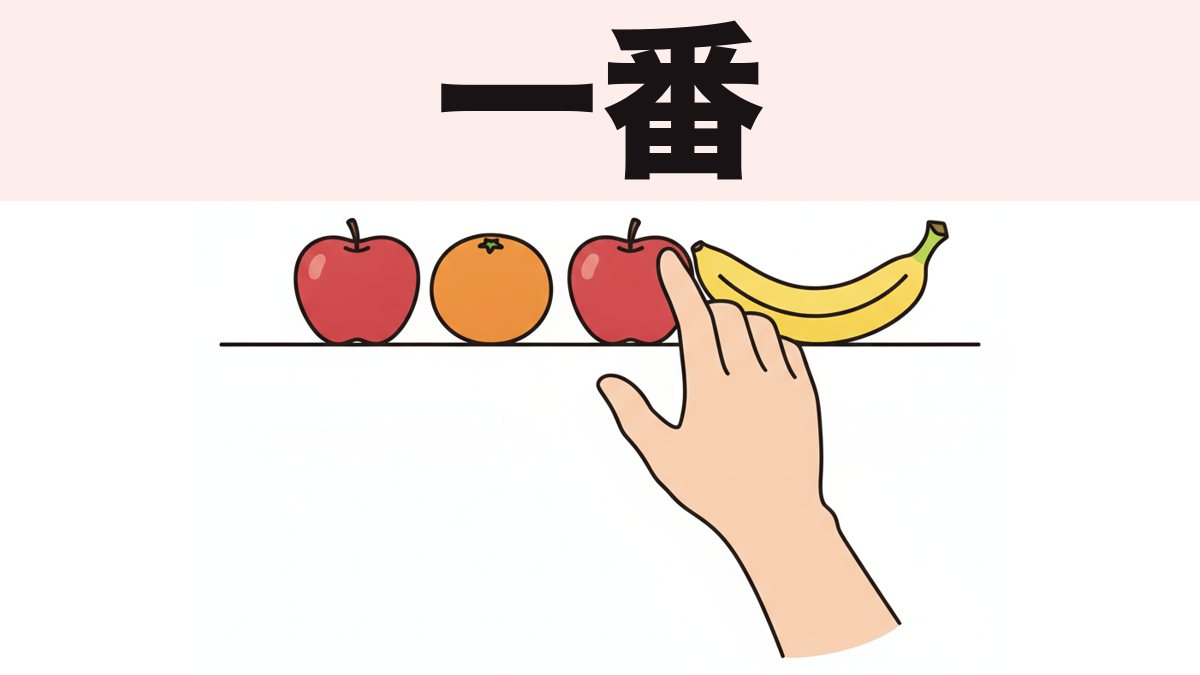
Japanese has no -est ending. To make a superlative you put 一番 (いちばん) in front of the adjective: 一番高い is "the most expensive." The set the comparison happens inside is marked with 〜の中で, and that phrase does more work than 一番 itself.
日本語には「-est」のような形がありません。形容詞の前に「一番(いちばん)」を置くだけです。「一番高い」で「the most expensive」になります。くらべる集まりは「〜の中で」で表します。実は、「一番」より「の中で」のほうが仕事をしています。
Superlatives are structurally simpler in Japanese than in English — nothing conjugates, nothing is irregular — and the difficulty sits entirely in the frame around them.
The basics
一番 + adjective
この店が一番安いです。 — This shop is the cheapest. (polite) 日本語が一番難しいと思います。 — I think Japanese is the hardest. (polite)
一番 is an adverb sitting in front of the adjective, and the adjective does not change at all. 安い stays 安い. Compare English, where "cheap" becomes "cheapest" and "good" becomes "best" — Japanese does none of that.
一番 literally means "number one," and it is the same 一番 you meet in 一番線 (platform one) and in 一番好き ("like the most").
〜の中で: the set you are comparing inside
クラスの中で田中さんが一番背が高いです。 — Tanaka is the tallest in the class. (polite) 果物の中で、りんごが一番好きです。 — Of all fruit, I like apples best. (polite)
The pattern is 〜の中で + X が + 一番 + adjective. The の中で phrase names the set, X names the winner, and が marks it because you are identifying which member of a known set it is. That が is doing exactly the job described in は vs が — identification out of a set.
Asking a superlative question
Here Japanese differs from English in a way that catches people.
果物の中で何が一番好きですか。 — What fruit do you like best? (polite — open question) りんごとみかんとバナナの中でどれが一番好きですか。 — Of apples, oranges and bananas, which do you like best? (polite — closed set)
With an open category, 何. With a listed set, どれ. Using 何 after naming three options sounds like you are ignoring the list you just gave. This is the same こそあど logic covered in これ, それ, あれ, どれ.
For people the word is 誰, and for places どこ — the question word matches the category, not the grammar.
Beyond the basics
最も: the written superlative
最も (もっとも) means the same as 一番 and belongs to writing and formal speech.
最も重要な問題です。 — It is the most important issue. (formal, written)
You will meet 最も in news, reports and academic writing. Saying it out loud in conversation sounds like reading a headline. 一番 is what people say.
There is also the prefix 最〜 (さい), which builds fixed compounds: 最高 (best), 最低 (worst), 最新 (newest), 最初 (first), 最後 (last). These are individual vocabulary items rather than a productive pattern — you cannot invent 最安い.
一番 with verbs
一番 also modifies verbs directly, which English cannot do with "most."
一番よく使う言葉です。 — It's the word I use most. (polite) 一番行きたい国はどこですか。 — Which country do you most want to go to? (polite)
一番よく〜 is the common shape for "the most often," and 一番〜たい is "want to most." Both are useful and neither needs any extra structure.
The negative superlative
To say something is the least, you flip the adjective rather than the 一番.
これが一番安いです。 — This is the cheapest. (polite) これが一番高くないです。 — (this is not "least expensive" — it says "this is the most not-expensive," which is odd)
Japanese prefers to name the opposite adjective: for "least expensive," say 一番安い. For "the least interesting," 一番つまらない. Building a superlative on a negative is grammatical but reads as clumsy, and native speakers avoid it.
二番目に: second-most
二番目に大きい都市です。 — It's the second-largest city. (polite)
〜番目に plus an adjective handles the rest of the ranking. Note the に, which is required: 二番目に大きい, not 二番目大きい.
Comparatives are a different structure
一番 handles superlatives; comparatives use a completely separate frame.
りんごよりみかんの方が好きです。 — I prefer oranges to apples. (polite)
That is 〜より〜の方が, and mixing the two frames is a common error: 一番より is not a thing. Decide whether you are ranking two items or picking one out of many, then choose the frame.
Common mistakes
- Trying to conjugate the adjective. There is no 安いest. 一番 does all the work and 安い stays as it is.
- Dropping の中で. Grammatical, but the sentence loses the set. 一番好きです alone leaves "out of what?" unanswered.
- Using は instead of が. 一番 sentences identify a member of a set, which is が territory. りんごが一番好きです.
- Using 何 after listing options. With a named set, the word is どれ.
- Saying 最も in conversation. Correct but written. Say 一番.
- Building superlatives on negatives. 一番高くない is awkward. Use the opposite adjective instead.
- Mixing 一番 with より. They belong to different frames — one ranks a set, the other compares two things.
The superlative frame
| What you want | Structure | Example |
|---|---|---|
| X is the most ~ | Xが一番+adjective | これが一番安いです |
| The most ~ in a set | 〜の中でXが一番+adj | 果物の中でりんごが一番好きです |
| Open question | 〜の中で何が一番+adj | 何が一番好きですか |
| Closed question | AとBとCの中でどれが | どれが一番好きですか |
| About a person | 誰が一番+adjective | 誰が一番速いですか |
| The most often | 一番よく+verb | 一番よく使います |
| Second-most | 二番目に+adjective | 二番目に大きい |
| Formal, written | 最も+adjective | 最も重要な問題 |
Practice
Questions 3 and 4 are the pair: the same question with an open category and with a named list.
1. Say "this shop is the cheapest," politely.
Show answer
この店が一番安いです。 — 一番 goes in front and 安い does not change at all.
2. Say "of all fruit, I like apples best."
Show answer
果物の中で、りんごが一番好きです。 — の中で names the set, が identifies the winner.
3. Ask what fruit someone likes best, as an open question.
Show answer
果物の中で何が一番好きですか。 — 何 for an open category.
4. Ask the same question after listing apples, oranges and bananas.
Show answer
りんごとみかんとバナナの中でどれが一番好きですか。 — どれ, because you have just named the set. 何 would ignore your own list.
5. Say "it's the word I use most," politely.
Show answer
一番よく使う言葉です。 — 一番よく is the standard shape for "most often."
6. Say "it's the second-largest city."
Show answer
二番目に大きい都市です。 — The に is required before the adjective.
7. Write the formal, written version of "the most important issue."
Show answer
最も重要な問題です。 — 最も belongs in writing. In speech, 一番.
8. Say "which country do you most want to go to?"
Show answer
一番行きたい国はどこですか。 — 一番 modifies 行きたい directly. No extra structure needed.
9. Fix this: りんごは一番好きです。
Show answer
りんごが一番好きです。 — Superlatives identify a member of a set, which takes が.
10. How would you say "the least expensive"?
Show answer
一番安い — Use the opposite adjective. 一番高くない is grammatical but clumsy, and nobody says it.
FAQ
Is 一番 or 最も more correct? Both are correct. 一番 is spoken and neutral; 最も is written and formal. Choosing between them is register, not grammar.
Why is it が and not は? Because a superlative picks one member out of a known set, and identification out of a set is exactly what が does. は would topicalize the item instead, which changes what the sentence is doing.
Can I drop 〜の中で? Yes, when the set is obvious from context. In a shop, これが一番安いです needs no の中で because the set is the shop. When the set is not obvious, leaving it out makes the sentence vague.
How do I say "one of the most ~"? 最も〜の一つ ("one of the most ~") in writing, or in speech 一番〜の一つ, though many speakers prefer to restructure: とても〜です plus a comparison.
What is the difference between 一番 and 最高? 一番 ranks; 最高 evaluates. 最高 means "the best, the greatest" as a judgement and is also used as an exclamation — 最高! means "amazing!" You cannot swap them.
Does 一番 always mean "most"? No — it also literally means "number one" in ordering: 一番線 (platform 1), 一番目 (the first one). Context separates them without difficulty.
Vocabulary from this article
Tap the block to select all of it, then copy. In Anki: File → Import, note type Basic, separator Tab — the first column becomes the front, the second the back.
一番	いちばん — the most, number one
最も	もっとも — the most (formal)
最高	さいこう — the best, the greatest
最低	さいてい — the worst
最新	さいしん — the newest
最初	さいしょ — the first
最後	さいご — the last
中	なか — inside, among
果物	くだもの — fruit
都市	とし — city
重要	じゅうよう — important
番目	ばんめ — the Nth
速い	はやい — fast
安い	やすい — cheap
難しい	むずかしい — difficult
言葉	ことば — word
国	くに — country
問題	もんだい — issue, problem
I'm Yuuki, a Japanese teacher based in Tokyo. I've taught on italki as a Top 1% teacher and watched over 1,500 anime. The 何/どれ split is the one people are surprised by — they build a perfect superlative sentence and then use the wrong question word for a list they just read out themselves.
Sources: the author's own lessons and standard reference grammars.
日本語の最上級は、英語よりずっと簡単です。形が変わることも、特別な形もありません。むずかしいのは、まわりの形だけです。
基本
「一番」+形容詞
この店が一番安いです。 — This shop is the cheapest. (polite) 日本語が一番難しいと思います。 — I think Japanese is the hardest. (polite)
「一番」は副詞です。形容詞の前に置くだけで、形容詞は変わりません。「安い」は「安い」のままです。
「一番」は「番号が1」という意味です。「一番線」「一番好き」も同じことばです。
「〜の中で」
クラスの中で田中さんが一番背が高いです。 — Tanaka is the tallest in the class. (polite) 果物の中で、りんごが一番好きです。 — Of all fruit, I like apples best. (polite)
形は「〜の中で + Xが + 一番 + 形容詞」です。「の中で」が集まりを言い、「X」が1番のものです。助詞は「が」です。知っている集まりの中から1つを選んでいるからです。
最上級の質問
ここが英語とちがいます。
果物の中で何が一番好きですか。 — What fruit do you like best? (polite — open question) りんごとみかんとバナナの中でどれが一番好きですか。 — Of apples, oranges and bananas, which do you like best? (polite — closed set)
はばの広い種類なら「何」、3つ並べたあとなら「どれ」です。並べたのに「何」と聞くと、自分が出したリストを無視しているように聞こえます。
人なら「誰」、場所なら「どこ」です。
もう少し先へ
「最も」
「最も(もっとも)」は「一番」と同じ意味で、書く時に使います。
最も重要な問題です。 — It is the most important issue. (formal, written)
ニュースや報告書に出ます。話す時に使うと、見出しを読んでいるように聞こえます。
「最〜」のことばもあります。「最高」「最低」「最新」「最初」「最後」。これは決まったことばで、自由に作れません。「最安い」とは言えません。
動詞にもつきます
一番よく使う言葉です。 — It's the word I use most. (polite) 一番行きたい国はどこですか。 — Which country do you most want to go to? (polite)
「一番よく〜」で「いちばん多く」、「一番〜たい」で「いちばん〜したい」です。
「いちばん〜ない」は使いません
これが一番安いです。 — This is the cheapest. (polite)
「一番高くない」は文としては作れますが、変です。反対の形容詞を使ってください。「いちばん高くない」ではなく「いちばん安い」です。
「二番目に」
二番目に大きい都市です。 — It's the second-largest city. (polite)
「〜番目に」+形容詞です。「に」を落とせません。
くらべる時は別の形です
りんごよりみかんの方が好きです。 — I prefer oranges to apples. (polite)
2つをくらべる時は「〜より〜の方が」です。「一番より」という形はありません。「集まりから1つ選ぶ」のか「2つをくらべる」のかを、先に決めてください。
よくある間違い
- 形容詞を変えようとする。 「安い」のままです。
- 「の中で」を落とす。 「何の中で?」が分からなくなります。
- 「は」を使う。 「りんごが一番好きです」です。
- 並べたあとに「何」を使う。 「どれ」です。
- 話す時に「最も」を使う。 「一番」です。
- 「一番〜ない」を作る。 反対の形容詞を使います。
- 「一番」と「より」をまぜる。 別の形です。
まとめ
| 言いたいこと | 形 | 例 |
|---|---|---|
| Xがいちばん〜 | Xが一番+形容詞 | これが一番安いです |
| 集まりの中で | 〜の中でXが一番+形容詞 | 果物の中でりんごが一番好きです |
| はばの広い質問 | 〜の中で何が一番+形容詞 | 何が一番好きですか |
| 並べたあとの質問 | AとBとCの中でどれが | どれが一番好きですか |
| 人について | 誰が一番+形容詞 | 誰が一番速いですか |
| いちばん多く | 一番よく+動詞 | 一番よく使います |
| 2番目 | 二番目に+形容詞 | 二番目に大きい |
| 書く時 | 最も+形容詞 | 最も重要な問題 |
練習
3番と4番が組です。同じ質問でも、リストを出したかどうかで変わります。
1. 「この店が一番安いです」と言ってください。
答えを見る
この店が一番安いです。 — 形容詞は変わりません。
2. 「果物の中でりんごが一番好きです」と言ってください。
答えを見る
果物の中で、りんごが一番好きです。 — 「の中で」が集まり、「が」が1番のものです。
3. 「果物の中で何が一番好きですか」と聞いてください。
答えを見る
果物の中で何が一番好きですか。 — はばの広い種類なので「何」です。
4. りんご・みかん・バナナを並べてから、同じことを聞いてください。
答えを見る
りんごとみかんとバナナの中でどれが一番好きですか。 — 並べたあとは「どれ」です。
5. 「一番よく使う言葉です」と言ってください。
答えを見る
一番よく使う言葉です。 — 「一番よく」で「いちばん多く」です。
6. 「二番目に大きい都市です」と言ってください。
答えを見る
二番目に大きい都市です。 — 「に」がいります。
7. 「最も重要な問題です」と書いてください。
答えを見る
最も重要な問題です。 — 書く時の形です。
8. 「一番行きたい国はどこですか」と聞いてください。
答えを見る
一番行きたい国はどこですか。 — 「一番」は動詞にもつきます。
9. 直してください: りんごは一番好きです。
答えを見る
りんごが一番好きです。 — 集まりから1つ選ぶので「が」です。
10. 「いちばん安くない」を、自然な形にしてください。
答えを見る
一番安い — 反対の形容詞を使います。「一番高くない」とは言いません。
よくある質問
「一番」と「最も」はどちらが正しいですか。 どちらも正しいです。「一番」は話しことば、「最も」は書きことばです。
どうして「が」ですか。 知っている集まりの中から1つを選んでいるからです。「は」だと、話題にするだけになります。
「〜の中で」を落とせますか。 分かりきっている時は落とせます。お店の中なら「これが一番安いです」で通じます。
「〜の1つ」は何と言いますか。 書く時は「最も〜の一つ」です。話す時は形を変えることが多いです。
「一番」と「最高」はちがいますか。 「一番」は順位、「最高」は評価です。「最高!」は「すごくいい!」という意味です。
「一番」はいつも「most」ですか。 ちがいます。「一番線」「一番目」のように、番号の1という意味もあります。
この記事に出た単語
このブロックを長く押して全部選び、コピーしてください。Ankiでは ファイル → 読み込み、ノートタイプは 基本、区切りは タブ にします。左が表、右が裏になります。
一番	いちばん — the most, number one
最も	もっとも — the most (formal)
最高	さいこう — the best, the greatest
最低	さいてい — the worst
最新	さいしん — the newest
最初	さいしょ — the first
最後	さいご — the last
中	なか — inside, among
果物	くだもの — fruit
都市	とし — city
重要	じゅうよう — important
番目	ばんめ — the Nth
速い	はやい — fast
安い	やすい — cheap
難しい	むずかしい — difficult
言葉	ことば — word
国	くに — country
問題	もんだい — issue, problem
日本語教師のユウキです。東京にいます。 italkiで Top 1% の教師をしています。アニメは1,500本以上見ました。みんなが驚くのは「何」と「どれ」のちがいです。きれいな最上級の文を作ったあとで、自分が今読んだリストなのに「何」と聞いてしまいます。
More drills like the ones above, plus a timed JLPT-style mock test: Practice · N5上のような練習問題と、時間つきのJLPT形式のもぎ試験: 練習ページ · N5
Want to try this in a real conversation?
本当の会話で、ためしてみませんか?
30-minute trial lesson, $13. Times shown in your own timezone.
30分の体験レッスン、$13。時間はあなたのタイムゾーンで表示されます。
Book a trial lesson · $13