Ukeru meaning: 受ける for classes and exams, ウケる for "that''s hilarious「受ける」と「ウケる」: 授業・試験を受ける と「それウケる」
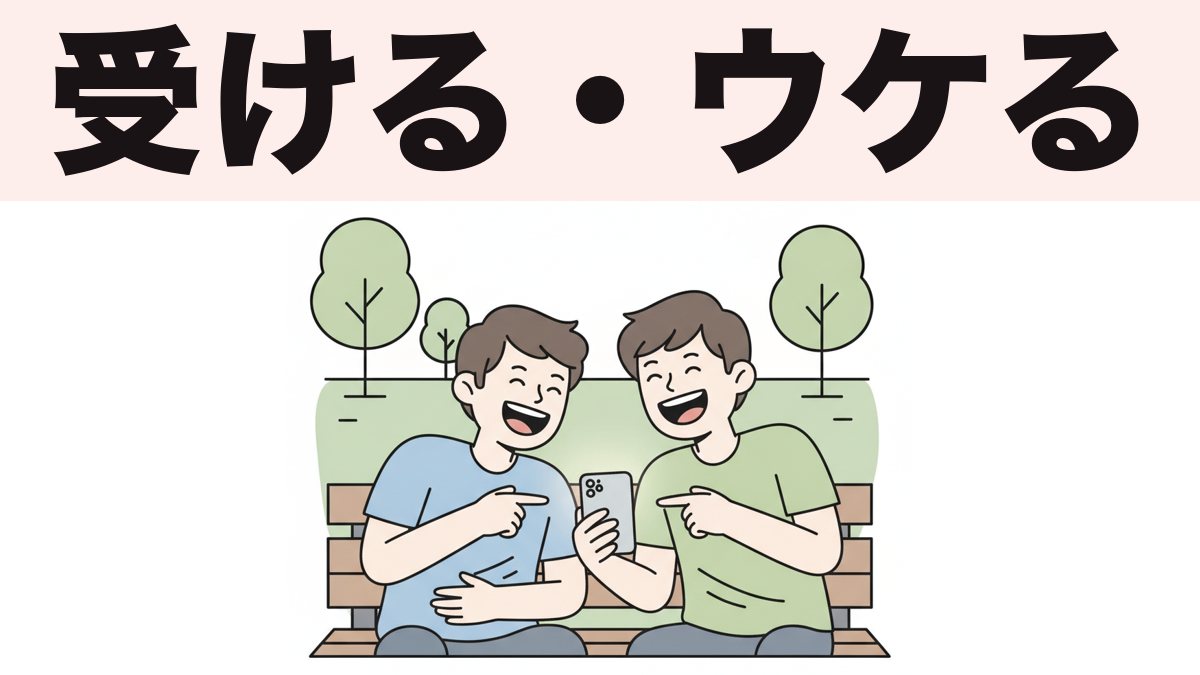
受ける (うける) is the verb for being on the receiving end of something: you 受ける a class, an exam, an interview, a phone call or damage. Written in katakana as ウケる, it becomes slang for "that's hilarious" — a joke that "is received" well by the audience. Same verb, two very different registers.
受ける(うける)は、何かを「受け取る側」になる動詞です。授業、試験、面接、電話、手術を受けます。カタカナで「ウケる」と書くと、「すごくおもしろい」という若者ことばになります。冗談がみんなに「受け入れられた」から、です。同じ動詞で、使う場面がまったくちがいます。
The textbook meaning is the one you need for daily life; the slang is the one you hear in every group chat. Both come from the same picture: something comes towards you, and you take it.
The basics
What does 受ける mean?
The core meaning is "to receive" — to be the one something is given to or done to. That covers a wide range of English verbs.
| Japanese | English | What you receive |
|---|---|---|
| 授業を受ける | take a class | the lesson |
| 試験を受ける | take an exam | the exam |
| 面接を受ける | have an interview | the interview |
| 電話を受ける | take a phone call | the call |
| 手術を受ける | have surgery | the operation |
| 影響を受ける | be influenced | the influence |
The important one for learners is the first row. English says "take a class," and learners reach for 取る. With a university course, 取る is fine (授業を取る, to sign up for a course), but the act of attending and receiving the lesson is 受ける.
毎週、オンラインで日本語の授業を受けています。 — I take a Japanese class online every week. (attending) 来月、試験を受けます。 — I'm taking an exam next month. (sitting the exam) この本から大きな影響を受けた。 — This book had a big influence on me. (receiving influence)
受ける or 取る for classes?
Both are heard, but they mean different things. 取る is choosing and registering: 今学期は三つ授業を取った, "I took three courses this semester." 受ける is being in the lesson: 今日は午後に授業を受ける, "I have a class this afternoon."
For private lessons and one-to-one tutoring, 受ける is the natural verb: レッスンを受ける. There is nothing to register for — you just receive the lesson.
What about exams?
Exams are 受ける, never 取る. 試験を取る sounds like stealing the paper. For passing and failing, use 受かる (to pass) and 落ちる (to fail):
試験を受けて、受かった! — I took the exam and passed! (受ける → 受かる) 一回目は落ちたけど、また受ける。 — I failed the first time, but I'll take it again. (落ちる)
受かる looks like 受ける's twin, and it is: 受ける is taking it, 受かる is it "being received" in your favour.
Beyond the basics
What does ウケる mean as slang?
ウケる is "that's so funny" or "LOL." It comes from the performance meaning of 受ける: a joke that 受ける is one the audience receives well — it lands. From there it turned into a reaction word.
それ、ウケる! — That's hilarious! (casual reaction) マジウケる。 — Seriously, I'm dying. (very casual) その話、みんなにウケたよ。 — Everyone loved that story. (went down well)
It is usually written in katakana when used this way, which marks it as slang. In speech, only the tone tells you which meaning is meant — and the context makes it obvious.
Is ウケる always a compliment?
Not always. Said flatly, it can be sarcastic: someone announces a questionable plan, and a friend says ウケる in a dry voice, meaning "that's ridiculous." The same thing happens with "LOL" in English messages. How Japanese handles that kind of dry humour is in 皮肉 and sarcasm in Japanese.
What is 受け身?
受け身 (うけみ) is the grammar term for the passive voice — literally "receiving body." It comes from the same verb, because the passive is about being on the receiving end: 先生に褒められた, "I was praised by the teacher." The full grammar is in the passive form.
The word also appears in daily speech: 受け身の人 is a passive person, someone who waits for things to happen to them.
What does 引き受ける mean?
引き受ける (ひきうける) is "to take on" a job, a request or a responsibility — to accept it as yours. It is the verb you use when someone asks for help and you say yes.
その仕事、私が引き受けます。 — I'll take that job on. (accepting a task) 頼まれたら断れなくて、つい引き受けてしまう。 — When someone asks, I can't say no, and I end up taking it on. (a common complaint)
It is also where 受けて立つ comes from, a set phrase for accepting a challenge: 挑戦を受けて立つ, "I accept the challenge." Both keep the same picture — something comes at you, and you take it.
How does it sound in anime?
Both meanings are common. School anime are full of 試験を受ける and 入試 (entrance exams), and the phrase 受験生 (a student studying for entrance exams) is everywhere. Comedy and slice-of-life characters use ウケる! and ウケるんだけど as reactions — often by the most casual character in the group. A character who says ウケる in a very flat voice is usually the sarcastic one.
Common mistakes
- Using 取る for exams. 試験を受ける. 取る with an exam sounds like taking the paper.
- Using 受ける for "pass." 受けた means you sat it. For passing, 受かった or 合格した.
- Using ウケる in polite speech. It is slang. In a meeting, say 面白いですね.
- Writing the slang in kanji. 受ける is fine in writing, but the "LOL" meaning is almost always written ウケる.
- Using 受ける for giving. It is always the receiving side. The giver is 授ける or just あげる / 与える.
- Missing the sarcasm. A flat ウケる can mean "that's absurd," not "that's funny."
Practice
Answers are hidden — build yours first, then open. Questions 1 and 2 are a pair: taking and passing.
1. Say "I'm taking the exam next week," politely.
Show answer
来週、試験を受けます — sitting an exam is 受ける.
2. Say "I passed!" about the same exam, casually.
Show answer
受かった! — passing is 受かる. 受けた would only say you sat it.
3. Say "I take a private lesson every Saturday."
Show answer
毎週土曜日にレッスンを受けています — you receive the lesson, so 受ける. ている for a regular habit.
4. Your friend sends a funny photo. React casually.
Show answer
ウケる! — the slang reaction, written in katakana.
5. Say "My joke went over really well at the party."
Show answer
パーティーで私の冗談がすごくウケた — the joke is the subject, and it was received well.
6. Say "I was strongly influenced by that film."
Show answer
その映画に強い影響を受けた — you receive the influence: 影響を受ける.
7. In a work meeting, a colleague tells a funny story. React politely.
Show answer
面白いですね — ウケる is too casual for a meeting.
8. Fix: 明日、日本語の試験を取ります。
Show answer
明日、日本語の試験を受けます — exams take 受ける.
9. Say "I had an interview at a company today."
Show answer
今日、会社の面接を受けた — interviews are 受ける from the candidate's side.
FAQ
What is the difference between 受ける and もらう? もらう is receiving an object or a favour from someone: プレゼントをもらう. 受ける is receiving something done to you or given as a service: a lesson, an exam, treatment, influence.
Is ウケる rude? Not rude, just very casual. It is fine among friends and in messages, not in formal settings.
What does 受験 mean? Taking an entrance exam, usually for high school or university. 受験生 is a student preparing for one.
What is 受付? Reception — the desk that "receives" visitors. You see 受付 signs in hospitals, offices and events.
Does 受ける have a potential form? Yes: 受けられる, "can take." この授業は誰でも受けられます — anyone can take this class.
Is 受け取る the same as 受ける? 受け取る is "to receive and take in hand" — a parcel, a payment, a letter. It is more physical than 受ける.
Vocabulary from this article
Tap the block to select all of it, then copy. In Anki: File → Import, note type Basic, separator Tab — the first column becomes the front, the second the back.
受ける	うける — to receive; to take (a class, an exam)
受かる	うかる — to pass (an exam)
落ちる	おちる — to fail (an exam); to fall
授業	じゅぎょう — class, lesson
試験	しけん — exam
面接	めんせつ — interview
手術	しゅじゅつ — surgery, operation
影響	えいきょう — influence
受け身	うけみ — passive (voice); passivity
受験	じゅけん — taking an entrance exam
受験生	じゅけんせい — student preparing for entrance exams
受付	うけつけ — reception desk
受け取る	うけとる — to receive (in hand)
冗談	じょうだん — joke
合格	ごうかく — passing (an exam)
入試	にゅうし — entrance exam
I'm Yuuki, a Japanese teacher based in Tokyo. I've taught on italki as a Top 1% teacher and watched over 1,500 anime. 受ける comes up in lessons when a student tells me about a new class they are taking — and it is a good moment to add ウケる, which they will hear far more often than they expect.
Sources: the author's own lessons and standard reference grammars.
教科書の意味は毎日の生活で必要です。若者ことばの意味は、友だちとのメッセージで毎日のように見ます。どちらも「何かが自分に来て、それを受け取る」という同じ絵から来ています。
基本
受けるの意味
中心の意味は「受け取る」です。何かをしてもらう、あたえられる側です。英語ではいろいろな動詞になります。
| 日本語 | 英語 | 受け取るもの |
|---|---|---|
| 授業を受ける | take a class | 授業 |
| 試験を受ける | take an exam | 試験 |
| 面接を受ける | have an interview | 面接 |
| 電話を受ける | take a phone call | 電話 |
| 手術を受ける | have surgery | 手術 |
| 影響を受ける | be influenced | 影響 |
大事なのは1行目です。英語は take a class なので、「取る」を使いたくなります。大学の授業を登録するなら「授業を取る」でいいですが、授業に出て教えてもらうのは「受ける」です。
毎週、オンラインで日本語の授業を受けています。 — I take a Japanese class online every week. (attending) 来月、試験を受けます。 — I'm taking an exam next month. (sitting the exam) この本から大きな影響を受けた。 — This book had a big influence on me. (receiving influence)
授業は「受ける」?「取る」?
「取る」は選んで登録すること。「今学期は三つ授業を取った」。「受ける」は授業の中にいること。「今日は午後に授業を受ける」。個人レッスンは登録がないので、「レッスンを受ける」が自然です。
試験は?
試験はいつも「受ける」です。「試験を取る」は、問題用紙をぬすむように聞こえます。合格は「受かる」、不合格は「落ちる」です。
試験を受けて、受かった! — I took the exam and passed! (受ける → 受かる) 一回目は落ちたけど、また受ける。 — I failed the first time, but I'll take it again. (落ちる)
もう少し先へ
若者ことばの「ウケる」
「ウケる」は「すごくおもしろい」「笑える」です。舞台の「受ける」(冗談が客にうまく受け入れられる)から来て、反応のことばになりました。
それ、ウケる! — That's hilarious! (casual reaction) マジウケる。 — Seriously, I'm dying. (very casual) その話、みんなにウケたよ。 — Everyone loved that story. (went down well)
この意味の時は、ふつうカタカナで書きます。
ウケるは、いつもほめことば?
いつもではありません。平らな声で言うと、皮肉になります。「それはないでしょ」という意味です。くわしくは皮肉の記事を見てください。
受け身
「受け身」は文法の受け身形のことです。「先生に褒められた」。受け取る側の文です。受け身形の記事にくわしくあります。ふだんのことばでは「受け身の人」は、自分から動かない人です。
引き受ける
「引き受ける」は、仕事やたのみごとを自分のものとして受け入れることです。たのまれて「いいよ」と言う時の動詞です。
その仕事、私が引き受けます。 — I'll take that job on. (accepting a task) 頼まれたら断れなくて、つい引き受けてしまう。 — When someone asks, I can't say no, and I end up taking it on. (a common complaint)
「受けて立つ」もここから来ています。「挑戦を受けて立つ」は「挑戦を受ける」という決まった言い方です。
アニメでは
学校のアニメでは「試験を受ける」「入試」「受験生」がよく出ます。日常もののアニメでは、「ウケる!」「ウケるんだけど」が反応として出ます。平らな声で「ウケる」と言うキャラクターは、たいてい皮肉屋です。
よくあるまちがい
- 試験に「取る」を使う。 「試験を受ける」です。
- 合格に「受けた」を使う。 「受けた」は試験に出ただけ。合格は「受かった」「合格した」。
- ていねいな場面で「ウケる」。 会議では「面白いですね」。
- 若者ことばを漢字で書く。 「笑える」の意味は、ふつう「ウケる」とカタカナ。
- あげる側に「受ける」を使う。 いつも受け取る側です。
- 皮肉に気づかない。 平らな「ウケる」は「ありえない」の意味のこともあります。
練習
答えはかくしてあります。先に自分で考えてから開けてください。1と2はペアです。受けることと、受かること。
1. ていねいに「来週、試験を受ける」と言う。
答えを見る
来週、試験を受けます — 試験に出るのは「受ける」。
2. 同じ試験に合格した。くだけて言う。
答えを見る
受かった! — 合格は「受かる」。「受けた」は出ただけです。
3. 「毎週土曜日に個人レッスンを受けている」と言う。
答えを見る
毎週土曜日にレッスンを受けています — いつもしているので「ている」。
4. 友だちがおもしろい写真を送ってきた。くだけて反応する。
答えを見る
ウケる! — 若者ことばの反応。カタカナです。
5. 「パーティーで私の冗談がすごくウケた」と言う。
答えを見る
パーティーで私の冗談がすごくウケた — 冗談が主語です。
6. 「その映画に強い影響を受けた」と言う。
答えを見る
その映画に強い影響を受けた — 影響を受け取るので「受ける」。
7. 会議で同僚がおもしろい話をした。ていねいに反応する。
答えを見る
面白いですね — 「ウケる」はくだけすぎです。
8. 直してください: 明日、日本語の試験を取ります。
答えを見る
明日、日本語の試験を受けます — 試験は「受ける」。
9. 「今日、会社の面接を受けた」と言う。
答えを見る
今日、会社の面接を受けた — 面接は受ける側から「受ける」。
よくある質問
「受ける」と「もらう」のちがいは? 「もらう」は物や親切を人からもらうこと。「受ける」は授業、試験、治療、影響など、してもらうことを受け取ることです。
「ウケる」は失礼? 失礼ではありませんが、とてもくだけています。友だちやメッセージでは大丈夫です。
「受験」は? 高校や大学の入試を受けることです。「受験生」は入試の勉強をしている学生です。
「受付」は? 来た人を受ける場所、受付です。病院や会社で見ます。
「受ける」の可能形は? 「受けられる」。「この授業は誰でも受けられます」。
「受け取る」は同じ? 「受け取る」は荷物やお金など、手で受け取ることです。「受ける」より具体的です。
この記事に出た単語
ブロックをタップして全部を選び、コピーしてください。Anki では File → Import、ノートタイプは Basic、区切りは Tab です。左が表、右が裏になります。
受ける	うける — to receive; to take (a class, an exam)
受かる	うかる — to pass (an exam)
落ちる	おちる — to fail (an exam); to fall
授業	じゅぎょう — class, lesson
試験	しけん — exam
面接	めんせつ — interview
手術	しゅじゅつ — surgery, operation
影響	えいきょう — influence
受け身	うけみ — passive (voice); passivity
受験	じゅけん — taking an entrance exam
受験生	じゅけんせい — student preparing for entrance exams
受付	うけつけ — reception desk
受け取る	うけとる — to receive (in hand)
冗談	じょうだん — joke
合格	ごうかく — passing (an exam)
入試	にゅうし — entrance exam
私はユウキです。東京で日本語を教えています。 italki の Top 1% の先生で、アニメは1,500本以上見ました。レッスンでは、生徒が新しく始めた授業の話をする時によく出ます。その時に「ウケる」もいっしょに教えると、思ったよりずっとよく聞くことばだと分かってもらえます。
出典: 著者自身のレッスンと、一般的な文法書。
More drills like the ones above, plus a timed JLPT-style mock test: Practice · N4上のような練習問題と、時間つきのJLPT形式のもぎ試験: 練習ページ · N4
Want to try this in a real conversation?
本当の会話で、ためしてみませんか?
30-minute trial lesson, $13. Times shown in your own timezone.
30分の体験レッスン、$13。時間はあなたのタイムゾーンで表示されます。
Book a trial lesson · $13