The Japanese passive 〜られる: including the one that means "and it annoyed me受身(〜られる): 「〜されて、いやだった」を表す形もあります
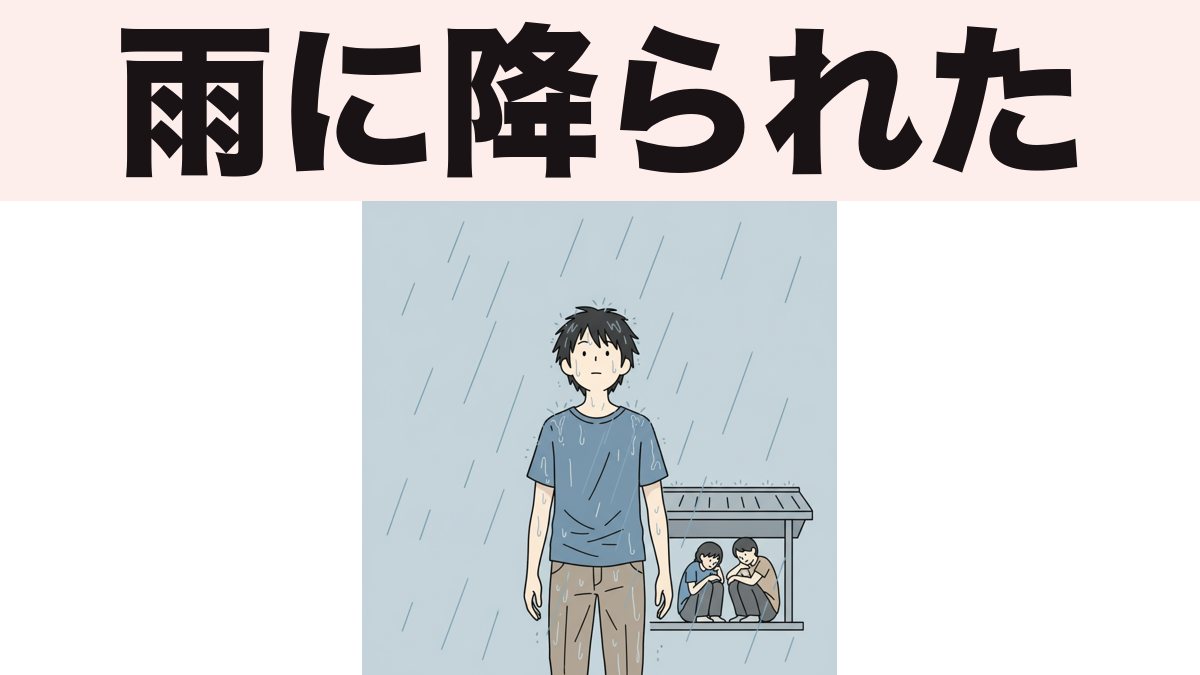
The Japanese passive does the job you expect — "it was done" — and then one job English cannot do at all. 雨に降られた means "I got rained on," with the annoyance built into the grammar. There is no English tense for that, which is why it takes learners so long to start using it.
日本語の受身は、思ったとおりの仕事をします。「〜される」です。そして、英語にはできない仕事をもう1つします。「雨に降られた」は「雨にふられて、こまった」で、いやな気もちが文法に入っています。英語にはこの形がありません。だから学習者はなかなか使えるようになりません。
The conjugation is the easy part. What makes this worth an article is the second use, and the fact that the passive form of Group 2 verbs is identical to the potential form — a genuine ambiguity that Japanese itself has been quietly resolving.
The basics
How to build it
| Verb type | Rule | Example |
|---|---|---|
| Group 1 | final -u → -areru | 読む → 読まれる |
| Group 2 | drop る, add られる | 食べる → 食べられる |
| する | → される | 注意する → 注意される |
| 来る | → 来られる | 来る → 来られる |
この本は多くの人に読まれています。 — This book is read by many people. 先生に褒められました。 — I was praised by the teacher. 会議は三時に開かれます。 — The meeting will be held at three.
The agent takes に
Whoever did it takes に, not を and not が.
母に怒られた。 — I got told off by my mother. 友達に助けられた。 — I was helped by a friend.
For creations and discoveries, formal Japanese uses によって instead:
この寺は千年前に建てられました。 — This temple was built a thousand years ago. 『源氏物語』は紫式部によって書かれました。 — The Tale of Genji was written by Murasaki Shikibu.
によって is the one you want when naming a creator or an agent in writing. に is for ordinary people doing ordinary things to you.
The suffering passive: the part English lacks
This is the use that makes the passive genuinely useful in conversation. Japanese can make an intransitive verb passive to say that something happened and it affected you badly.
雨に降られた。 — I got rained on. (and it was a nuisance) 子供に泣かれて、眠れなかった。 — The baby cried on me, and I couldn't sleep. 友達に来られて、勉強できなかった。 — A friend turned up and I couldn't study.
Look at that middle sentence. Nothing was done to you grammatically — the baby simply cried — but the passive puts you in the sentence as the person it happened to. English has to add "on me" and a tone of voice.
財布を盗まれました。 — I had my wallet stolen.
This one takes both: the thing stolen keeps を, and you are the subject. 私の財布が盗まれました is grammatical but sounds like a police report about an object; 財布を盗まれました is about what happened to you.
Beyond the basics
食べられる is both passive and potential
Group 2 verbs make their passive and their potential identically, which is a real ambiguity.
これは食べられますか。 — Can this be eaten? / Is this edible? (potential) ケーキを弟に食べられた。 — My little brother ate my cake. (passive — and I mind)
Context usually decides. But Japanese has been resolving it anyway, through a change called ら抜き言葉 ("ra-dropping"): in casual speech the potential drops the ら, leaving the passive with it.
| Potential (casual) | Passive | |
|---|---|---|
| 食べる | 食べれる | 食べられる |
| 見る | 見れる | 見られる |
| 来る | 来れる | 来られる |
食べれる is extremely common in speech and still considered non-standard in writing and formal contexts. Recognise it, expect to hear it constantly, and write 食べられる. The important thing is knowing why it exists: it is the language solving exactly the problem you just noticed.
Group 1 verbs have no such problem — 読める (potential) and 読まれる (passive) are already different.
Why news and signs are full of passives
Japanese formal writing uses the passive to avoid naming an agent, exactly as English does.
〜と言われています。 — It is said that… 中止されました。 — It has been cancelled. この駅は1920年に作られました。 — This station was built in 1920.
〜と言われています is worth learning as a unit. It is how Japanese attributes a claim to nobody in particular, and it appears constantly in articles, documentaries and explanations.
How is it different from the causative-passive?
They look related and describe different situations.
| Form | Meaning | Did you act? |
|---|---|---|
| 飲まれた | It was drunk (by someone) | No |
| 飲まされた | I was made to drink | Yes, unwillingly |
| 飲めた | I was able to drink | Yes, willingly |
〜させられる always means someone made you do something. The plain passive means something was done, possibly to you. The overlap in feel is that both can carry resentment — but only one of them has you performing the action.
How does it sound in anime?
The suffering passive and the plain passive both turn up, and the emotional weight is usually on the first:
殺された。 — He was killed. 裏切られた。 — I was betrayed. 先に行かれた。 — They got ahead of me. (and I mind) こんな所で死なれてたまるか。 — Don't you dare die on me here.
That last construction — 死なれる — is the suffering passive at full strength. Nobody is doing anything to the speaker; someone is simply dying, and the grammar makes it something being done to them. It is one of the few places where Japanese grammar is straightforwardly more expressive than English.
Common mistakes
- Using を for the agent. The person who did it takes に: 先生に褒められました.
- Confusing passive and potential in Group 2. 食べられる is both. Context decides; in casual speech, 食べれる is the potential.
- Writing 食べれる. Fine to say, non-standard to write. Produce 食べられる in anything formal.
- 私の財布が盗まれました for a theft. Grammatical, but it makes the sentence about the wallet. 財布を盗まれました is about you.
- Avoiding the suffering passive. It is not advanced decoration — 雨に降られた is an ordinary sentence, and skipping it means saying something flatter than you meant.
- によって with an everyday agent. 母によって怒られた is odd. によって is for creators and formal agents; に is for people.
Practice
Answers are hidden — build yours first, then open. Questions 5 and 6 are a pair: identical grammar, two different meanings, and one of them is going away.
1. Make 読む passive.
Show answer
読まれる — Group 1: the final -u becomes -areru. Polite: 読まれます.
2. Say "I was praised by the teacher."
Show answer
先生に褒められました — the agent takes に, never を or が.
3. Say "I got rained on."
Show answer
雨に降られた — the suffering passive. Nothing was done to you grammatically; the passive is what puts you in the sentence as the person affected.
4. Say "I had my wallet stolen."
Show answer
財布を盗まれました — the stolen thing keeps を and you are the subject. 私の財布が盗まれました is about the wallet, not about you.
5. What does これは食べられますか mean?
Show answer
"Is this edible?" — the potential reading. Group 2 verbs make the passive and potential identically.
6. What does ケーキを弟に食べられた mean?
Show answer
"My little brother ate my cake" — and I mind — the passive reading of the same form. This is the pair to question 5: identical grammar, and only context separates them.
7. What is ら抜き言葉, and what problem does it solve?
Show answer
Dropping ら from the potential — 食べれる instead of 食べられる. It separates the potential from the passive, which is exactly the ambiguity in questions 5 and 6. Common in speech, non-standard in writing.
8. Say "the Tale of Genji was written by Murasaki Shikibu."
Show answer
『源氏物語』は紫式部によって書かれました — によって for creators and formal agents. 紫式部に書かれました would be odd.
9. What is the difference between 飲まれた and 飲まされた?
Show answer
Whether you did the drinking — 飲まれた means it was drunk by someone. 飲まされた is the causative-passive: you drank it, unwillingly.
10. What does 〜と言われています do?
Show answer
Attributes a claim to nobody in particular — "it is said that…". It is how Japanese articles and documentaries make a statement without naming a source.
FAQ
Is the Japanese passive used as much as the English one? Differently. For "the door was opened," Japanese usually reaches for an intransitive verb (ドアが開いた) instead. Where the passive earns its place is when someone is affected — which is why the suffering passive is the use you will actually need.
Can any verb take the suffering passive? Intransitive verbs commonly do — 降られる, 泣かれる, 来られる, 死なれる — and the effect is always "and this was a problem for me." It cannot be used for something pleasant, which is a reliable test.
Is ら抜き言葉 wrong? It is non-standard, not wrong. It has been spreading for decades, it is entirely normal in speech, and it will probably be standard eventually. For now: say it if you like, do not write it in an exam.
How do I make it negative or past? Regularly, because 〜れる/〜られる conjugates as a Group 2 verb: 読まれない, 読まれた, 読まれなかった, 読まれています.
Why is 私の財布が盗まれました worse? It is not wrong — it is just about the wallet rather than about you. Japanese strongly prefers to make the affected person the subject, which is the same instinct behind the whole suffering passive.
Does the passive relate to keigo? Yes, and confusingly: 〜れる/〜られる is also a mild honorific. 先生が来られました can mean "the teacher came" (respectful), not "the teacher was come." Context and the lack of an agent tell you which, and this honorific use is common in business Japanese.
Vocabulary from this article
Tap the block to select all of it, then copy. In Anki: File → Import, note type Basic, separator Tab — the first column becomes the front, the second the back.
読む	よむ — to read
食べる	たべる — to eat
褒める	ほめる — to praise
怒る	おこる — to get angry, to tell off
助ける	たすける — to help, to save
盗む	ぬすむ — to steal
財布	さいふ — wallet
雨	あめ — rain
降る	ふる — to fall (rain)
泣く	なく — to cry
会議	かいぎ — meeting
開く	ひらく — to hold (an event), to open
寺	てら — temple
建てる	たてる — to build
作る	つくる — to make
中止	ちゅうし — cancellation
注意	ちゅうい — warning
裏切る	うらぎる — to betray
殺す	ころす — to kill
死ぬ	しぬ — to die
弟	おとうと — younger brother
駅	えき — station
I'm Yuuki, a Japanese teacher based in Tokyo. I've taught on italki as a Top 1% teacher and watched over 1,500 anime. Learners produce 読まれています fine and then never once say 雨に降られた, because there is no English shape to translate from — and that is the half of the passive that actually comes up in conversation.
Sources: the author's own lessons and standard reference grammars.
活用はかんたんな方です。記事1本になる理由は、2つめの使い方と、グループ2の受身が可能形とまったく同じ形になることです。日本語自身が、そのあいまいさを静かに直しつつあります。
基本
作り方
| 種類 | ルール | 例 |
|---|---|---|
| グループ1 | 最後の -u → -areru | 読む → 読まれる |
| グループ2 | る をとって られる | 食べる → 食べられる |
| する | → される | 注意する → 注意される |
| 来る | → 来られる | 来る → 来られる |
この本は多くの人に読まれています。 — This book is read by many people. 先生に褒められました。 — I was praised by the teacher. 会議は三時に開かれます。 — The meeting will be held at three.
した人は「に」
やった人は「に」です。「を」でも「が」でもありません。
母に怒られた。 — I got told off by my mother. 友達に助けられた。 — I was helped by a friend.
作った人や発見した人は、かたい文で「によって」を使います。
この寺は千年前に建てられました。 — This temple was built a thousand years ago. 『源氏物語』は紫式部によって書かれました。 — The Tale of Genji was written by Murasaki Shikibu.
「によって」は作った人を出す時の形です。ふつうの人がふつうのことをする時は「に」です。
迷惑の受身: 英語にない方
会話で本当に役に立つのは、この使い方です。日本語は自動詞も受身にできて、「それが起きて、自分がこまった」を表せます。
雨に降られた。 — I got rained on. 子供に泣かれて、眠れなかった。 — The baby cried on me, and I couldn't sleep. 友達に来られて、勉強できなかった。 — A friend turned up and I couldn't study.
まん中の文を見てください。文法としては、自分に何もされていません。子どもが泣いただけです。でも受身が、自分を「それが起きた人」として文に入れます。英語は "on me" と声のトーンを足さないといけません。
財布を盗まれました。 — I had my wallet stolen.
これは両方入っています。ぬすまれたものが「を」のままで、自分が主語です。「私の財布が盗まれました」も正しいですが、ものについての記録みたいです。「財布を盗まれました」は、自分に起きたことの話です。
もう少し先へ
「食べられる」は受身でもあり、可能形でもあります
グループ2の動詞は、受身と可能形がまったく同じ形になります。本当にあいまいです。
これは食べられますか。 — Can this be eaten? (可能) ケーキを弟に食べられた。 — My little brother ate my cake. (受身・いやだった)
ふつうは前後で分かります。でも日本語は、それを直しつつあります。「ら抜き言葉」です。話す時、可能形から「ら」を落として、受身に「ら」を残します。
| 可能(話しことば) | 受身 | |
|---|---|---|
| 食べる | 食べれる | 食べられる |
| 見る | 見れる | 見られる |
| 来る | 来れる | 来られる |
「食べれる」は話す時にとても多くて、書く時やかたい場面ではまだ標準ではありません。聞いて分かるようにして、書く時は「食べられる」にしてください。大事なのは「なぜあるか」です。今あなたが気づいた問題を、言語が自分で直しているのです。
グループ1にはこの問題がありません。「読める」(可能)と「読まれる」(受身)は、もうちがう形です。
ニュースや看板に受身が多い理由
かたい日本語は、だれがやったかを出さないために受身を使います。英語と同じです。
〜と言われています。 — It is said that… 中止されました。 — It has been cancelled. この駅は1920年に作られました。 — This station was built in 1920.
「〜と言われています」はまるごと覚えてください。だれとも言わずに「そう言われている」と伝える形で、記事やせつめいにいつも出ます。
使役受身とはどうちがいますか
にて見えますが、ちがう場面です。
| 形 | 意味 | 自分がしましたか |
|---|---|---|
| 飲まれた | だれかに飲まれた | いいえ |
| 飲まされた | 飲まされた | はい・いやいや |
| 飲めた | 飲めた | はい・自分の意思で |
「〜させられる」は、いつも「だれかにさせられた」です。ふつうの受身は「された」です。どちらもくやしさが入ることがありますが、動作をしているのは1つだけです。
アニメではどう聞こえますか?
迷惑の受身もふつうの受身も出ます。気もちが重いのは前の方です。
殺された。 — He was killed. 裏切られた。 — I was betrayed. 先に行かれた。 — They got ahead of me. こんな所で死なれてたまるか。 — Don't you dare die on me here.
さいごの「死なれる」が、迷惑の受身のいちばん強い形です。だれも話し手に何もしていません。ただだれかが死のうとしていて、文法がそれを「自分にされること」にしています。日本語の文法が英語よりはっきり気もちを運ぶ、めずらしい場所です。
よくある間違い
- した人に「を」。 やった人は「に」です。「先生に褒められました」。
- グループ2で受身と可能を混ぜること。 「食べられる」は両方です。話す時の可能は「食べれる」です。
- 「食べれる」と書くこと。 話すのはいいですが、書く時は標準ではありません。
- ぬすまれた時に「私の財布が盗まれました」。 正しいですが、ものの話になります。「財布を盗まれました」が自分の話です。
- 迷惑の受身をさけること。 「雨に降られた」はふつうの文です。使わないと、平らな言い方になります。
- ふつうの人に「によって」。 「母によって怒られた」は変です。「によって」は作った人やかたい場面です。
練習
答えはかくれています。まず自分の答えを作ってから開いてください。5番と6番は対になっています。
1. 「読む」を受身にしてください。
答えを見る
読まれる — グループ1は最後の -u が -areru になります。ていねいは「読まれます」。
2. 「先生にほめられました」と言ってください。
答えを見る
先生に褒められました — やった人は「に」です。「を」でも「が」でもありません。
3. 「雨にふられた」と言ってください。
答えを見る
雨に降られた — 迷惑の受身です。文法としては何もされていませんが、受身が自分を「こまった人」として文に入れます。
4. 「さいふをぬすまれた」と言ってください。
答えを見る
財布を盗まれました — ぬすまれたものが「を」のままで、自分が主語です。「私の財布が盗まれました」はものの話になります。
5. 「これは食べられますか」はどんな意味ですか。
答えを見る
「食べられますか(食べていいものですか)」 — 可能の読み方です。グループ2は受身と可能が同じ形です。
6. 「ケーキを弟に食べられた」はどんな意味ですか。
答えを見る
弟にケーキを食べられました(いやだった) — 同じ形の受身の読み方です。5番と対で、前後の文でしか分かりません。
7. 「ら抜き言葉」は何で、何を直していますか。
答えを見る
可能形から「ら」を落とすことです — 「食べれる」。5番と6番のあいまいさを分けています。話しことばでは多く、書く時は標準ではありません。
8. 「『源氏物語』は紫式部が書きました」を受身で言ってください。
答えを見る
『源氏物語』は紫式部によって書かれました — 作った人は「によって」です。「紫式部に書かれました」は変です。
9. 「飲まれた」と「飲まされた」はどうちがいますか。
答えを見る
自分が飲んだかどうか — 「飲まれた」はだれかに飲まれました。「飲まされた」は使役受身で、自分がいやいや飲みました。
10. 「〜と言われています」は何をしていますか。
答えを見る
だれとも言わずに「そう言われている」と伝えています — 記事やせつめいで、出どころを出さずに書く形です。
よくある質問
日本語の受身は、英語と同じくらい使いますか。 使い方がちがいます。「ドアが開けられた」ではなく「ドアが開いた」(自動詞)を使うことが多いです。受身が生きるのは「人がえいきょうを受けた」時で、だから迷惑の受身がいちばん必要になります。
どの動詞でも迷惑の受身になりますか。 自動詞がよくなります。降られる・泣かれる・来られる・死なれる。意味はいつも「それで自分がこまった」です。うれしいことには使えません。
「ら抜き言葉」は間ちがいですか。 標準ではありませんが、間ちがいではありません。何十年も広がっていて、話す時はまったくふつうです。試験では書かないでください。
否定や過去はどう作りますか。 ふつうです。「〜れる/られる」はグループ2の動詞として活用します。読まれない、読まれた、読まれなかった、読まれています。
「私の財布が盗まれました」はなぜよくないのですか。 まちがいではありません。ただ、ものの話になって、自分の話になりません。日本語は「えいきょうを受けた人」を主語にしたがります。
受身と敬語は関係ありますか。 あります。「〜れる/られる」は、かるい尊敬語にもなります。「先生が来られました」は「先生がいらっしゃいました」で、「来られた(迷惑)」ではありません。やった人が出ないことと場面で分かります。仕事の日本語によく出ます。
この記事に出た単語
ブロックをタップすると全部選べます。そのままコピーしてください。Anki では ファイル → 読み込み、ノートタイプ 基本、区切り タブ。1列目が表、2列目が裏になります。
読む	よむ — to read
食べる	たべる — to eat
褒める	ほめる — to praise
怒る	おこる — to get angry, to tell off
助ける	たすける — to help, to save
盗む	ぬすむ — to steal
財布	さいふ — wallet
雨	あめ — rain
降る	ふる — to fall (rain)
泣く	なく — to cry
会議	かいぎ — meeting
開く	ひらく — to hold (an event), to open
寺	てら — temple
建てる	たてる — to build
作る	つくる — to make
中止	ちゅうし — cancellation
注意	ちゅうい — warning
裏切る	うらぎる — to betray
殺す	ころす — to kill
死ぬ	しぬ — to die
弟	おとうと — younger brother
駅	えき — station
私はユウキです。東京で日本語を教えています。 italki の Top 1% の先生で、アニメは1,500本以上見ました。「読まれています」はみんな作れます。でも「雨に降られた」は一度も言いません。英語にうつす形がないからです。そして、会話に本当に出るのは、そちらの半分です。
More drills like the ones above, plus a timed JLPT-style mock test: Practice · N4上のような練習問題と、時間つきのJLPT形式のもぎ試験: 練習ページ · N4
Want to try this in a real conversation?
本当の会話で、ためしてみませんか?
30-minute trial lesson, $13. Times shown in your own timezone.
30分の体験レッスン、$13。時間はあなたのタイムゾーンで表示されます。
Book a trial lesson · $13