ようとする vs てみる: two ways to say "try" in Japaneseようとする と てみる: 日本語の2つの「try」
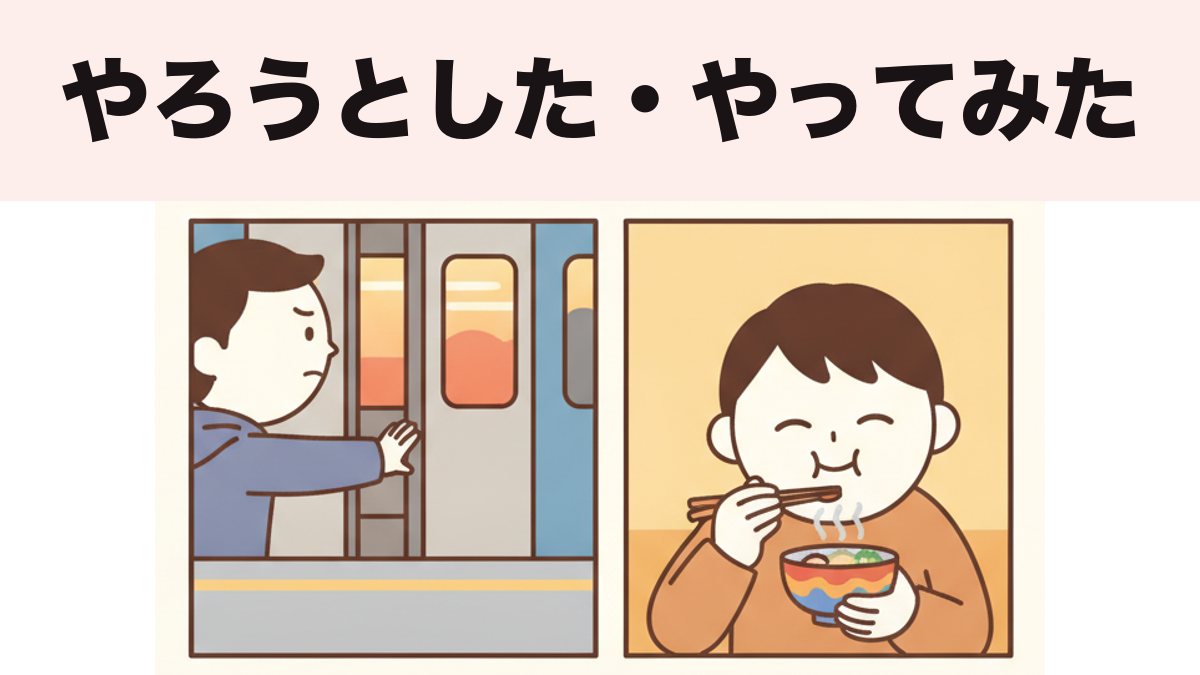
English uses one word, "try," for two different things, and Japanese splits them: 〜ようとする means you attempted something (and usually did not get there), while 〜てみる means you actually did it to see what happens. ドアを開けようとした — I tried to open the door (it did not open). ドアを開けてみた — I tried opening the door (and found out).
英語は「try」1つで、2つのちがうことを言います。日本語は分けます。〜ようとするは「やろうとした(でも、たいていできなかった)」。〜てみるは「本当にやって、どうなるか見た」。ドアを開けようとした — ドアは開かなかった。ドアを開けてみた — 開けて、結果が分かった。
That is why learners who translate "I tried" word for word land on the wrong one about half the time. The question to ask is not "did I try?" but "did the action actually happen?"
The basics
How do you make the ようとする form?
Take the volitional form of the verb — the "let's" form — and add とする. The volitional is the same form you meet in 行こう ("let's go"), so if you know that, you already have half of this.
| Verb type | Dictionary form | Volitional | + とする |
|---|---|---|---|
| る-verb | 食べる | 食べよう | 食べようとする |
| う-verb | 書く | 書こう | 書こうとする |
| う-verb | 乗る | 乗ろう | 乗ろうとする |
| る-verb | 降りる | 降りよう | 降りようとする |
| Irregular | する | しよう | しようとする |
| Irregular | 来る | 来よう (こよう) | 来ようとする |
For う-verbs, move the final sound to the お-row and add う: 書く → 書こう, 飲む → 飲もう, 待つ → 待とう. For る-verbs, drop る and add よう. That is the whole rule. If the volitional itself is new, ましょう and its casual form covers it from the "let's" side.
What does 〜ようとした mean in a sentence?
It describes an attempt, and almost always an attempt that something cut short. The second half of the sentence tells you what went wrong.
電車に乗ろうとした時、ドアが閉まった。 — Just as I tried to get on the train, the doors closed. (the attempt failed) 寝ようとしたら、電話が鳴った。 — I was about to go to sleep when the phone rang. (interrupted) 何度も思い出そうとしたけど、名前が出てこない。 — I keep trying to remember, but the name won't come. (effort without result)
Notice the pattern: ようとした + 時 / たら / けど, then the thing that got in the way. On its own, ようとした sounds unfinished — the listener is waiting for the "but."
What does 〜てみる mean?
It means you did the action as an experiment. The action happened; what you did not know in advance was the result.
新しいラーメン屋に行ってみた。 — I tried the new ramen place. (you went) 一口食べてみてください。 — Try a bite. (taste it and see) 日本語で話してみたら、意外と通じた。 — I tried speaking Japanese and, surprisingly, it worked. (you did it, and learned something)
てみる is the te-form plus みる ("see"), and it conjugates like any る-verb: てみます, てみた, てみたい, てみて. Written in hiragana, not 見る, when it means "try."
Side by side
| ようとする | てみる | |
|---|---|---|
| Did the action happen? | Usually not, or not fully | Yes |
| Focus | The effort | The experiment and its result |
| Typical follow-up | けど / 時 / たら + a problem | たら + what you found out |
| English | Tried to…, was about to… | Tried …ing, gave it a go |
| Example | 食べようとした (tried to eat — something stopped me) | 食べてみた (tried eating it — here's the verdict) |
Beyond the basics
Can ようとする mean "about to"?
Yes, and with things that have no will of their own, that is the only meaning. A door cannot try, so ドアが閉まろうとしている just means the door is about to close.
ドアが閉まろうとしている。 — The doors are about to close. (no intention involved) 日が沈もうとしている。 — The sun is about to set. (a little literary)
This is also why the "about to" sentence and the "I tried" sentence share a form: both describe the moment just before something happens. If you want the plain "just about to" meaning without any sense of effort, 〜るところ is the everyday choice — ところ grammar lays out that timeline.
What about ようと思う?
Different verb, different meaning. ようと思う is "I'm thinking of doing," a plan rather than an attempt.
来年、日本に行こうと思っています。 — I'm thinking of going to Japan next year. (a plan) 日本に行こうとしたけど、チケットが高すぎた。 — I tried to go to Japan, but the tickets were too expensive. (an attempt that stalled)
One letter separates them in romaji, which is why they get mixed up. 思う is thinking about it; する is making a move. How ようと思う compares with つもり is in つもり grammar.
What does ようとしない mean?
In the negative, ようとする turns into a complaint: someone refuses, or will not even make the effort.
子どもが野菜を食べようとしない。 — My kid won't even try to eat vegetables. (refusal) 彼は人の話を聞こうとしない。 — He doesn't even try to listen to other people. (criticism)
This form is almost always about someone else, and almost always carries some frustration.
How does it sound in anime?
ようとする shows up at dramatic moments because it freezes the instant before something happens. A character reaching for a door handle as it slams shut, an attack interrupted mid-swing — narration and inner monologue love 〜ようとした瞬間 ("the instant I tried to…"). In casual speech the progressive shrinks: 〜ようとしていた becomes 〜ようとしてた, "I was trying to."
てみる, meanwhile, is everywhere in ordinary dialogue and softens into てみ in very casual speech: やってみ ("give it a go"), 食べてみ. Combined with 〜てしまう, you get the classic 食べてみたら、止まらなくなっちゃった — "I tried one and couldn't stop."
Common mistakes
- Using ようとした when you actually did it. ラーメンを食べようとした tells the listener you never got to eat it. If you ate it to see what it was like, say 食べてみた.
- Using てみた for a failed attempt. ドアを開けてみた means the door opened (or at least you tried the handle and learned it was locked). If you were stopped before you could, it is 開けようとした.
- Mixing up ようと思う and ようとする. 行こうと思う is a plan; 行こうとした is an attempt. Swap them and your story changes.
- Writing 見る for てみる. 食べて見る reads as "eat and look at it." The "try" meaning is written in hiragana.
- Leaving ようとした hanging. 電話しようとした on its own feels unfinished. Add what happened: 電話しようとしたけど、番号が分からなかった.
- Getting the volitional wrong. 乗るとする is not the same thing. The form needs the お-sound: 乗ろうとする.
Practice
Answers are hidden — build yours first, then open. Questions 1 and 2 are a pair: same verb, opposite result.
1. You tried to open a jar, but it would not open. Say it.
Show answer
瓶を開けようとしたけど、開かなかった — the jar never opened, so it was an attempt, not an experiment. ようとした + けど + the failure.
2. You tried opening the window to see if the room would get cooler. Say it.
Show answer
窓を開けてみた — the window did open. You did it to see what would happen, which is exactly てみる.
3. Make the ようとする form of 書く.
Show answer
書こうとする — う-verb, so く moves to こ and う is added: 書こう, then とする.
4. Make the ようとする form of 来る.
Show answer
来ようとする(こようとする) — 来る is irregular. The volitional is こよう, not くよう.
5. Just as you tried to get off the bus, the doors closed. Say it.
Show answer
バスを降りようとした時、ドアが閉まった — 降りる is a る-verb, so 降りよう. 時 marks the moment the attempt was interrupted.
6. Invite a friend to taste your cooking: "Try a bit."
Show answer
ちょっと食べてみて — an invitation to experiment. ようとして would make no sense here, because you want them to actually eat it.
7. "I'm thinking of studying Japanese every morning." Which form?
Show answer
毎朝日本語を勉強しようと思っています — this is a plan, so ようと思う. ようとしている would mean you are already making attempts.
8. Complain that your cat won't even try to come out from under the bed.
Show answer
猫がベッドの下から出ようとしない — ようとしない is refusal, often with a little frustration.
9. Fix this sentence: 昨日、そのカフェに行こうとした。コーヒーがおいしかった。
Show answer
昨日、そのカフェに行ってみた。コーヒーがおいしかった。 — you tasted the coffee, so you got there. That is てみた, not ようとした.
10. The train is about to leave. Say it without any sense of effort.
Show answer
電車が出るところだ (or 出ようとしている) — a train has no will, so ようとしている can only mean "about to." ところ is the more everyday way to say it.
FAQ
Is ようとする the same as たい? No. たい is a wish — 食べたい, I want to eat. ようとする is a move toward doing it. You can want to eat something without ever trying to.
Can I use てみる for things I will do in the future? Yes. 今度、行ってみます — "I'll give it a try next time." It is a very natural, slightly soft way to say you will do something.
Is てみたい common? Very. 日本に行ってみたい, "I'd like to try going to Japan," is one of the most common sentences learners say, and it sounds more natural than just 行きたい when the experience is new to you.
Does ようとする always mean failure? Not always, but the focus is on the attempt, and in the past tense it strongly suggests something got in the way. For a plain success, just use the past tense of the verb.
What is 〜ようとしている? "Is trying to" or "is about to." 彼は何か言おうとしている — he's trying to say something. With objects, it is simply "about to."
Is ようとする polite enough for work? Yes. It is neutral grammar; the politeness comes from the ending. ご連絡しようとしたのですが is perfectly fine in a work email.
Vocabulary from this article
Tap the block to select all of it, then copy. In Anki: File → Import, note type Basic, separator Tab — the first column becomes the front, the second the back.
乗る	のる — to get on, to ride
降りる	おりる — to get off
閉まる	しまる — to close (by itself)
開ける	あける — to open (something)
開く	あく — to open (by itself)
寝る	ねる — to sleep, to go to bed
鳴る	なる — to ring
思い出す	おもいだす — to remember, to recall
一口	ひとくち — one bite, a mouthful
意外と	いがいと — surprisingly
通じる	つうじる — to get through, to be understood
沈む	しずむ — to sink, to set (sun)
瞬間	しゅんかん — moment, instant
瓶	びん — jar, bottle
窓	まど — window
猫	ねこ — cat
野菜	やさい — vegetables
連絡	れんらく — contact, getting in touch
来年	らいねん — next year
毎朝	まいあさ — every morning
I'm Yuuki, a Japanese teacher based in Tokyo. I've taught on italki as a Top 1% teacher and watched over 1,500 anime. This pair comes up whenever a student tells a story about something that went wrong — "I tried to catch the train" is a ようとした sentence, and it's the moment most learners discover that 乗ろう and 乗る are not interchangeable.
Sources: the author's own lessons and standard reference grammars.
だから「I tried」をそのまま訳すと、半分ぐらいまちがえます。考えることは「やろうとしたか」ではありません。「本当にやったか」です。
基本
ようとするの形の作り方
動詞の「意向形」(「行こう」の形)に「とする」を付けます。
| 動詞のグループ | 辞書形 | 意向形 | + とする |
|---|---|---|---|
| る動詞 | 食べる | 食べよう | 食べようとする |
| う動詞 | 書く | 書こう | 書こうとする |
| う動詞 | 乗る | 乗ろう | 乗ろうとする |
| る動詞 | 降りる | 降りよう | 降りようとする |
| 不規則 | する | しよう | しようとする |
| 不規則 | 来る | 来よう(こよう) | 来ようとする |
う動詞は、最後の音を「お」の段にして「う」を付けます。書く→書こう、飲む→飲もう、待つ→待とう。る動詞は「る」を取って「よう」を付けます。意向形がまだ分からない人は、ましょうの記事も見てください。
〜ようとしたの意味
「やろうとした」という意味です。たいてい、何かでじゃまされました。文の後ろで「何があったか」を言います。
電車に乗ろうとした時、ドアが閉まった。 — Just as I tried to get on the train, the doors closed. (the attempt failed) 寝ようとしたら、電話が鳴った。 — I was about to go to sleep when the phone rang. (interrupted) 何度も思い出そうとしたけど、名前が出てこない。 — I keep trying to remember, but the name won't come. (effort without result)
形は「ようとした+時/たら/けど」、そのあとに問題を言います。「ようとした」だけで終わると、聞く人は「それで?」と待ちます。
〜てみるの意味
「ためしにやった」という意味です。やったことは本当です。分からなかったのは結果です。
新しいラーメン屋に行ってみた。 — I tried the new ramen place. (you went) 一口食べてみてください。 — Try a bite. (taste it and see) 日本語で話してみたら、意外と通じた。 — I tried speaking Japanese and, surprisingly, it worked. (you did it, and learned something)
て形+「みる」です。る動詞と同じように変わります(てみます、てみた、てみたい、てみて)。「try」の意味の時は、「見る」ではなく、ひらがなで書きます。
ならべてみる
| ようとする | てみる | |
|---|---|---|
| 本当にやった? | たいていやっていない | やった |
| 大事なところ | がんばったこと | ためしたことと結果 |
| 後ろに来ること | けど/時/たら+問題 | たら+分かったこと |
| 英語 | Tried to…, was about to… | Tried …ing |
| 例 | 食べようとした(じゃまが入った) | 食べてみた(どうだったか言える) |
もう少し先へ
「〜しそう」「〜する直前」の意味もある?
あります。意思がない物には、この意味しかありません。ドアは「がんばれない」ので、「ドアが閉まろうとしている」は「もうすぐ閉まる」です。
ドアが閉まろうとしている。 — The doors are about to close. (no intention involved) 日が沈もうとしている。 — The sun is about to set. (a little literary)
ふつうに「もうすぐ〜する」と言いたい時は、〜るところがよく使われます。ところの記事にくわしく書きました。
ようと思うとのちがい
「ようと思う」は「〜するつもり」です。計画です。「ようとする」は「やってみようと動いた」です。
来年、日本に行こうと思っています。 — I'm thinking of going to Japan next year. (a plan) 日本に行こうとしたけど、チケットが高すぎた。 — I tried to go to Japan, but the tickets were too expensive. (an attempt that stalled)
「思う」は考えているだけ。「する」は動いた。つもりの記事も見てください。
ようとしない
否定にすると、文句になります。「やろうともしない」という意味です。
子どもが野菜を食べようとしない。 — My kid won't even try to eat vegetables. (refusal) 彼は人の話を聞こうとしない。 — He doesn't even try to listen to other people. (criticism)
たいてい、ほかの人のことで、少しイライラした気持ちが入ります。
アニメではどう聞こえる?
「ようとする」は、何かが起こる直前をとめて見せるので、大事な場面でよく出ます。「〜ようとした瞬間」はナレーションや心の声でよく聞きます。話し言葉では「〜ようとしていた」が「〜ようとしてた」になります。
「てみる」は毎日の会話にたくさん出ます。とてもくだけると「やってみ」「食べてみ」になります。〜てしまうといっしょに使うと、「食べてみたら、止まらなくなっちゃった」になります。
よくあるまちがい
- 本当にやったのに「ようとした」を使う。 「ラーメンを食べようとした」は「食べられなかった」に聞こえます。食べたなら「食べてみた」です。
- できなかったのに「てみた」を使う。 「ドアを開けてみた」は「開けた」です。じゃまされたなら「開けようとした」です。
- 「ようと思う」と「ようとする」をまぜる。 「行こうと思う」は計画。「行こうとした」はやろうとしたこと。
- 「てみる」を「見る」と書く。 「食べて見る」は「食べて、それを見る」に読めます。
- 「ようとした」で終わる。 「電話しようとしたけど、番号が分からなかった」のように、何があったか言います。
- 意向形をまちがえる。 「乗るとする」ではありません。「乗ろうとする」です。
練習
答えはかくしてあります。先に自分で考えてから開けてください。1と2はペアです。同じ動詞で、結果が反対です。
1. びんを開けようとしたけど、開かなかった。言ってください。
答えを見る
瓶を開けようとしたけど、開かなかった — びんは開かなかったので、「やろうとした」です。
2. 部屋がすずしくなるか見るために、窓を開けた。言ってください。
答えを見る
窓を開けてみた — 窓は開きました。ためしにやったので「てみる」です。
3. 「書く」の「ようとする」の形は?
答えを見る
書こうとする — う動詞なので、く→こ、そして「う」。書こう+とする。
4. 「来る」の「ようとする」の形は?
答えを見る
来ようとする(こようとする) — 来るは不規則です。「くよう」ではありません。
5. バスを降りようとした時、ドアが閉まった。言ってください。
答えを見る
バスを降りようとした時、ドアが閉まった — 降りるはる動詞なので「降りよう」。「時」はじゃまが入った瞬間です。
6. 友だちに自分の料理を「ちょっと食べて」とすすめる。
答えを見る
ちょっと食べてみて — ためしにやってほしいので「てみる」です。
7. 「毎朝日本語を勉強するつもり」と言いたい。どの形?
答えを見る
毎朝日本語を勉強しようと思っています — 計画なので「ようと思う」です。
8. ねこがベッドの下から出てこない、と文句を言う。
答えを見る
猫がベッドの下から出ようとしない — 「ようとしない」は、やろうともしない、です。
9. 直してください: 昨日、そのカフェに行こうとした。コーヒーがおいしかった。
答えを見る
昨日、そのカフェに行ってみた。コーヒーがおいしかった。 — コーヒーを飲んだので、カフェに行けました。だから「てみた」です。
10. 電車がもうすぐ出る。がんばる意味なしで言ってください。
答えを見る
電車が出るところだ(または 出ようとしている) — 電車には意思がないので、「もうすぐ」の意味だけです。
よくある質問
ようとするは「たい」と同じ? ちがいます。「たい」は気持ちです。「ようとする」は実際に動くことです。
これからのことに「てみる」を使える? 使えます。「今度、行ってみます」はとても自然です。
「てみたい」はよく使う? とてもよく使います。「日本に行ってみたい」は、はじめての経験の時、「行きたい」より自然に聞こえます。
ようとするは、いつも失敗の意味? いつもではありません。でも過去形では、何かじゃまが入った感じが強いです。
〜ようとしているは? 「しようとしている」か「もうすぐ〜する」です。「彼は何か言おうとしている」。
仕事で使ってもいい? いいです。ていねいさは文の終わりで決まります。「ご連絡しようとしたのですが」はメールでも大丈夫です。
この記事に出た単語
ブロックをタップして全部を選び、コピーしてください。Anki では File → Import、ノートタイプは Basic、区切りは Tab です。左が表、右が裏になります。
乗る	のる — to get on, to ride
降りる	おりる — to get off
閉まる	しまる — to close (by itself)
開ける	あける — to open (something)
開く	あく — to open (by itself)
寝る	ねる — to sleep, to go to bed
鳴る	なる — to ring
思い出す	おもいだす — to remember, to recall
一口	ひとくち — one bite, a mouthful
意外と	いがいと — surprisingly
通じる	つうじる — to get through, to be understood
沈む	しずむ — to sink, to set (sun)
瞬間	しゅんかん — moment, instant
瓶	びん — jar, bottle
窓	まど — window
猫	ねこ — cat
野菜	やさい — vegetables
連絡	れんらく — contact, getting in touch
来年	らいねん — next year
毎朝	まいあさ — every morning
東京の日本語教師、ユウキです。 italkiでTop 1%の先生として教えています。アニメは1,500本以上見ました。このペアは、生徒が「うまくいかなかった話」をする時によく出てきます。
出典: 著者自身のレッスンと、一般的な文法書。
More drills like the ones above, plus a timed JLPT-style mock test: Practice · N4上のような練習問題と、時間つきのJLPT形式のもぎ試験: 練習ページ · N4
Want to try this in a real conversation?
本当の会話で、ためしてみませんか?
30-minute trial lesson, $13. Times shown in your own timezone.
30分の体験レッスン、$13。時間はあなたのタイムゾーンで表示されます。
Book a trial lesson · $13