Causative-passive させられる: the form for being made to do things使役受身 させられる: 「やらされた」の形
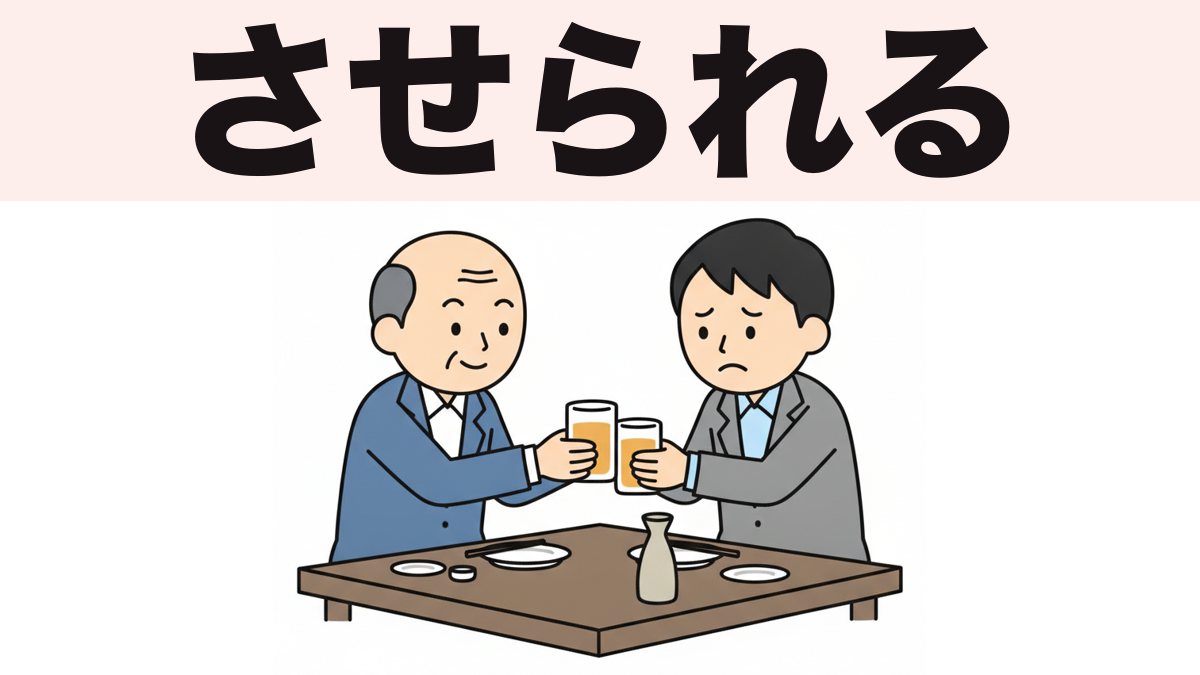
The causative-passive means "I was made to do something I did not want to do." It is built by stacking two forms you already know — causative plus passive — and unlike almost anything else in Japanese grammar, it comes with a built-in complaint.
使役受身は「したくないのに、させられた」という意味です。使役と受身を重ねて作ります。どちらももう知っている形です。そして日本語文法ではめずらしく、この形には**文句**が最初から入っています。
This is the form that looks like the hardest thing on the N3 list and is actually one of the most predictable. There is one construction, one meaning, and one contraction. What makes it feel hard is that the parts are long and the English translation is clumsy.
The basics
How to build it
Make the causative, then make that passive. Two steps, both of which you already have.
| Verb | Causative | Causative-passive |
|---|---|---|
| 飲む | 飲ませる | 飲ませられる |
| 書く | 書かせる | 書かせられる |
| 食べる | 食べさせる | 食べさせられる |
| する | させる | させられる |
| 来る | 来させる | 来させられる |
The shortcut is simpler than the two-step: take the causative ending せる/させる and swap it for せられる/させられる.
上司にお酒を飲ませられました。 — I was made to drink by my boss. 三時間も待たせられた。 — I was made to wait three whole hours. 子供の時、ピアノを習わせられた。 — As a child, I was made to learn piano.
Who takes which particle
The person who made you do it takes に. You are the subject.
私は先生に本を読ませられました。 — I was made to read the book by the teacher.
Compare the plain causative, where the roles are reversed:
先生は私に本を読ませました。 — The teacher made me read the book. 私は先生に本を読ませられました。 — I was made to read the book by the teacher.
Same event. The causative tells it from the teacher's side; the causative-passive tells it from yours — and only the second one carries how you felt about it.
The contraction nobody teaches: 〜される
For Group 1 verbs, 〜せられる contracts to 〜される in ordinary speech. This is not slang; it is what people say.
| Full | Contracted |
|---|---|
| 飲ませられる | 飲まされる |
| 待たせられる | 待たされる |
| 書かせられる | 書かされる |
| 行かせられる | 行かされる |
飲まされた。 — I got made to drink. 待たされた。 — I was kept waiting.
待たされる in particular is a word you will hear constantly and rarely see in a textbook. The one exception: verbs ending in す (話す, 出す) do not contract — 話させられる stays as it is, because 話さされる would be unpronounceable in practice.
Beyond the basics
It always carries a complaint
This is the part that matters more than the conjugation. The causative-passive is not neutral. Using it says you did not want to do the thing.
飲みました。 — I drank. (neutral) 飲まされました。 — I was made to drink. (and I resented it)
There is no polite, cheerful causative-passive. If someone made you do something and you were fine with it, Japanese uses a different construction entirely — usually 〜てもらう, which frames it as a favour: 手伝ってもらいました ("I had them help me").
This means you should be careful using it about anything your listener did. 課長に残業させられました said in front of the 課長 is a complaint delivered to their face.
Where it actually appears
Three places, reliably:
Work stories. The single most common use, and the reason it is worth learning:
毎日残業させられています。 — I'm being made to work overtime every day. 休みの日に呼び出されました。 — I was called in on my day off.
Childhood. Describing things your parents made you do:
子供の時、野菜を食べさせられた。 — As a child, I was made to eat vegetables.
Waiting. The 待たされる family, which covers everything from restaurants to relationships:
一時間待たされた。 — They kept me waiting an hour.
How is it different from the plain passive?
The plain passive can also carry annoyance — Japanese calls that the "suffering passive" — but it does not require anyone to have made you act.
| Form | Meaning | Did you do the action? |
|---|---|---|
| 雨に降られた | I got rained on | No — it happened to you |
| 財布を盗まれた | My wallet was stolen | No |
| 飲まされた | I was made to drink | Yes — but not by choice |
That last row is the whole distinction. In the causative-passive you performed the action; someone else supplied the will. That combination of "I did it" and "I didn't want to" is what no single English word covers, and why the translation always comes out as "was made to."
How does it sound in anime?
It shows up in exactly the places you would expect — resentment, obligation, and being pushed around:
待たされるのは嫌いだ。 — I hate being kept waiting. やらされてるだけだ。 — I'm only doing it because I'm made to. さんざん振り回された。 — I got thoroughly jerked around.
やらされてる is worth listening for: it is 〜される plus 〜ている, contracted twice, and it is how a character says "this is not my choice" in four syllables.
Common mistakes
- Mixing up the direction. 先生に読ませられた means the teacher made you read. 先生に読ませた means you made the teacher read, which is a very different social situation.
- Using the full form where people contract. 待たせられた is correct and sounds textbook. 待たされた is what people say — except for す-verbs, which never contract.
- Using it when you didn't mind. It always implies reluctance. For something you were happy to have someone do for you, use 〜てもらう.
- Contracting a す-verb. 話させられる does not become 話さされる. Group 2 verbs (食べさせられる) do not contract either.
- Forgetting the particle flips. In the causative the doer is the subject; in the causative-passive you are, and they take に.
- Treating it as advanced and skipping it. 待たされた and 飲まされた are everyday words. You will hear them long before you are "ready" for N3.
Practice
Answers are hidden — build yours first, then open. Questions 2 and 3 are a pair: the same two people, and the form decides who did the making.
1. Make 飲む into the causative-passive.
Show answer
飲ませられる — causative 飲ませる, then swap せる for せられる. In speech it contracts to 飲まされる.
2. What does 私は先生に本を読ませられました mean?
Show answer
I was made to read the book by the teacher — you are the subject, and the person who made you takes に. You did the reading, unwillingly.
3. What does 私は先生に本を読ませました mean?
Show answer
I made the teacher read the book — plain causative, so the roles reverse. This is the pair to question 2: the same two people, and one ending decides who was made to do what.
4. Contract 待たせられた the way people actually say it.
Show answer
待たされた — Group 1 verbs contract せられる to される. This one is extremely common and rarely in textbooks.
5. Why does 話させられる not contract?
Show answer
It ends in す — す-verbs (話す, 出す) keep the full form, because the contracted 話さされる is unworkable to say. Group 2 verbs like 食べさせられる also do not contract.
6. Say "I'm made to work overtime every day."
Show answer
毎日残業させられています — する becomes させられる with no other change. This is the single most common real-world use of the form.
7. Your friend kindly helped you move house. Why is 手伝わされました wrong?
Show answer
It says you resented it — the causative-passive always implies reluctance, and here the reluctance would be theirs to feel, not yours. Use 手伝ってもらいました.
8. What is the difference between 雨に降られた and 飲まされた?
Show answer
Whether you performed the action — rain happened to you and you did nothing. In 飲まされた you did the drinking; someone else supplied the will.
9. What does やらされてる mean, and what is in it?
Show answer
"I'm only doing it because I'm made to" — やる plus the contracted causative-passive plus 〜ている, contracted again. Four syllables carrying a whole attitude.
10. Why would 課長に残業させられました be risky to say at work?
Show answer
It is a complaint about a named person — the form itself states that you did not want to. Said where the 課長 can hear, it is not a description; it is an accusation.
FAQ
Is the causative-passive really that common? The full form is not; the contracted one is everywhere. 待たされた, 飲まされた, やらされた and 買わされた are ordinary conversational words, and you will meet them long before a textbook introduces the grammar.
Can it ever be neutral? Barely. Even in a flat statement like 子供の時、ピアノを習わせられた, the form is doing the work of saying "not my idea." If you want neutral, describe the action plainly: ピアノを習いました.
What is the polite form? Regular: 飲ませられます, 飲まされました. The politeness of the ending and the resentment of the construction are independent — you can complain very politely, which is often exactly what people are doing.
How do I say the opposite — that I was allowed to do something? 〜させてもらう or 〜させていただく: 休ませていただきました ("I was allowed to take time off"). This is the same causative, but received as a favour rather than imposed, and it is everywhere in business Japanese.
Is 〜される always the causative-passive? No — it is also the ordinary passive of する-verbs and of some Group 1 verbs. 注意される is "to be warned" (plain passive), not "to be made to warn." Context and the verb tell you which, and with practice the ambiguity almost never bites.
Why does Japanese have a whole form for this? Because the two ideas it combines — you did it, and you did not want to — are genuinely separate in Japanese grammar and genuinely common in life. English has to use three words and a tone of voice; Japanese has an ending.
Vocabulary from this article
Tap the block to select all of it, then copy. In Anki: File → Import, note type Basic, separator Tab — the first column becomes the front, the second the back.
飲む	のむ — to drink
書く	かく — to write
食べる	たべる — to eat
待つ	まつ — to wait
習う	ならう — to learn (from someone)
読む	よむ — to read
上司	じょうし — boss, superior
お酒	おさけ — alcohol
先生	せんせい — teacher
子供	こども — child
野菜	やさい — vegetables
残業	ざんぎょう — overtime work
呼び出す	よびだす — to call someone in
休み	やすみ — day off, holiday
財布	さいふ — wallet
盗む	ぬすむ — to steal
雨	あめ — rain
課長	かちょう — section chief
手伝う	てつだう — to help
注意	ちゅうい — warning, caution
嫌い	きらい — disliked, hated
I'm Yuuki, a Japanese teacher based in Tokyo. I've taught on italki as a Top 1% teacher and watched over 1,500 anime. Learners meet 待たされた in conversation years before they meet させられる in a textbook, and the fastest way in is to notice that you already know the word — you just did not know it had a name.
Sources: the author's own lessons and standard reference grammars.
N3でいちばんむずかしそうに見えて、じつはいちばん予想どおりの形です。作り方は1つ、意味も1つ、短くなる形も1つだけです。むずかしく感じるのは、部品が長いからです。
基本
作り方
使役を作って、それを受身にします。2つとも、もう知っている形です。
| 動詞 | 使役 | 使役受身 |
|---|---|---|
| 飲む | 飲ませる | 飲ませられる |
| 書く | 書かせる | 書かせられる |
| 食べる | 食べさせる | 食べさせられる |
| する | させる | させられる |
| 来る | 来させる | 来させられる |
近道はもっとかんたんです。使役の「せる/させる」を「せられる/させられる」にかえるだけです。
上司にお酒を飲ませられました。 — I was made to drink by my boss. 三時間も待たせられた。 — I was made to wait three whole hours. 子供の時、ピアノを習わせられた。 — As a child, I was made to learn piano.
助詞はどうなりますか
させた人が「に」です。自分が主語になります。
私は先生に本を読ませられました。 — I was made to read the book by the teacher.
ふつうの使役とくらべてください。役わりが反対になります。
先生は私に本を読ませました。 — The teacher made me read the book. 私は先生に本を読ませられました。 — I was made to read the book by the teacher.
同じできごとです。使役は先生の側から、使役受身は自分の側から言っています。そして、気もちが入るのは2つめだけです。
教えてもらえない短い形: 〜される
グループ1の動詞では、話す時「〜せられる」が「〜される」になります。くだけたことばではなく、これがふつうです。
| 長い形 | 短い形 |
|---|---|
| 飲ませられる | 飲まされる |
| 待たせられる | 待たされる |
| 書かせられる | 書かされる |
| 行かせられる | 行かされる |
飲まされた。 — I got made to drink. 待たされた。 — I was kept waiting.
とくに「待たされる」はいつも聞きますが、教科書にはあまり出ません。れいがいが1つあります。「す」で終わる動詞(話す・出す)は短くなりません。「話させられる」のままです。
もう少し先へ
いつも文句が入っています
作り方より、こちらが大事です。この形は中立ではありません。使うと「したくなかった」と言うことになります。
飲みました。 — I drank. (中立) 飲まされました。 — I was made to drink. (いやだった)
うれしい使役受身はありません。させられても平気だったなら、日本語はべつの形を使います。ふつうは「〜てもらう」です。「手伝ってもらいました」。
だから、聞いている人がした事には気をつけてください。「課長に残業させられました」を課長の前で言うと、本人への文句になります。
どこで使いますか
3つの場面で、かならず出ます。
仕事の話。 いちばん多くて、覚える理由になる場面です。
毎日残業させられています。 — I'm being made to work overtime every day. 休みの日に呼び出されました。 — I was called in on my day off.
子どものころ。 親にさせられたことです。
子供の時、野菜を食べさせられた。 — As a child, I was made to eat vegetables.
待つこと。 「待たされる」のなかまです。
一時間待たされた。 — They kept me waiting an hour.
ふつうの受身とどうちがいますか
ふつうの受身にも「いやだった」が入ることがあります(迷惑の受身)。でも、だれかが「させた」必要はありません。
| 形 | 意味 | 自分がしましたか |
|---|---|---|
| 雨に降られた | 雨にふられた | いいえ・起きただけ |
| 財布を盗まれた | さいふをとられた | いいえ |
| 飲まされた | 飲まされた | はい・でも自分の意思ではない |
さいごの行が、ぜんぶのちがいです。使役受身では自分が動作をしています。意思だけがほかの人のものです。「やった」と「やりたくなかった」が1つになっているので、英語には1語がありません。
アニメではどう聞こえますか?
くやしさ・むりやり・ふり回されること。そういう場面に出ます。
待たされるのは嫌いだ。 — I hate being kept waiting. やらされてるだけだ。 — I'm only doing it because I'm made to. さんざん振り回された。 — I got thoroughly jerked around.
「やらされてる」を聞いてみてください。「やる」+短い使役受身+「〜ている」で、2回短くなっています。5音で「自分の意思じゃない」を言い切ります。
よくある間違い
- 向きを反対にすること。 「先生に読ませられた」は先生が読ませました。「先生に読ませた」は自分が先生に読ませました。ぜんぜんちがう場面です。
- 話す時に長い形を使うこと。 「待たせられた」は正しいですが、教科書の音です。「待たされた」が自然です(「す」の動詞をのぞく)。
- いやじゃなかった時に使うこと。 いつも「いやだった」が入ります。よろこんでいるなら「〜てもらう」です。
- 「す」の動詞を短くすること。 「話させられる」は「話さされる」になりません。グループ2(食べさせられる)も短くなりません。
- 助詞を忘れること。 使役はさせた人が主語、使役受身は自分が主語で、相手が「に」です。
- むずかしいと思ってとばすこと。 「待たされた」「飲まされた」は毎日のことばです。
練習
答えはかくれています。まず自分の答えを作ってから開いてください。2番と3番は対になっています。
1. 「飲む」を使役受身にしてください。
答えを見る
飲ませられる — 使役「飲ませる」の「せる」を「せられる」にします。話す時は「飲まされる」です。
2. 「私は先生に本を読ませられました」はどんな意味ですか。
答えを見る
先生に読まされました — 自分が主語で、させた人が「に」です。読んだのは自分ですが、自分の意思ではありません。
3. 「私は先生に本を読ませました」はどんな意味ですか。
答えを見る
自分が先生に読ませました — ふつうの使役なので、役わりが反対です。2番と同じ2人で、語びだけが「だれがさせたか」を決めます。
4. 「待たせられた」を話す時の形にしてください。
答えを見る
待たされた — グループ1は「せられる」が「される」になります。とてもよく使いますが、教科書にはあまり出ません。
5. 「話させられる」が短くならないのはなぜですか。
答えを見る
「す」で終わる動詞だからです — 「話さされる」は言いにくいので、長い形のままです。グループ2(食べさせられる)も短くなりません。
6. 「毎日残業させられています」と言ってください。
答えを見る
毎日残業させられています — 「する」は「させられる」になります。この形のいちばん多い使い方です。
7. 友だちが引っこしを手つだってくれました。「手伝わされました」がなぜだめですか。
答えを見る
「いやだった」という意味になるからです — しかも、いやだったのは友だちの方になります。「手伝ってもらいました」にします。
8. 「雨に降られた」と「飲まされた」はどうちがいますか。
答えを見る
自分が動作をしたかどうか — 雨はただ起きました。「飲まされた」は自分が飲みました。意思だけがほかの人のものです。
9. 「やらされてる」には何が入っていますか。
答えを見る
やる+使役受身の短い形+〜ている — 2回短くなっています。5音で「自分の意思じゃない」を言い切ります。
10. 「課長に残業させられました」を会社で言うのが、なぜあぶないですか。
答えを見る
名前を出した文句になるからです — 形そのものが「したくなかった」と言っています。本人に聞こえる場所では、説明ではなく文句になります。
よくある質問
使役受身はそんなによく使いますか。 長い形はあまり使いません。短い形はどこにでもあります。「待たされた」「飲まされた」「やらされた」「買わされた」はふつうの会話のことばです。
中立に使えますか。 ほとんどできません。「子供の時、ピアノを習わせられた」も「自分で決めたことではない」と言っています。中立なら「ピアノを習いました」です。
ていねいな形はありますか。 ふつうにあります。「飲ませられます」「飲まされました」。ていねいさと文句は別なので、とてもていねいに文句を言うこともできます。だいたいそうしています。
「させてもらった(許してもらった)」はどう言いますか。 「〜させてもらう」「〜させていただく」です。「休ませていただきました」。同じ使役ですが、押しつけられたのではなく、いただいた形です。仕事の日本語にたくさん出ます。
「〜される」はいつも使役受身ですか。 ちがいます。「する」の動詞やグループ1のふつうの受身にもなります。「注意される」は「注意をうける」で、「注意させられる」ではありません。前後の文と動詞で分かります。
なぜ日本語にこの形があるのですか。 「自分がした」と「したくなかった」は、日本語の文法では本当にべつのことで、しかも人生ではよくあることだからです。英語は3語と声のトーンで表しますが、日本語には語びが1つあります。
この記事に出た単語
ブロックをタップすると全部選べます。そのままコピーしてください。Anki では ファイル → 読み込み、ノートタイプ 基本、区切り タブ。1列目が表、2列目が裏になります。
飲む	のむ — to drink
書く	かく — to write
食べる	たべる — to eat
待つ	まつ — to wait
習う	ならう — to learn (from someone)
読む	よむ — to read
上司	じょうし — boss, superior
お酒	おさけ — alcohol
先生	せんせい — teacher
子供	こども — child
野菜	やさい — vegetables
残業	ざんぎょう — overtime work
呼び出す	よびだす — to call someone in
休み	やすみ — day off, holiday
財布	さいふ — wallet
盗む	ぬすむ — to steal
雨	あめ — rain
課長	かちょう — section chief
手伝う	てつだう — to help
注意	ちゅうい — warning, caution
嫌い	きらい — disliked, hated
私はユウキです。東京で日本語を教えています。 italki の Top 1% の先生で、アニメは1,500本以上見ました。みんな「待たされた」を、教科書で「させられる」に会う何年も前に、会話で覚えています。だからいちばん早い入り口は、「もう知っていることばだった」と気づくことです。
More drills like the ones above, plus a timed JLPT-style mock test: Practice · N3上のような練習問題と、時間つきのJLPT形式のもぎ試験: 練習ページ · N3
Want to try this in a real conversation?
本当の会話で、ためしてみませんか?
30-minute trial lesson, $13. Times shown in your own timezone.
30分の体験レッスン、$13。時間はあなたのタイムゾーンで表示されます。
Book a trial lesson · $13