Japanese frequency adverbs: いつも, よく, ときどき — and the two that force a negative回数のことば: いつも・よく・ときどき、そして否定が要る2つ
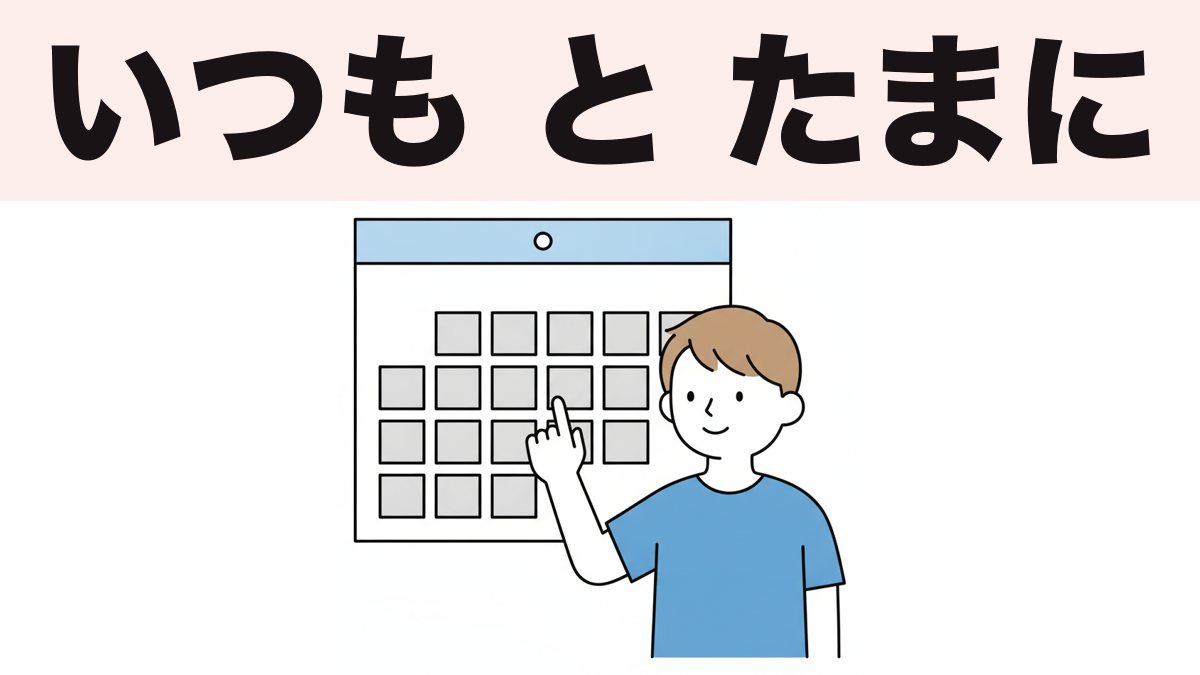
The scale runs いつも (always) → よく (often) → ときどき (sometimes) → たまに (occasionally) → あまり (not much) → ぜんぜん (not at all). The trap is at the bottom: あまり and ぜんぜん are only half a word each. They require a negative verb, and using them with a positive one produces a sentence that does not finish.
いつも(always)→ たいてい → よく → ときどき → たまに → あまり → ぜんぜん。下の2つが落とし穴です。「あまり」と「ぜんぜん」は、半分だけのことばです。動詞を否定にしないと、文が終わりません。
Frequency adverbs are the fastest way to make a beginner sentence sound like something a person would say. 日本語を勉強します is a fact; よく日本語を勉強します is a person talking. And the negative pair at the bottom of the scale is one of the neatest pieces of Japanese grammar there is.
The basics
The full scale
| Japanese | Reading | Roughly | Verb form |
|---|---|---|---|
| いつも | いつも | always | positive |
| たいてい | たいてい | usually, mostly | positive |
| よく | よく | often | positive |
| ときどき | ときどき | sometimes | positive |
| たまに | たまに | occasionally, rarely | positive |
| あまり | あまり | not much | negative |
| ぜんぜん | ぜんぜん | not at all | negative |
いつも七時に起きます。 — I always get up at seven. (polite) ときどき映画を見ます。 — I sometimes watch films. (polite)
Where do they go in the sentence?
Before the verb, and usually near the front of the sentence. Japanese word order is flexible here, so all of these are fine.
よく日本語を勉強します。 — I often study Japanese. (polite) 日本語をよく勉強します。 — Same meaning, slightly more emphasis on 日本語. (polite)
The safe default is to put the adverb at the start. Moving it later shifts a small amount of emphasis onto whatever now comes first, which is a nuance you can ignore for a long time.
あまり and ぜんぜん need a negative
This is the part that matters.
あまり見ません。 — I don't watch much. (polite — negative required) ぜんぜん分かりません。 — I don't understand at all. (polite — negative required)
あまり見ます is not a sentence. The word あまり does not mean "much"; it means "not much," with the "not" carried by the verb. The two halves belong together, in the same way "hardly" needs "any" in English — you cannot say "I hardly watch some films."
This is the same pattern as question word + も + negative: 何も, 誰も and どこにも all work by splitting the negative across two positions in the sentence.
Beyond the basics
よく has a second meaning
よく is the adverb form of いい (good), so it also means "well."
よく寝ました。 — I slept well. (polite — quality, not frequency) よく寝ます。 — I sleep often. (polite — frequency)
Tense usually separates them: past tends to read as "well," non-past as "often." Context settles the rest, and Japanese speakers do not find this ambiguous.
There is also a third use — よく in front of a surprising statement means "I'm impressed you managed to": よく分かりましたね ("well spotted"). That one is pure idiom and worth recognizing.
たまに vs ときどき: how rare is rare?
Both translate as "sometimes," and they are not quite the same.
- ときどき — sometimes; a regular but non-frequent pattern
- たまに — occasionally; rarer, and often with a flavour of "as a treat" or "out of the ordinary"
ときどき外で食べます。 — I sometimes eat out. (polite — part of my normal pattern) たまに外で食べます。 — I occasionally eat out. (polite — it's a departure from the norm)
If you are describing a weekly habit, ときどき. If you are describing something that happens a few times a year and feels like an occasion, たまに.
ぜんぜん in casual speech
Prescriptively, ぜんぜん requires a negative. In actual casual speech, young speakers use it with positives to mean "totally" — ぜんぜん大丈夫 ("totally fine"), ぜんぜんいい ("totally fine by me").
ぜんぜん大丈夫です。 — It's totally fine. (casual-polite — very common, technically non-standard)
This is genuinely widespread and you will hear it constantly, including in anime. Recognize it; use the standard negative version in writing and with anyone you are being careful around, because some older speakers still regard the positive version as sloppy.
毎〜: the counting versions
For a definite frequency rather than a vague one, use 毎 (まい).
毎日勉強しています。 — I study every day. (polite) 週に三回ジムに行きます。 — I go to the gym three times a week. (polite — 〜に〜回 is the pattern)
〜に〜回 is the structure for "N times per period": 月に一回 (once a month), 年に二回 (twice a year). The に marks the period and 回 counts the occurrences. This pairs with the counter system — 回 is one of the useful ones.
Frequency with 〜ている
For a habit rather than a single act, the ている form does useful work.
最近よく雨が降っています。 — It's been raining a lot lately. (polite — an ongoing pattern)
The ている form plus a frequency adverb is how Japanese talks about recent tendencies, and it sounds noticeably more natural than the plain non-past for anything described as "lately."
Common mistakes
- Using あまり with a positive verb. あまり見ます is not a sentence. It is あまり見ません.
- Using ぜんぜん with a positive verb in writing. Standard written Japanese requires the negative. The positive version is spoken slang.
- Translating たまに as "sometimes" and using it for weekly habits. たまに is rarer than ときどき and carries a "special occasion" flavour.
- Putting the adverb after the verb. Japanese adverbs go before the verb. 勉強しますよく is not a sentence.
- Saying 毎週に or 毎日に. 毎 words do not take に. It is 毎日勉強します, not 毎日に.
- Confusing よく (often) with よく (well) and worrying about it. Tense and context resolve it every time. Native speakers never notice the ambiguity.
The scale, with the negatives marked
| Frequency | Word | Sentence |
|---|---|---|
| 100% | いつも | いつも歩いて行きます |
| ~80% | たいてい | たいてい歩いて行きます |
| ~60% | よく | よく歩いて行きます |
| ~40% | ときどき | ときどき歩いて行きます |
| ~15% | たまに | たまに歩いて行きます |
| ~10% | あまり | あまり歩いて行きません |
| 0% | ぜんぜん | ぜんぜん歩いて行きません |
Practice
Questions 5 and 6 are the pair: the same adverb, and only one of them is a grammatical sentence.
1. Say "I always get up at seven," politely.
Show answer
いつも七時に起きます。 — Adverb near the front, before the verb.
2. Say "I sometimes watch films," politely.
Show answer
ときどき映画を見ます。 — ときどき is a regular but non-frequent pattern.
3. Say "I occasionally eat out" — meaning it is a departure from the norm.
Show answer
たまに外で食べます。 — たまに is rarer than ときどき and carries an "as a treat" flavour.
4. Say "I don't understand at all," politely.
Show answer
ぜんぜん分かりません。 — ぜんぜん supplies half the negative; the verb supplies the other half.
5. Say "I don't watch much," politely.
Show answer
あまり見ません。 — あまり means "not much," so the verb must be negative.
6. Why is あまり見ます wrong?
Show answer
あまり は「not much」で、「not」を動詞が持つからです。 — The negative is split across two positions. With a positive verb the sentence never finishes.
7. Say "I go to the gym three times a week."
Show answer
週に三回ジムに行きます。 — 〜に〜回: に marks the period, 回 counts the occurrences.
8. Say "I slept well," politely.
Show answer
よく寝ました。 — Past tense pushes よく toward "well" rather than "often".
9. Fix this: 毎日に勉強します。
Show answer
毎日勉強します。 — 毎 words never take に.
10. Say "it's been raining a lot lately," politely.
Show answer
最近よく雨が降っています。 — ている for an ongoing recent tendency. The plain non-past would sound like a general fact about the climate.
FAQ
Is ぜんぜん大丈夫 actually wrong? It is non-standard rather than wrong. It is extremely common in speech and universally understood, but it still reads as casual, and a few older speakers dislike it. Use the negative form in writing.
Where exactly does the adverb go? Before the verb, and usually near the start of the sentence. Anywhere before the verb is grammatical; the start is the safest default.
What is the difference between たいてい and よく? たいてい is closer to "usually, as a rule" and implies a default behaviour. よく is "often" and makes no claim about being the default.
Can I stack frequency adverbs? No. One per clause. If you want more precision, use a counted frequency: 週に二、三回 ("two or three times a week").
Is あまり ever used without a negative? Yes, in a different sense — あまりに(も) means "excessively" before an adjective: あまりにも高い ("far too expensive"). That is a separate item and it does not take a negative.
How do I say "hardly ever"? ほとんど〜ません. ほとんど means "almost all" or, with a negative, "hardly any": ほとんど見ません is "I hardly ever watch it," slightly stronger than あまり見ません.
Vocabulary from this article
Tap the block to select all of it, then copy. In Anki: File → Import, note type Basic, separator Tab — the first column becomes the front, the second the back.
いつも	いつも — always
たいてい	たいてい — usually
よく	よく — often; well
ときどき	ときどき — sometimes
たまに	たまに — occasionally
あまり	あまり — not much (with negative)
ぜんぜん	ぜんぜん — not at all (with negative)
ほとんど	ほとんど — almost all; hardly (with negative)
毎日	まいにち — every day
毎週	まいしゅう — every week
回	かい — times (counter)
週	しゅう — week
起きる	おきる — to get up
寝る	ねる — to sleep
映画	えいが — film
最近	さいきん — recently
雨	あめ — rain
大丈夫	だいじょうぶ — fine, all right
I'm Yuuki, a Japanese teacher based in Tokyo. I've taught on italki as a Top 1% teacher and watched over 1,500 anime. あまり見ます is one of the most satisfying errors to correct, because the moment a student sees that the negative is split across two words, a whole set of other patterns clicks at once.
Sources: the author's own lessons and standard reference grammars.
回数のことばを1つ入れるだけで、初級の文が「人が話している文」になります。「日本語を勉強します」は事実の説明、「よく日本語を勉強します」は人の話です。
基本
ぜんぶの並び
| 日本語 | 読み方 | だいたいの意味 | 動詞の形 |
|---|---|---|---|
| いつも | いつも | always | 肯定 |
| たいてい | たいてい | usually | 肯定 |
| よく | よく | often | 肯定 |
| ときどき | ときどき | sometimes | 肯定 |
| たまに | たまに | occasionally | 肯定 |
| あまり | あまり | not much | 否定 |
| ぜんぜん | ぜんぜん | not at all | 否定 |
いつも七時に起きます。 — I always get up at seven. (polite) ときどき映画を見ます。 — I sometimes watch films. (polite)
どこに入れますか
動詞の前です。ふつうは文の初めのほうに置きます。
よく日本語を勉強します。 — I often study Japanese. (polite) 日本語をよく勉強します。 — Same meaning, slightly more emphasis on 日本語. (polite)
文の初めに置くのが、いちばん安全です。
「あまり」「ぜんぜん」は否定が必要
ここが大事です。
あまり見ません。 — I don't watch much. (polite — negative required) ぜんぜん分かりません。 — I don't understand at all. (polite — negative required)
「あまり見ます」は文になりません。「あまり」は「much」ではなく「not much」です。「not」の部分を動詞が持っています。2つで1つです。
「何も」「誰も」「どこにも」と同じ形です。
もう少し先へ
「よく」にはもう1つの意味があります
「よく」は「いい」の形を変えたものです。だから「well」の意味もあります。
よく寝ました。 — I slept well. (polite — quality, not frequency) よく寝ます。 — I sleep often. (polite — frequency)
だいたい、過去なら「well」、今・未来なら「often」です。日本の人は、これであいまいだと感じません。
3つ目の使い方もあります。「よく分かりましたね」は「よく気づきましたね」という意味です。決まった言い方です。
「たまに」と「ときどき」
- ときどき — いつものパターンの中で、時々
- たまに — もっと少ない。「特別な時」という感じ
ときどき外で食べます。 — I sometimes eat out. (polite — part of my normal pattern) たまに外で食べます。 — I occasionally eat out. (polite — it's a departure from the norm)
毎週のことなら「ときどき」、年に数回なら「たまに」です。
話す時の「ぜんぜん」
本当は否定が必要です。でも、若い人は「ぜんぜん大丈夫」のように、肯定でも使います。
ぜんぜん大丈夫です。 — It's totally fine. (casual-polite — very common, technically non-standard)
とてもよく聞きます。アニメでも出ます。分かればいいです。書く時と、気をつかう相手には、否定の形を使ってください。
「毎〜」と「〜に〜回」
毎日勉強しています。 — I study every day. (polite) 週に三回ジムに行きます。 — I go to the gym three times a week. (polite — 〜に〜回 is the pattern)
「月に一回」「年に二回」も同じ形です。「に」が期間、「回」が数です。
「〜ている」と一緒に
最近よく雨が降っています。 — It's been raining a lot lately. (polite — an ongoing pattern)
「最近」の話は、「ています」のほうがずっと自然です。
よくある間違い
- 「あまり」を肯定で使う。 「あまり見ません」です。
- 書く時に「ぜんぜん」を肯定で使う。 書く時は否定にします。
- 「たまに」を毎週のことに使う。 「ときどき」です。
- 動詞の後ろに置く。 「勉強しますよく」は文になりません。
- 「毎日に」と言う。 「毎日」に「に」はつきません。
- 「よく」の2つの意味を心配する。 場面で分かります。
並び(否定が要るものに印)
| 回数 | ことば | 文 |
|---|---|---|
| 100% | いつも | いつも歩いて行きます |
| 約80% | たいてい | たいてい歩いて行きます |
| 約60% | よく | よく歩いて行きます |
| 約40% | ときどき | ときどき歩いて行きます |
| 約15% | たまに | たまに歩いて行きます |
| 約10% | あまり | あまり歩いて行きません |
| 0% | ぜんぜん | ぜんぜん歩いて行きません |
練習
5番と6番が組です。同じことばで、片方だけが文になります。
1. 「いつも七時に起きます」と言ってください。
答えを見る
いつも七時に起きます。 — 動詞の前、文の初めのほうです。
2. 「ときどき映画を見ます」と言ってください。
答えを見る
ときどき映画を見ます。 — いつものパターンの中の「時々」です。
3. 「たまに外で食べます」と言ってください。
答えを見る
たまに外で食べます。 — 「ときどき」より少なく、特別な感じです。
4. 「ぜんぜん分かりません」と言ってください。
答えを見る
ぜんぜん分かりません。 — 「ぜんぜん」と否定で1セットです。
5. 「あまり見ません」と言ってください。
答えを見る
あまり見ません。 — 「あまり」は「not much」なので、動詞は否定です。
6. 「あまり見ます」は、なぜ間違いですか。
答えを見る
「あまり」が「not much」で、「not」を動詞が持つからです。 — 肯定だと、文が終わりません。
7. 「週に三回ジムに行きます」と言ってください。
答えを見る
週に三回ジムに行きます。 — 「に」が期間、「回」が数です。
8. 「よく寝ました」と言ってください。
答えを見る
よく寝ました。 — 過去なので「well」の意味になります。
9. 直してください: 毎日に勉強します。
答えを見る
毎日勉強します。 — 「毎」のことばに「に」はつきません。
10. 「最近よく雨が降っています」と言ってください。
答えを見る
最近よく雨が降っています。 — 「最近」の話は「ています」です。
よくある質問
「ぜんぜん大丈夫」は間違いですか。 間違いというより、くだけた言い方です。とてもよく使われます。書く時は否定にしてください。
ことばはどこに置きますか。 動詞の前ならどこでも大丈夫です。文の初めがいちばん安全です。
「たいてい」と「よく」はちがいますか。 「たいてい」は「ふつうはそうする」、「よく」は「回数が多い」です。
2つ並べて使えますか。 使えません。1つの文に1つです。数を言いたい時は「週に二、三回」のようにします。
「あまり」を否定なしで使うことはありますか。 あります。「あまりにも高い」は「高すぎる」という別の意味です。この時は否定にしません。
「ほとんど〜ない」は何ですか。 「あまり」より強い言い方です。「ほとんど見ません」は「ほとんど見ない」です。
この記事に出た単語
このブロックを長く押して全部選び、コピーしてください。Ankiでは ファイル → 読み込み、ノートタイプは 基本、区切りは タブ にします。左が表、右が裏になります。
いつも	いつも — always
たいてい	たいてい — usually
よく	よく — often; well
ときどき	ときどき — sometimes
たまに	たまに — occasionally
あまり	あまり — not much (with negative)
ぜんぜん	ぜんぜん — not at all (with negative)
ほとんど	ほとんど — almost all; hardly (with negative)
毎日	まいにち — every day
毎週	まいしゅう — every week
回	かい — times (counter)
週	しゅう — week
起きる	おきる — to get up
寝る	ねる — to sleep
映画	えいが — film
最近	さいきん — recently
雨	あめ — rain
大丈夫	だいじょうぶ — fine, all right
日本語教師のユウキです。東京にいます。 italkiで Top 1% の教師をしています。アニメは1,500本以上見ました。「あまり見ます」は、直していて気持ちのいい間違いです。「否定が2か所に分かれている」と分かった瞬間に、ほかの形もまとめて分かるからです。
More drills like the ones above, plus a timed JLPT-style mock test: Practice · N5上のような練習問題と、時間つきのJLPT形式のもぎ試験: 練習ページ · N5
Want to try this in a real conversation?
本当の会話で、ためしてみませんか?
30-minute trial lesson, $13. Times shown in your own timezone.
30分の体験レッスン、$13。時間はあなたのタイムゾーンで表示されます。
Book a trial lesson · $13