The particle を: the object marker that also means "through" and "out of助詞の「を」: 目的語だけでなく、通る道と出る場所も表す
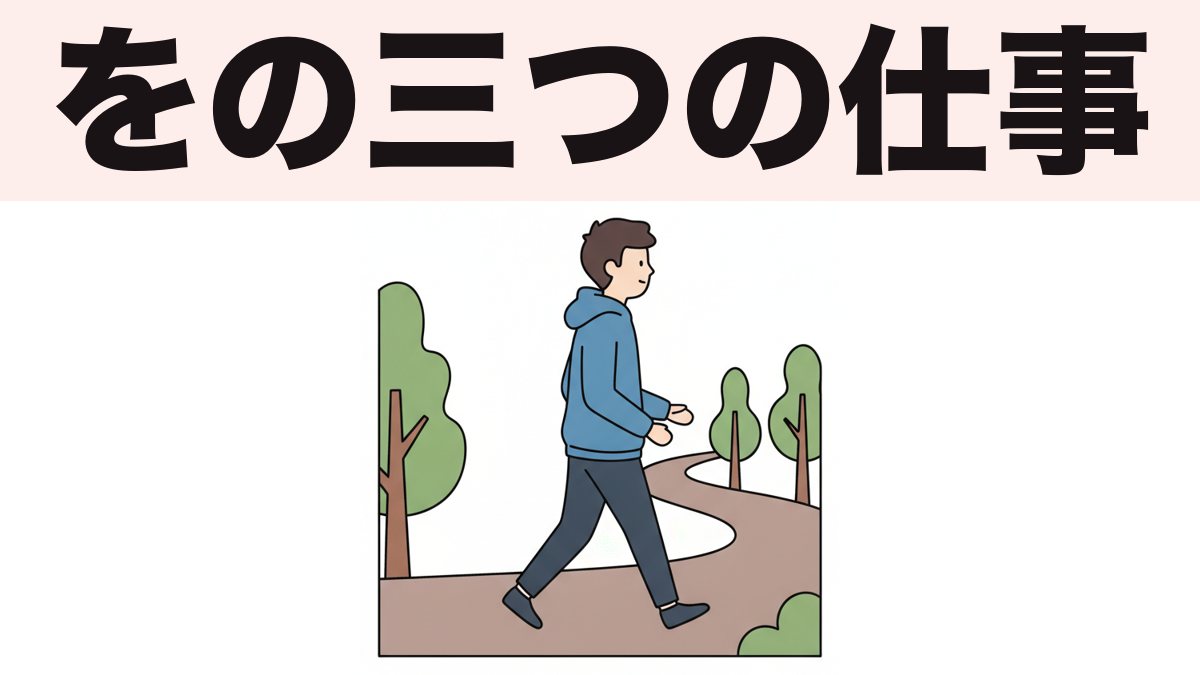
を marks the direct object — the thing a verb acts on — and it is pronounced "o" even though it is written with the character for "wo". It also has two movement uses that surprise learners: the space you pass through, and the place you leave.
「を」は目的語目的語動詞がはたらきかける相手を表します。書くのは「を」ですが、読み方は「お」です。そして、学習者がおどろく使い方が2つあります。通る場所と、出る場所です。
It looks like the easiest particle in Japanese and then turns up in 公園を歩く ("walk through the park") and 家を出る ("leave the house"), where nothing is being acted on at all. Both uses follow from one idea.
The basics
What does を do?
It marks the thing the verb does something to.
パンを食べます。 — I eat bread. (polite; パン is what gets eaten) 日本語を勉強しています。 — I'm studying Japanese. (polite) 手紙を書きました。 — I wrote a letter. (polite)
Word order does not decide the object in Japanese; the particle does. That is why 手紙を昨日書きました and 昨日手紙を書きました are both fine — を travels with 手紙, which is the point of Japanese word order.
Why is it written を but pronounced "o"?
Historical spelling. を once represented a "wo" sound, which merged with お centuries ago. Modern Japanese keeps the character for exactly one job: marking the object.
That restriction is useful. Any を you see is a particle — it never appears inside a word. If you spot を, you have found the object, which makes it the single most reliable signpost in a Japanese sentence for a beginner.
On a keyboard you type wo to get it, which is one of the few places the old sound still shows up.
Which verbs take を?
Transitive ones — verbs that do something to something. Japanese draws this line more sharply than English does, and often has two separate verbs where English reuses one.
ドアを開けます。 — I open the door. (transitive, takes を) ドアが開きます。 — The door opens. (intransitive, takes が)
English uses "open" for both; Japanese uses 開ける and 開く, and the particle changes with the verb. Getting this wrong produces sentences that sound like the door has been assaulted. The full pairing is in transitive and intransitive verbs.
What are the movement uses?
Two, and they are the reason を is not simply "the object marker."
公園を歩きます。 — I walk through the park. (the space passed through) 橋を渡ります。 — I cross the bridge. (the space traversed) 家を出ます。 — I leave the house. (the place departed from) 電車を降ります。 — I get off the train. (the place departed from)
Nothing here is being acted on. The underlying idea is that を marks the thing the action passes over or out of — the route, or the point of departure. Once you see it that way, 公園を散歩する and パンを食べる stop feeling like two unrelated grammars.
Beyond the basics
When does を become が?
With a set of words that describe states rather than actions: 好き, 嫌い, 上手, 下手, ほしい, and the potential form.
| You want to say | Correct | Not |
|---|---|---|
| I like sushi | 寿司が好きです | 寿司を好きです |
| I want water | 水がほしいです | 水をほしいです |
| I can speak Japanese | 日本語が話せます | 日本語を話せます |
| I'm good at cooking | 料理が上手です | 料理を上手です |
The logic is that these are not actions performed on an object — they are states in which something is the subject. 好き is an adjective, not a verb, so there is no action to have an object. The potential form does the same thing, as covered in ことができる and the potential form.
You will hear 日本語を話せます from native speakers occasionally. It is spreading, and it is still safer to use が while you are building the habit.
Can you drop を?
In casual speech, often — especially in short sentences where the role is obvious.
ご飯食べた? — Did you eat? (casual, を dropped) これ見て。 — Look at this. (casual, を dropped)
This works because the word order and the verb make the relationship clear. In longer or reordered sentences, dropping it creates genuine ambiguity, and in writing it simply looks wrong. Drop it in conversation, keep it when you write.
Why can there be only one を per clause?
Because a clause has one direct object, and Japanese enforces it more strictly than English does. Two を in one clause is a grammatical error, and it bites most often with the causative.
子供に野菜を食べさせます。 — I make the child eat vegetables. (polite)
The child takes に, not を, because 野菜 already has the を slot. Getting this wrong — 子供を野菜を食べさせます — is the most common causative mistake, and the rule explains it: one を, one clause. The causative's own logic is in the causative form.
Does を appear with する verbs?
Yes, and it is how you split a compound verb for emphasis.
勉強します。 — I study. (polite, one unit) 日本語の勉強をします。 — I do Japanese study. (polite, 勉強 becomes a noun with を)
Both are correct. The second treats 勉強 as a noun object of する, which lets you modify it: 日本語の勉強をたくさんしました. What you cannot do is stack them — 日本語を勉強をします has two を and fails the one-per-clause rule.
Common mistakes
- 寿司を好きです. 好き is an adjective describing a state: 寿司が好きです.
- 日本語を話せます. The potential form takes が: 日本語が話せます.
- Two を in one clause. 子供を野菜を食べさせます should be 子供に野菜を食べさせます.
- Using を with intransitive verbs. ドアを開きます is wrong; either ドアを開けます or ドアが開きます.
- Reading を as "wo" in speech. It is pronounced "o". The spelling is historical.
- Dropping を in writing. Fine in casual speech, wrong on a page.
Practice
Answers are hidden — build yours first, then open. Questions 3 and 4 are a pair: the same door, two different verbs.
1. Say "I eat bread" politely.
Show answer
パンを食べます — パン is what the verb acts on, so it takes を.
2. Fix this: 寿司を好きです。
Show answer
寿司が好きです — 好き is an adjective describing a state, not a verb acting on an object.
3. Say "I open the door."
Show answer
ドアを開けます — 開ける is transitive, so the door takes を.
4. Say "the door opens."
Show answer
ドアが開きます — 開く is intransitive, so the door is the subject and takes が. This is the pair to question 3: same door, different verb, different particle.
5. Say "I walk through the park."
Show answer
公園を歩きます — the movement use: を marks the space passed through, not an object being acted on.
6. Say "I get off the train."
Show answer
電車を降ります — the departure use. The train is what you exit, which を also marks.
7. Fix this: 子供を野菜を食べさせます。
Show answer
子供に野菜を食べさせます — one を per clause. 野菜 has it, so the child takes に.
8. Say "I can speak Japanese."
Show answer
日本語が話せます — the potential form takes が. You will hear を from native speakers, but が is the safe habit.
9. How do you type を?
Show answer
wo — the old spelling survives on the keyboard even though the sound is "o".
10. A friend says これ見て. What is missing, and is it wrong?
Show answer
を, and no — dropping it is normal in casual speech when the role is obvious. In writing, keep it.
FAQ
Is を ever pronounced "wo"? Not in ordinary speech. Singers sometimes articulate it as "wo" for rhythm, and some regional speech preserves a trace, but "o" is the standard.
How do I know if a verb takes を or が? By whether it is transitive. Japanese verb pairs like 開ける/開く and 始める/始まる split the job, and learning them in pairs is faster than learning them separately.
Why does 好き take が when English says "I like sushi"? Because 好き is an adjective, not a verb. The Japanese sentence is closer to "as for me, sushi is likeable," which puts sushi in the subject slot.
Can a sentence have two を if it has two clauses? Yes. The restriction is one per clause, so a sentence with two verbs can have two — 本を買って、コーヒーを飲みました.
Is it ever okay to say 日本語を話せます? You will hear it, and it is increasingly common. It is still flagged as non-standard, so が is the better default for a learner.
Why do textbooks call it "wo" then? Because that is the romanisation of the character, not of the sound. The same gap shows up in は as a topic marker, pronounced "wa".
Vocabulary from this article
Tap the block to select all of it, then copy. In Anki: File → Import, note type Basic, separator Tab — the first column becomes the front, the second the back.
助詞	じょし — particle
目的語	もくてきご — direct object
他動詞	たどうし — transitive verb
自動詞	じどうし — intransitive verb
可能形	かのうけい — potential form
開ける	あける — to open (something)
開く	あく — to open (by itself)
渡る	わたる — to cross
出る	でる — to leave, to exit
降りる	おりる — to get off, to descend
歩く	あるく — to walk
散歩する	さんぽする — to take a walk
公園	こうえん — park
橋	はし — bridge
野菜	やさい — vegetables
寿司	すし — sushi
勉強	べんきょう — study
I'm Yuuki, a Japanese teacher based in Tokyo. I've taught on italki as a Top 1% teacher and watched over 1,500 anime. を is the particle students think they have finished with after week two, and then 家を出る appears and it turns out they had memorised a translation rather than an idea.
Sources: the author's own lessons and standard reference grammars.
いちばんかんたんな助詞に見えます。でも「公園を歩く」「家を出る」が出てきます。どこにも「はたらきかける相手」がありません。じつは、2つとも同じ考え方から来ています。
基本
「を」は何をする?
動詞が何かをする、その相手を表します。
パンを食べます。 — I eat bread. (ていねい。食べられるのがパン) 日本語を勉強しています。 — I'm studying Japanese. (ていねい) 手紙を書きました。 — I wrote a letter. (ていねい)
日本語では、目的語を決めるのは語順ではなく助詞です。だから「手紙を昨日書きました」も「昨日手紙を書きました」も正しいです。「を」は「手紙」といっしょに動きます(語順)。
どうして「を」と書いて「お」と読む?
昔の書き方が残っているからです。「を」はむかし「wo」の音でしたが、何百年も前に「お」と1つになりました。今の日本語では、この字は1つの仕事だけに使います。目的語のしるしです。
これは便利です。「を」が見えたら、それは助詞です。言葉の中には出てきません。つまり「を」を見つければ目的語が分かります。初級のうちは、いちばん頼りになる目印です。
キーボードでは wo と打ちます。昔の音が残っているのは、ここくらいです。
どの動詞が「を」を取る?
他動詞です。何かに対してはたらきかける動詞です。日本語はこの線が英語よりはっきりしていて、英語が1語で済ませる所に2つの動詞があります。
ドアを開けます。 — I open the door. (他動詞。「を」) ドアが開きます。 — The door opens. (自動詞。「が」)
英語はどちらも open です。日本語は「開ける」と「開く」で、助詞も変わります。まちがえると、ドアに何かしたような文になります。組は 他動詞と自動詞 にあります。
移動の使い方は?
2つあります。「をを目的語のしるし」だけではない理由です。
公園を歩きます。 — I walk through the park. (通る場所) 橋を渡ります。 — I cross the bridge. (通る場所) 家を出ます。 — I leave the house. (出る場所) 電車を降ります。 — I get off the train. (出る場所)
ここでは、何かにはたらきかけていません。元の考え方は「動作が通っていく所、出ていく所」です。そう見ると、「公園を散歩する」と「パンを食べる」が別々の文法ではなくなります。
もう少し先へ
「を」が「が」になるのはいつ?
動作ではなく状態を表す言葉のときです。「好き」「嫌い」「上手」「下手」「ほしい」、そして可能形です。
| 言いたいこと | 正しい | まちがい |
|---|---|---|
| 寿司が好き | 寿司が好きです | 寿司を好きです |
| 水がほしい | 水がほしいです | 水をほしいです |
| 日本語が話せる | 日本語が話せます | 日本語を話せます |
| 料理が上手 | 料理が上手です | 料理を上手です |
理由は、これらが「何かにする動作」ではなく「状態」だからです。「好き」は形容詞で、動詞ではありません。だから目的語がありません。可能形も同じです(ことができると可能形)。
日本の人が「日本語を話せます」と言うこともあります。広がってきていますが、覚えるうちは「が」の方が安全です。
「を」は落とせる?
会話ではよく落とします。短い文で、役目がはっきりしている時です。
ご飯食べた? — Did you eat? (カジュアル。「を」なし) これ見て。 — Look at this. (カジュアル。「を」なし)
語順と動詞で関係が分かるからです。長い文や、順番を変えた文では、本当に分からなくなります。書く時は落としません。話す時だけです。
1つの文に「を」は1つだけ?
1つの節に目的語は1つだからです。日本語は英語より厳しく、「を」が2つあると間違いです。いちばん出るのは使役の文です。
子供に野菜を食べさせます。 — I make the child eat vegetables. (ていねい)
子供は「に」です。「を」は「野菜」が使っているからです。「子供を野菜を食べさせます」は、使役でいちばん多い間違いで、理由はこのルールです。使役の考え方は 使役形 にあります。
「する」の動詞でも使う?
使います。1語を分けて、強調できます。
勉強します。 — I study. (ていねい。1つのかたまり) 日本語の勉強をします。 — I do Japanese study. (ていねい。「勉強」が名詞になって「を」が付く)
どちらも正しいです。2つめは「勉強」を名詞として扱うので、説明を足せます。「日本語の勉強をたくさんしました」。できないのは重ねることです。「日本語を勉強をします」は「を」が2つで、ルールに合いません。
よくある間違い
- 「寿司を好きです」。 「好き」は状態を表す形容詞です。「寿司が好きです」。
- 「日本語を話せます」。 可能形は「が」です。「日本語が話せます」。
- 1つの節に「を」が2つ。 「子供を野菜を食べさせます」→「子供に野菜を食べさせます」。
- 自動詞に「を」。 「ドアを開きます」はまちがい。「ドアを開けます」か「ドアが開きます」です。
- 話す時に「wo」と読む。 音は「お」です。書き方だけが昔のままです。
- 書く時に「を」を落とす。 会話ならふつうですが、文章ではまちがいです。
練習
答えはかくしてあります。先に自分で作ってから開いてください。3と4は同じドアで、動詞がちがいます。
1. ていねいに「パンを食べます」。
答えを見る
パンを食べます — 動詞がはたらきかける相手なので「を」です。
2. 直してください: 寿司を好きです。
答えを見る
寿司が好きです — 「好き」は状態を表す形容詞で、動詞ではありません。
3. 「ドアを開けます」と言ってください。
答えを見る
ドアを開けます — 「開ける」は他動詞なので、ドアに「を」が付きます。
4. 「ドアが開きます」と言ってください。
答えを見る
ドアが開きます — 「開く」は自動詞なので、ドアが主語で「が」です。3と対で、同じドア・別の動詞・別の助詞です。
5. 「公園を歩きます」と言ってください。
答えを見る
公園を歩きます — 移動の使い方です。通る場所を表していて、はたらきかけてはいません。
6. 「電車を降ります」と言ってください。
答えを見る
電車を降ります — 出る場所の使い方です。出ていく所も「を」で表します。
7. 直してください: 子供を野菜を食べさせます。
答えを見る
子供に野菜を食べさせます — 1つの節に「を」は1つです。「野菜」が使っているので、子供は「に」です。
8. 「日本語が話せます」と言ってください。
答えを見る
日本語が話せます — 可能形は「が」です。「を」も聞きますが、覚えるうちは「が」が安全です。
9. 「を」はどう打ちますか。
答えを見る
wo — 音は「お」なのに、キーボードでは昔の書き方が残っています。
10. 友だちが「これ見て」と言いました。何がありませんか。まちがいですか。
答えを見る
「を」。まちがいではありません — 役目が分かる会話では、落とすのがふつうです。書く時は入れます。
よくある質問
「を」を「wo」と発音することはありますか。 ふつうの会話ではありません。歌でリズムのために「wo」と言うことはあります。標準は「お」です。
「を」か「が」か、どう見分けますか。 他動詞かどうかです。「開ける/開く」「始める/始まる」のように対になっています。組で覚える方が早いです。
英語は "I like sushi" なのに、どうして「が」なの。 「好き」が動詞ではなく形容詞だからです。日本語の文は「私にとって、寿司が好ましい」に近い形で、寿司が主語の場所に入ります。
節が2つなら「を」も2つ使えますか。 使えます。制限は「1つの節に1つ」です。「本を買って、コーヒーを飲みました」は問題ありません。
「日本語を話せます」は言ってもいいですか。 実際に聞きますし、増えています。ただ、標準ではないとされます。学習中は「が」の方が安全です。
では、なぜ教科書は「wo」と書くのですか。 字のローマ字表記で、音の表記ではないからです。主題の「は」を「wa」と読むのと同じずれです。
この記事に出た単語
ブロックをタップすると全部選べます。そのままコピーしてください。Anki では ファイル → 読み込み、ノートタイプ 基本、区切り タブ。1列目が表、2列目が裏になります。
助詞	じょし — particle
目的語	もくてきご — direct object
他動詞	たどうし — transitive verb
自動詞	じどうし — intransitive verb
可能形	かのうけい — potential form
開ける	あける — to open (something)
開く	あく — to open (by itself)
渡る	わたる — to cross
出る	でる — to leave, to exit
降りる	おりる — to get off, to descend
歩く	あるく — to walk
散歩する	さんぽする — to take a walk
公園	こうえん — park
橋	はし — bridge
野菜	やさい — vegetables
寿司	すし — sushi
勉強	べんきょう — study
More drills like the ones above, plus a timed JLPT-style mock test: Practice · N5上のような練習問題と、時間つきのJLPT形式のもぎ試験: 練習ページ · N5
Want to try this in a real conversation?
本当の会話で、ためしてみませんか?
30-minute trial lesson, $13. Times shown in your own timezone.
30分の体験レッスン、$13。時間はあなたのタイムゾーンで表示されます。
Book a trial lesson · $13